

½ rupee – Bhutan
Add to wishlist
Bhutan
Context
Material
Diameter: 18 mm
Weight: 1.8 g
Thickness: 0.95 mm
Shape: Irregular round
Composition: Copper
Magnetic: No
Technique: Hammered
References
KM: #
Numista: #114034
Obverse
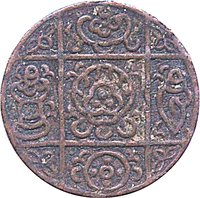
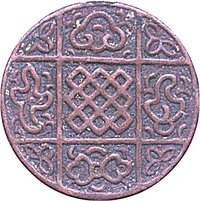
Description:
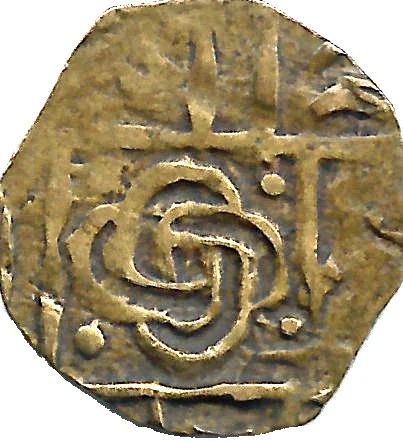
Knot symbol with "ndra" on the right.
Reverse
Description:
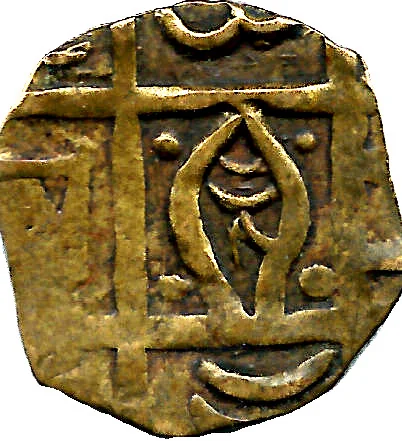
Conch shell
Edge
Plain
Mintings
| Year | Mint Mark | Mintage | Quality | Collection |
|---|---|---|---|---|
| — | — | — |
Historical background
In 1885, Bhutan’s currency situation was a complex tapestry of traditional barter, imported coinage, and nascent local minting, reflecting its position between the empires of British India and Tibet. The primary medium of exchange for most transactions, especially in rural areas, remained barter—rice, butter, and textiles were commonly used. However, monetized trade was conducted using a variety of silver coins. The most prevalent were Tibetan tangka coins and British Indian rupees, which flowed across the borders through trade in wool, spices, and other goods. These foreign currencies were essential for external commerce but their supply and value were subject to the political and economic currents of the region.
This period followed a time of internal turmoil, including the civil wars of the 1870s, which had disrupted stable economic governance. While some local silver coins, known as "Maartums" or "Chetrums," were reportedly minted sporadically under regional penlops (governors), there was no unified, national currency system. The authority to mint coins was decentralized and inconsistent, leading to variations in weight, purity, and acceptance. The British Mission of 1864-65 had resulted in the Treaty of Sinchula, which included an annual British subsidy paid in rupees, further embedding Indian currency into Bhutan's economy and giving the state a reliable source of coined silver.
Thus, in 1885, Bhutan stood at a monetary crossroads. It lacked a sovereign currency to unify its economy, yet was increasingly integrated into the monetary systems of its powerful neighbors. The circulation of Tibetan and Indian coins facilitated trade but also symbolized the kingdom’s limited control over its own fiscal tools. This situation would persist until the early 20th century, when the first centralized coinage under the Wangchuck dynasty began to take shape, aiming to assert greater economic sovereignty.
This period followed a time of internal turmoil, including the civil wars of the 1870s, which had disrupted stable economic governance. While some local silver coins, known as "Maartums" or "Chetrums," were reportedly minted sporadically under regional penlops (governors), there was no unified, national currency system. The authority to mint coins was decentralized and inconsistent, leading to variations in weight, purity, and acceptance. The British Mission of 1864-65 had resulted in the Treaty of Sinchula, which included an annual British subsidy paid in rupees, further embedding Indian currency into Bhutan's economy and giving the state a reliable source of coined silver.
Thus, in 1885, Bhutan stood at a monetary crossroads. It lacked a sovereign currency to unify its economy, yet was increasingly integrated into the monetary systems of its powerful neighbors. The circulation of Tibetan and Indian coins facilitated trade but also symbolized the kingdom’s limited control over its own fiscal tools. This situation would persist until the early 20th century, when the first centralized coinage under the Wangchuck dynasty began to take shape, aiming to assert greater economic sovereignty.
💎 Extremely Rare