

10 centimes – France
Add to wishlist
France
Context
Years: 1943–1944
Issuer: France
Period:
(1940—1944)
Currency:
(1795—1959)
Demonetization: 20 March 1947
Total mintage: 58,463,650
Material
Diameter: 17.3 mm
Weight: 1.5 g
Thickness: 1.25 mm
Shape: Round with a round hole
Composition: Zinc
Magnetic: No
Technique: Milled
Alignment: Coin alignment
flip
References
KM: #
Numista: #1140
Obverse
Description:
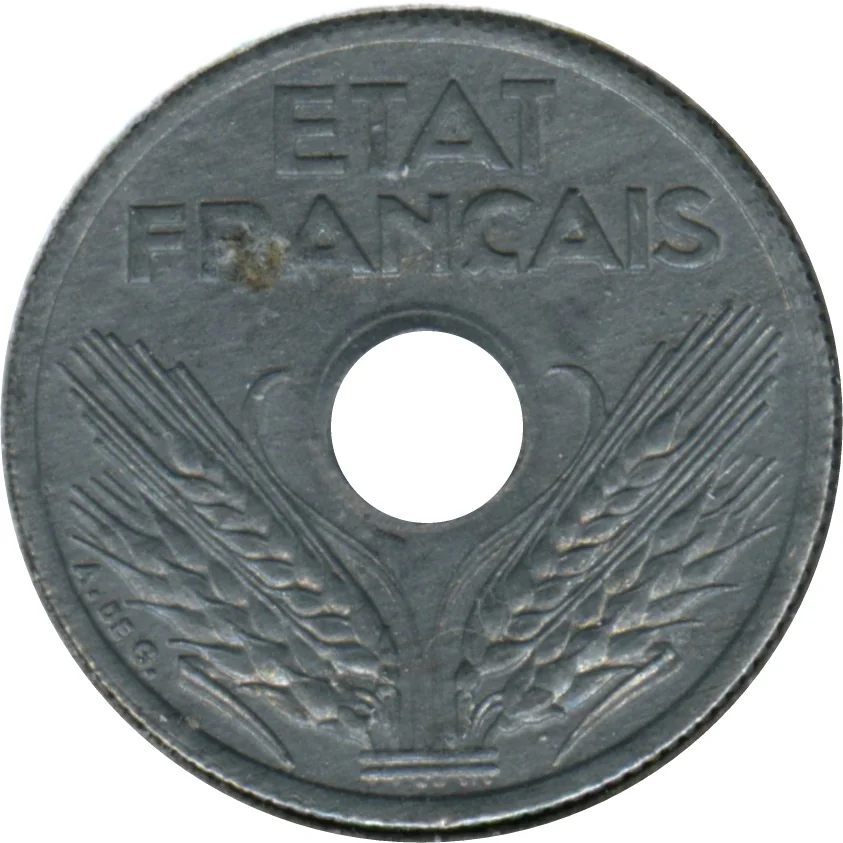
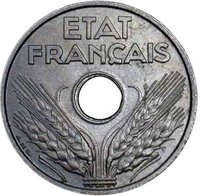
Grain sprigs border center hole.
Inscription:
ETAT
FRANÇAIS
A. DE G.
FRANÇAIS
A. DE G.
Translation:
French State
A. De G.
A. De G.
Script: Latin
Language: French
Engraver: Atelier de Gravure (A.G.M.M.)
Reverse
Description:
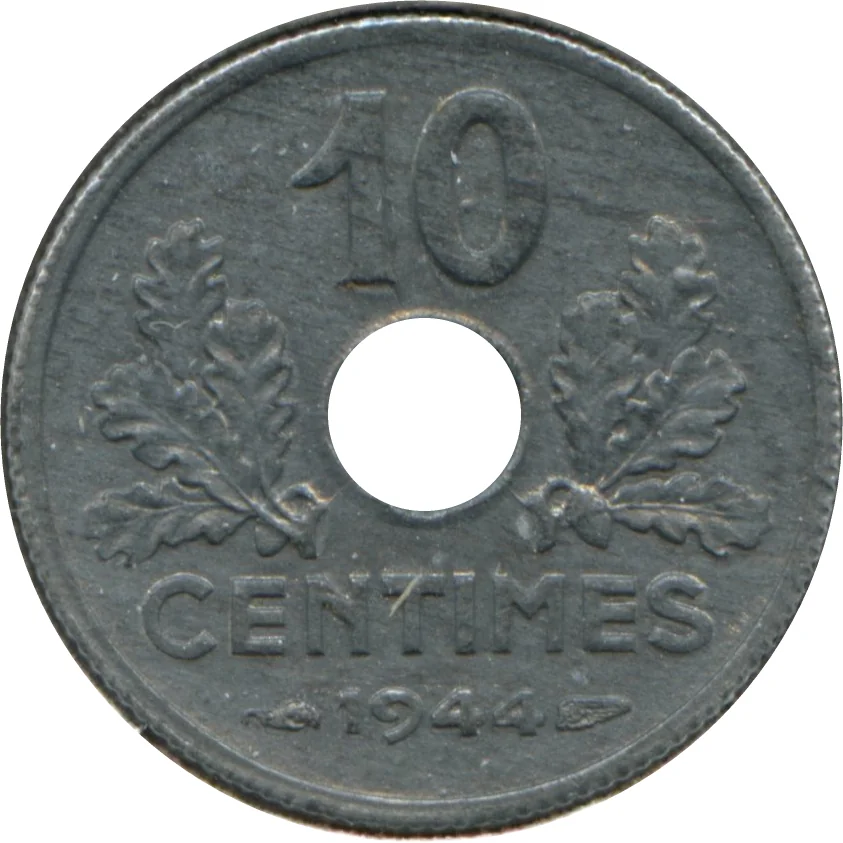
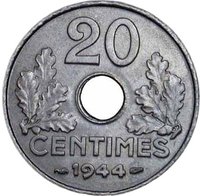
Denomination split by center hole, flanked by oak leaves, date beneath.
Inscription:
10
CENTIMES
1944
CENTIMES
1944
Script: Latin
Engraver: Atelier de Gravure (A.G.M.M.)
Edge
Reeded
Mints
| Name | Mark |
|---|---|
| Monnaie de Paris | — |
Mintings
| Year | Mint Mark | Mintage | Quality | Collection |
|---|---|---|---|---|
| 1943 | — | 300 | ||
| 1944 | — | 58,463,350 |
Historical background
In 1943, France's currency situation was a complex and strained reflection of its divided and occupied status. The official currency remained the French franc, but its management and value were dictated by the German occupation authorities. The Reichsbank effectively controlled the Banque de France, enforcing a grossly artificial exchange rate fixed at 20 francs to 1 Reichsmark (a rate nearly five times more favorable to the Germans than the pre-war parity). This mandated conversion fueled systematic looting, as the occupation costs levied on France were paid in francs printed specifically for this purpose, leading to rampant monetary inflation.
The economy suffered from severe scarcity and a burgeoning black market, which operated with vastly different valuations. While official prices were controlled, the real cost of goods on the black market soared, creating a de facto dual-price system. This eroded public confidence in the official currency, as hoarding of goods and alternative means of exchange became common. Furthermore, the Vichy government, attempting to assert some economic control, issued its own series of banknotes and promoted propaganda about economic renewal, but these efforts were largely futile against the overwhelming pressures of exploitation and shortage.
Parallel to this, the Allied invasion of North Africa in late 1942 introduced a new monetary element. In the liberated French colonies there, and in preparation for the future liberation of mainland France, the Allies and the French Committee of National Liberation began planning for a new currency. This set the stage for the eventual replacement of the Vichy and occupation-era notes with the "Free French" franc, a clear signal that the monetary chaos was also a battleground for political legitimacy and post-war planning.
The economy suffered from severe scarcity and a burgeoning black market, which operated with vastly different valuations. While official prices were controlled, the real cost of goods on the black market soared, creating a de facto dual-price system. This eroded public confidence in the official currency, as hoarding of goods and alternative means of exchange became common. Furthermore, the Vichy government, attempting to assert some economic control, issued its own series of banknotes and promoted propaganda about economic renewal, but these efforts were largely futile against the overwhelming pressures of exploitation and shortage.
Parallel to this, the Allied invasion of North Africa in late 1942 introduced a new monetary element. In the liberated French colonies there, and in preparation for the future liberation of mainland France, the Allies and the French Committee of National Liberation began planning for a new currency. This set the stage for the eventual replacement of the Vichy and occupation-era notes with the "Free French" franc, a clear signal that the monetary chaos was also a battleground for political legitimacy and post-war planning.
Series: 1943 France circulation coins
🌱 Very Common