

2500 Tenge – Kazakhstan
Kazakhstan
Context
Years: 1995–2009
Issuer: Kazakhstan 
Period:
(since 1991)
Currency:
(since 1993)
Total mintage: 5,000
Material
Diameter: 20 mm
Weight: 7.78 g
Gold weight: 7.78 g
Shape: Round
Composition: 99.99% Gold
Standard: Silver quarter ounce
Magnetic: No
Technique: Milled
Alignment: Medal alignment
flip
References
KM: #Click to copy to clipboard45
Numista: #100881
Value
Exchange value: 2500 KZT
Bullion value: $1299.66
Obverse
Description:
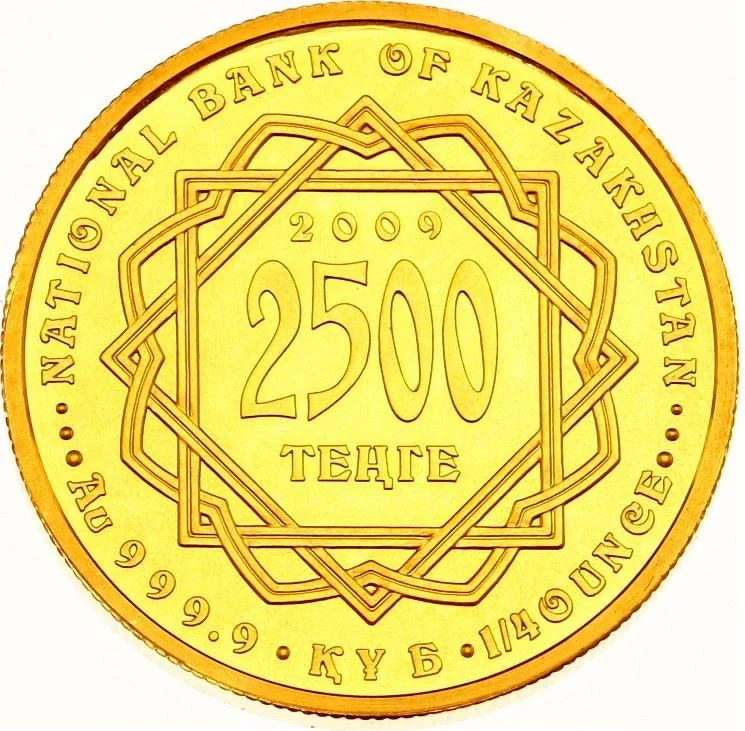
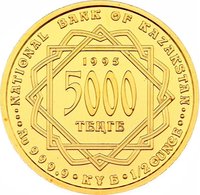
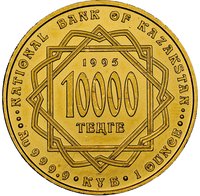
16-sided rosette, denomination, year, "NATIONAL BANK OF KAZAKHSTAN", weight in oz., "Қ.Ұ.Б."
Inscription:
NATIONAL BANK OF KAZAKHSTAN
2009
2500
ТЕҢГЕ
••• Au 999.9 • ҚҰБ • 1/4 OUNCE •••
2009
2500
ТЕҢГЕ
••• Au 999.9 • ҚҰБ • 1/4 OUNCE •••
Translation:
NATIONAL BANK OF KAZAKHSTAN
2009
2500
TENGE
••• Au 999.9 • MINT • 1/4 OUNCE •••
2009
2500
TENGE
••• Au 999.9 • MINT • 1/4 OUNCE •••
Reverse
Description:
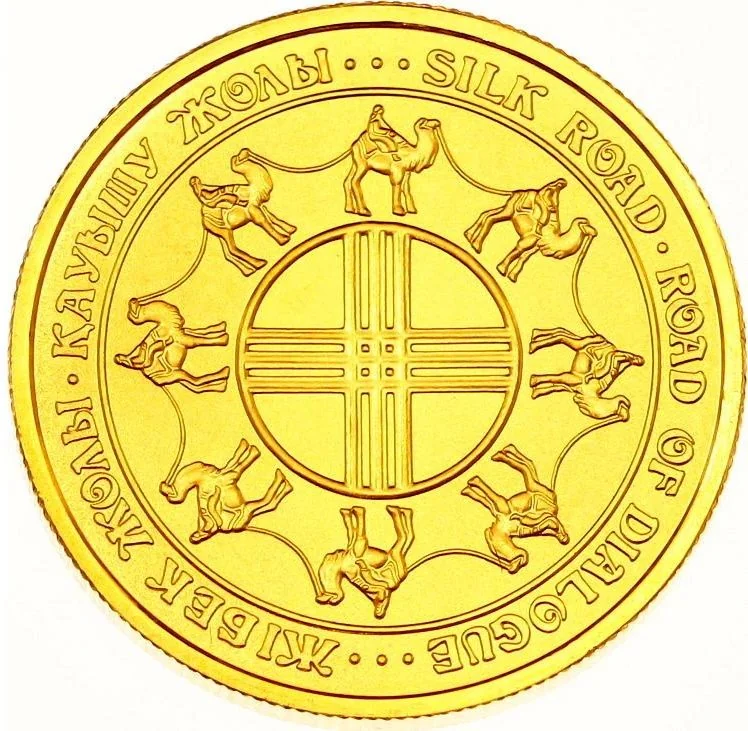
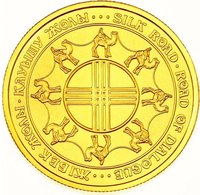
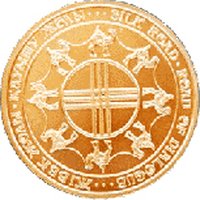
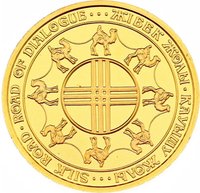
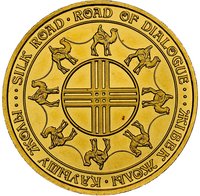
The shanyrak, a yurt's crown, encircles a camel caravan representing the Silk Road—a symbol of connection between nations and cultures. It is framed by the inscription: "ЖІБЕК ЖОЛЫ. ҚАУЫШУ ЖОЛЫ... SILK ROAD. ROAD OF DIALOGUE."
Inscription:
ЖІБЕК ЖОЛЫ • ҚАУЫШУ ЖОЛЫ ••• SILK ROAD • ROAD OF DIALOGUE •••
Translation:
Silk Road • Road of Dialogue
Edge
Reeded
Mints
| Name | Mark |
|---|---|
| Kazakhstan Mint | (ҚҰБ) |
Mintings
| Year | Mint Mark | Mintage | Quality | Collection |
|---|---|---|---|---|
| 1995 | ҚҰБ | 4,000 | ||
| 2009 | ҚҰБ | 1,000 |
Historical background
In 1995, Kazakhstan was navigating the turbulent aftermath of the Soviet Union's collapse, grappling with hyperinflation, a collapsing ruble zone, and the urgent need to establish its own monetary sovereignty. The country had introduced its temporary currency, the Kazakhstani tenge, in November 1993, replacing the Soviet and Russian rubles. However, by 1995, the young tenge was still under severe pressure. The National Bank of Kazakhstan was engaged in a difficult balancing act, trying to control money supply to curb inflation—which had skyrocketed to over 1,000% annually in 1994—while also managing a volatile exchange rate amidst a deep industrial slump and widespread non-payment crises between enterprises.
A pivotal development occurred in March 1995, when Kazakhstan officially left the "rouble zone" and abandoned the managed exchange rate corridor that had loosely tied it to the Russian currency. This move to a fully independent floating exchange rate for the tenge was a decisive step toward autonomous monetary policy. The goal was to use the exchange rate as a shock absorber and a tool for stabilization, allowing market forces to play a greater role in determining its value. This liberalization was a cornerstone of the broader economic reforms advocated by President Nursultan Nazarbayev and his government, which were heavily influenced by IMF recommendations and aimed at creating a market economy.
The results in 1995 were mixed but pointed toward stabilization. The floating rate led to a significant depreciation of the tenge, making exports more competitive but increasing the cost of imports. Crucially, however, this policy shift, combined with tighter fiscal and monetary discipline, began to tame hyperinflation. By the end of 1995, annual inflation had fallen dramatically to around 60%—still crippling but a marked improvement. Thus, 1995 was a year of painful transition where Kazakhstan solidified its monetary independence, setting the stage for the gradual stabilization and eventual growth of the economy in the late 1990s.
A pivotal development occurred in March 1995, when Kazakhstan officially left the "rouble zone" and abandoned the managed exchange rate corridor that had loosely tied it to the Russian currency. This move to a fully independent floating exchange rate for the tenge was a decisive step toward autonomous monetary policy. The goal was to use the exchange rate as a shock absorber and a tool for stabilization, allowing market forces to play a greater role in determining its value. This liberalization was a cornerstone of the broader economic reforms advocated by President Nursultan Nazarbayev and his government, which were heavily influenced by IMF recommendations and aimed at creating a market economy.
The results in 1995 were mixed but pointed toward stabilization. The floating rate led to a significant depreciation of the tenge, making exports more competitive but increasing the cost of imports. Crucially, however, this policy shift, combined with tighter fiscal and monetary discipline, began to tame hyperinflation. By the end of 1995, annual inflation had fallen dramatically to around 60%—still crippling but a marked improvement. Thus, 1995 was a year of painful transition where Kazakhstan solidified its monetary independence, setting the stage for the gradual stabilization and eventual growth of the economy in the late 1990s.
Series: Silk Road
✨ Legendary