


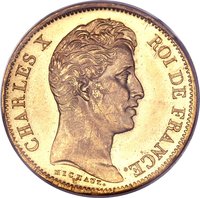
Obverse
Description:
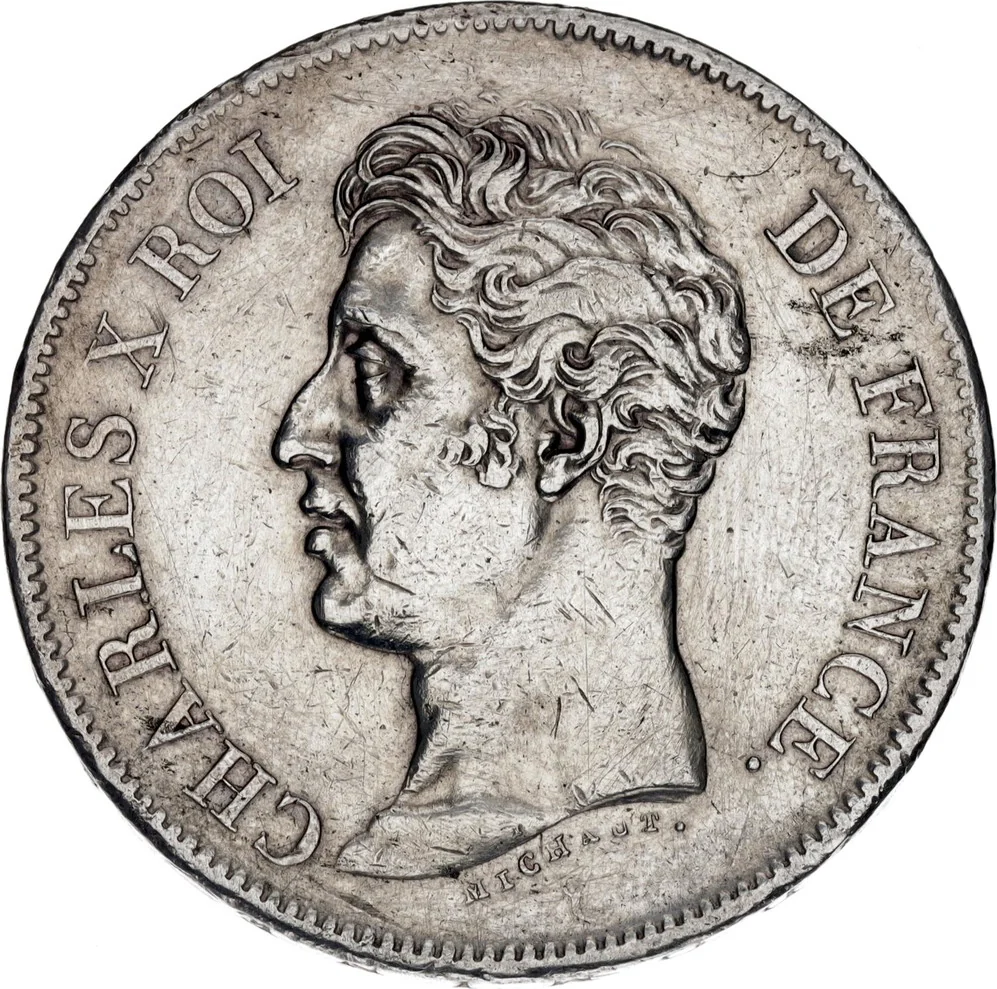
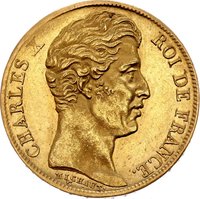
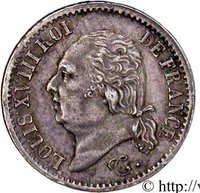
Charles X's bare head, left; signed "MICHAUT T" below.
Inscription:
CHARLES X ROI DE FRANCE.
Translation:
CHARLES X KING OF FRANCE.
Script: Latin
Language: French
Engraver: Auguste-François Michaut
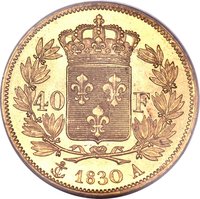
Reverse
Description:
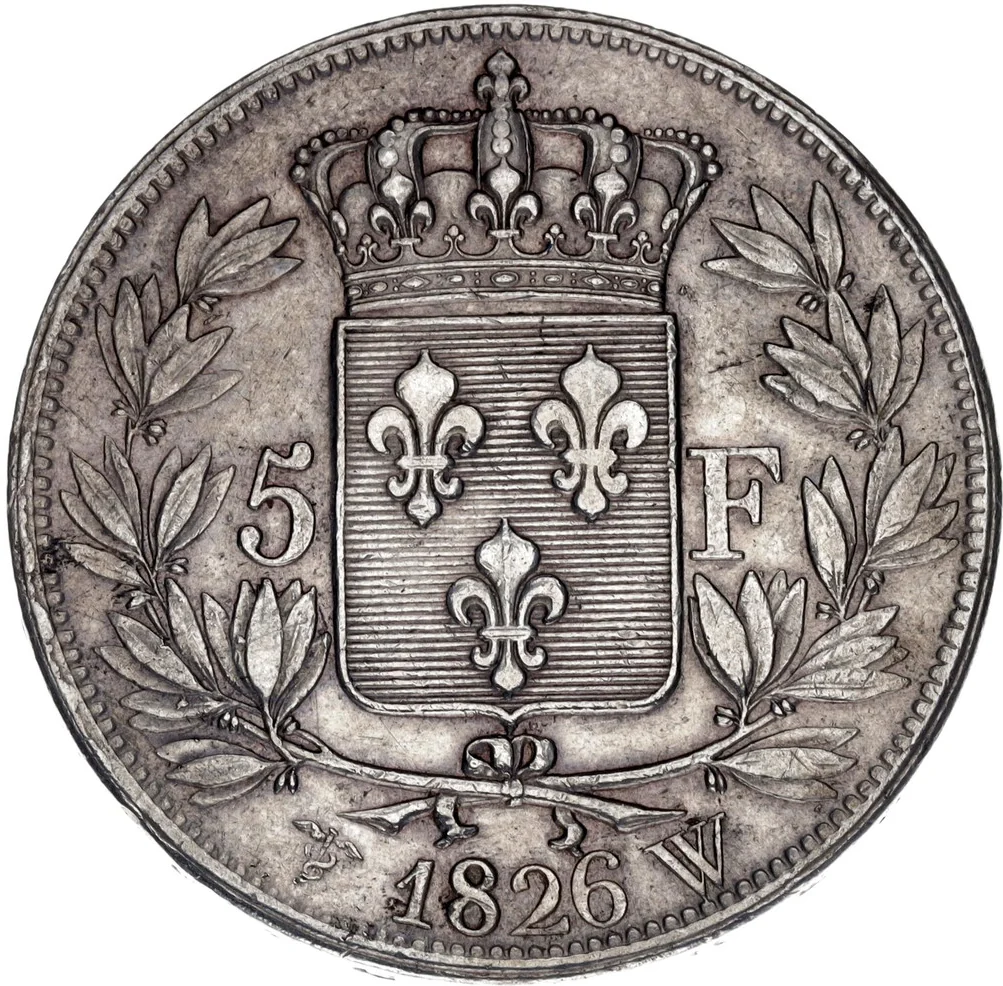
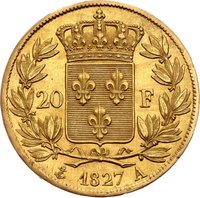
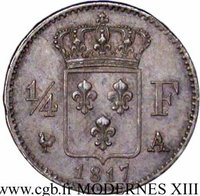
Shield of France crowned, flanked by olive branches.
Inscription:
5 F
1826 W (LILLE)
1826 W (LILLE)
Script: Latin
Engraver: Auguste-François Michaut
Edge
Inscribed in hollow
Legend:
DOMINE SALVUM FAC REGEM
Translation:
Lord, save the King.
Language: Latin
Mints
| Name | Mark |
|---|---|
| Monnaie de Paris | A |
| Rouen | B |
| Strasbourg | BB |
| Lyon | D |
| La Rochelle | H |
| Limoges | I |
| Bordeaux | K |
| Bayonne | L |
| Toulouse | M |
| Marseille | MA |
| Perpignan | Q |
| Lille | W |
Mintings
| Year | Mint Mark | Mintage | Quality | Collection |
|---|---|---|---|---|
| 1824 | A | — | ||
| 1825 | MA | 176,091 | ||
| 1825 | A | — | ||
| 1825 | B | 112,676 | ||
| 1825 | D | 184,935 | ||
| 1825 | BB | 156,407 | ||
| 1825 | H | 157,065 | ||
| 1825 | I | 154,614 | ||
| 1825 | K | 325,952 | ||
| 1825 | L | 226,872 | ||
| 1825 | M | 154,131 | ||
| 1825 | W | 1,103,207 | ||
| 1825 | Q | 162,664 | ||
| 1826 | A | 7,168,865 | ||
| 1826 | B | 594,685 | ||
| 1826 | BB | 410,744 | ||
| 1826 | D | 1,436,477 | ||
| 1826 | H | 571,644 | ||
| 1826 | I | 535,352 | ||
| 1826 | K | 428,528 | ||
| 1826 | L | 719,004 | ||
| 1826 | M | 670,622 | ||
| 1826 | MA | 1,071,526 | ||
| 1826 | Q | 345,555 | ||
| 1826 | T | 203,014 | ||
| 1826 | W | 3,581,450 |
Historical background
In 1824, France operated under a bimetallic monetary system, as established by the Franc Germinal law of 1803 under Napoleon Bonaparte. This system fixed the value of the franc to specific quantities of both gold and silver, with a legal ratio of 15.5 units of silver to 1 unit of gold. The currency, renowned for its stability, was defined by the franc germinal, containing 4.5 grams of fine silver. Coins of both metals were legal tender, and the system aimed to facilitate international trade by allowing the free minting of gold and silver into coinage at the set ratio.
However, this bimetallic system faced persistent strains. The fixed legal ratio between gold and silver often diverged from the fluctuating market ratios, leading to the phenomenon described by Gresham's Law: "bad money drives out good." When the market value of one metal rose above its official mint price, those coins would be hoarded or exported, leaving the cheaper metal in circulation. Following the Napoleonic Wars, silver was generally overvalued at the mint, causing gold coins to become scarce in everyday transactions. This created practical difficulties for commerce and highlighted the system's vulnerability to global bullion market shifts.
The year 1824 fell within the Bourbon Restoration, a period of relative financial conservatism. King Louis XVIII's government, and particularly the ministry of Jean-Baptiste de Villèle, prioritized budgetary stability and debt management. While the franc itself remained a strong and trusted unit of account, the underlying tensions in the bimetallic framework were a topic of concern for economists and bankers. The system would remain officially in place for decades, but the pressures evident in 1824 foreshadowed the eventual European shift toward a gold standard in the latter half of the 19th century.
However, this bimetallic system faced persistent strains. The fixed legal ratio between gold and silver often diverged from the fluctuating market ratios, leading to the phenomenon described by Gresham's Law: "bad money drives out good." When the market value of one metal rose above its official mint price, those coins would be hoarded or exported, leaving the cheaper metal in circulation. Following the Napoleonic Wars, silver was generally overvalued at the mint, causing gold coins to become scarce in everyday transactions. This created practical difficulties for commerce and highlighted the system's vulnerability to global bullion market shifts.
The year 1824 fell within the Bourbon Restoration, a period of relative financial conservatism. King Louis XVIII's government, and particularly the ministry of Jean-Baptiste de Villèle, prioritized budgetary stability and debt management. While the franc itself remained a strong and trusted unit of account, the underlying tensions in the bimetallic framework were a topic of concern for economists and bankers. The system would remain officially in place for decades, but the pressures evident in 1824 foreshadowed the eventual European shift toward a gold standard in the latter half of the 19th century.
🌱 Fairly Common