

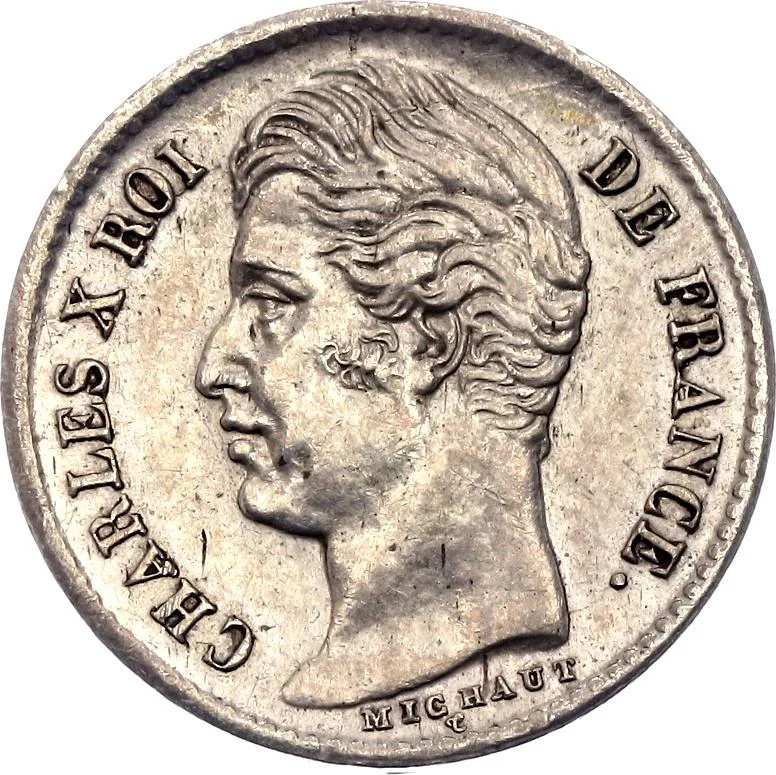
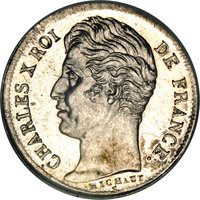
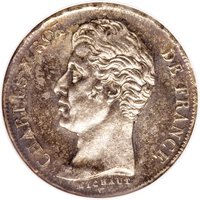
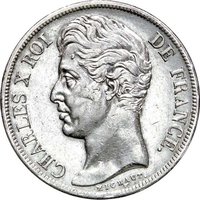
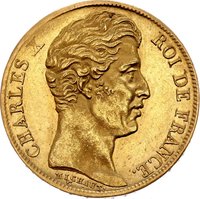
Obverse
Description:
Charles X's bare head; signed "MICHAUT T" below.
Inscription:
CHARLES X ROI DE FRANCE.
Translation:
CHARLES X KING OF FRANCE.
Script: Latin
Language: French
Engraver: Auguste-François Michaut
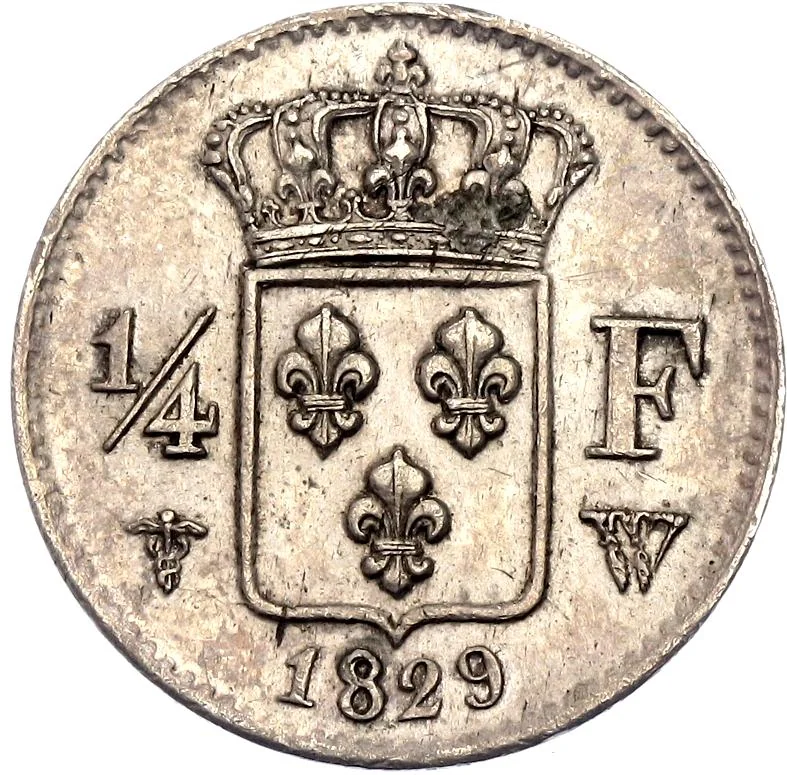
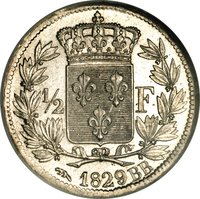
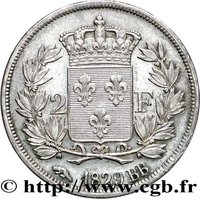
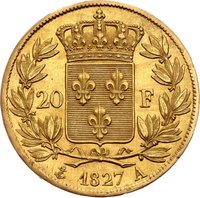
Reverse
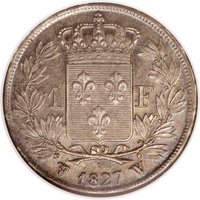
Description:
French royal arms.
Inscription:
1/4 F
W
1830
W
1830
Script: Latin
Engraver: Auguste-François Michaut
Edge
Plain
Categories
| Symbol> Crown |
| Person> Monarch |
| Symbols> Coat of Arms |
| Symbol> Fleur-de-lis |
Mints
| Name | Mark |
|---|---|
| Monnaie de Paris | A |
| Rouen | B |
| Strasbourg | BB |
| Lyon | D |
| La Rochelle | H |
| Limoges | I |
| Bordeaux | K |
| Bayonne | L |
| Toulouse | M |
| Perpignan | Q |
| Nantes | T |
| Lille | W |
Mintings
| Year | Mint Mark | Mintage | Quality | Collection |
|---|---|---|---|---|
| 1825 | A | 9,484 | ||
| 1826 | W | 15,234 | ||
| 1826 | Q | 7,528 | ||
| 1826 | T | 1,741 | ||
| 1826 | A | 82,620 | ||
| 1826 | B | 22,677 | ||
| 1826 | D | 13,082 | ||
| 1826 | M | 4,855 | ||
| 1826 | L | 10,971 | ||
| 1827 | A | 321,912 | ||
| 1827 | L | 7,570 | ||
| 1827 | M | 4,286 | ||
| 1827 | W | 22,149 | ||
| 1827 | B | 17,037 | ||
| 1827 | BB | 1,561 | ||
| 1827 | D | 7,814 | ||
| 1827 | I | 822 | ||
| 1828 | A | 446,095 | ||
| 1828 | B | 22,683 | ||
| 1828 | BB | 13,060 | ||
| 1828 | D | 12,500 | ||
| 1828 | H | 15,713 | ||
| 1828 | I | 2,214 | ||
| 1828 | L | 14,857 | ||
| 1828 | M | 47,922 | ||
| 1828 | Q | 12,520 | ||
| 1828 | T | 6,304 | ||
| 1828 | W | 46,687 | ||
| 1829 | T | 6,475 | ||
| 1829 | W | 107,832 | ||
| 1829 | A | 154,222 | ||
| 1829 | B | 32,008 | ||
| 1829 | BB | 13,774 | ||
| 1829 | D | 51,788 | ||
| 1829 | I | 10,448 | ||
| 1829 | K | 27,448 | ||
| 1829 | L | 6,480 | ||
| 1829 | M | 14,382 | ||
| 1830 | A | — | ||
| 1830 | K | 20,628 | ||
| 1830 | L | 15,132 | ||
| 1830 | W | 73,941 |
Historical background
In 1825, France was navigating a complex monetary landscape under the Bourbon Restoration. The country operated on a bimetallic system, established by the Franc Germinal law of 1803, which fixed the values of both gold and silver coins relative to the franc. However, this system was under strain. The official fixed ratio between gold and silver did not always reflect their fluctuating market values, leading to the disappearance of the undervalued metal from circulation—a phenomenon known as Gresham's Law. This often resulted in a shortage of usable coinage for everyday commerce, causing practical difficulties for the economy.
The government of King Charles X, led by Prime Minister Jean-Baptiste de Villèle, sought to address these issues with a significant recoinage operation in 1825. The primary goal was to retire the old, worn écus (silver crowns) and replace them with new, full-weight silver coins to restore confidence in the currency. More controversially, the operation aimed to demonetize the louis d'or, the principal gold coin, and move France toward a de facto silver standard. This was politically sensitive, as it was perceived to favor creditors (who would be repaid in more stable silver) over debtors.
Ultimately, the 1825 recoinage was only a partial success. While it improved the quality of silver in circulation, the attempt to suppress gold coinage failed due to strong public attachment to the louis d'or and the practical needs of large-scale and international trade. The fundamental instability of the bimetallic system remained, a problem France would grapple with for decades. The episode highlighted the tension between monetary theory and public trust, setting the stage for future debates that would culminate in the Latin Monetary Union later in the century.
The government of King Charles X, led by Prime Minister Jean-Baptiste de Villèle, sought to address these issues with a significant recoinage operation in 1825. The primary goal was to retire the old, worn écus (silver crowns) and replace them with new, full-weight silver coins to restore confidence in the currency. More controversially, the operation aimed to demonetize the louis d'or, the principal gold coin, and move France toward a de facto silver standard. This was politically sensitive, as it was perceived to favor creditors (who would be repaid in more stable silver) over debtors.
Ultimately, the 1825 recoinage was only a partial success. While it improved the quality of silver in circulation, the attempt to suppress gold coinage failed due to strong public attachment to the louis d'or and the practical needs of large-scale and international trade. The fundamental instability of the bimetallic system remained, a problem France would grapple with for decades. The episode highlighted the tension between monetary theory and public trust, setting the stage for future debates that would culminate in the Latin Monetary Union later in the century.
Series: 1825 France circulation coins
🌱 Fairly Common