

Obverse
Description:
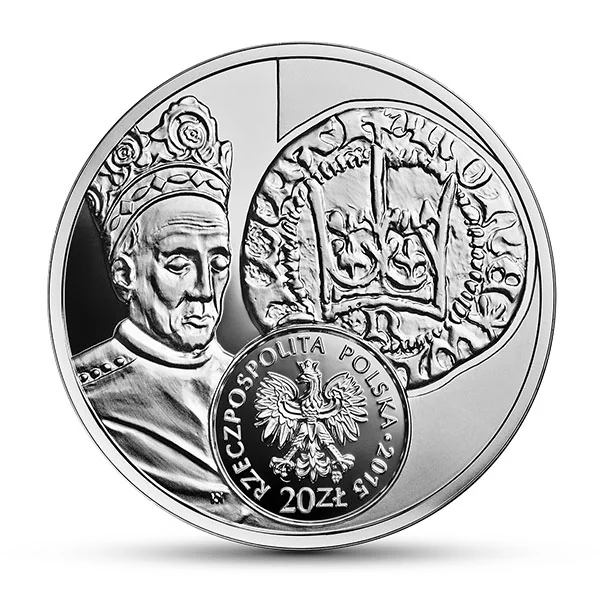
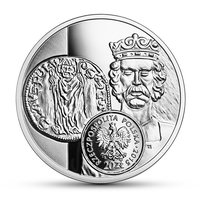
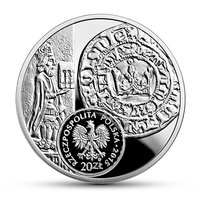
Bottom: a stylized modern 20-zloty coin. Right: the obverse of a Jagiellonian half-grosz, showing a crown and the inscription +MONE*WLADISLAI. Left: a crowned effigy of Ladislaus Jagiello on a proof surface.
Inscription:
RZECZPOSPOLITA POLSKA 2015
mw
20 ZŁ
mw
20 ZŁ
Translation:
REPUBLIC OF POLAND 2015
20 ZŁOTYCH
20 ZŁOTYCH
Script: Latin
Designer: Dominika Karpińska-Kopiec
Reverse
Description:
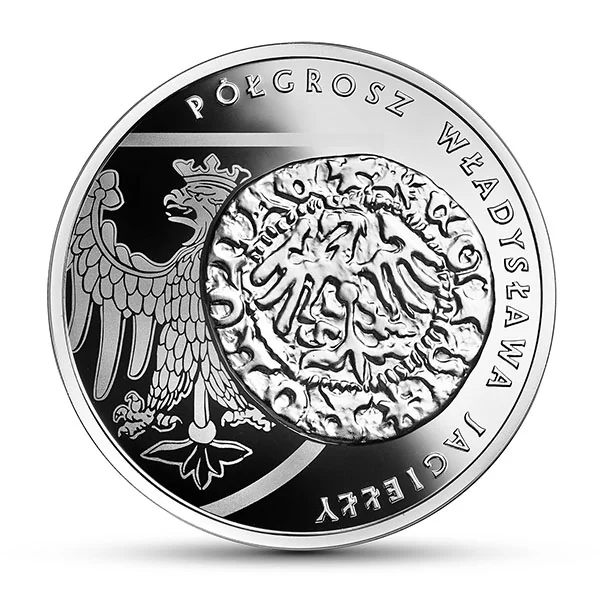
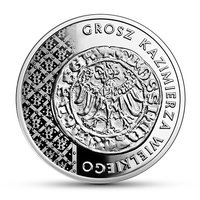
The reverse features the crowned White Eagle from a half-grosz of Ladislaus Jagiello, inscribed +REGIS*POLONIE, with the eagle from the king's tombstone shield in the left background.
Inscription:
PÓŁGROSZ WŁADYSŁAWA JAGIEŁŁY
Translation:
Half-grosz of Władysław Jagiełło
Script: Latin
Language: Polish
Designer: Dominika Karpińska-Kopiec
Edge
Plain
Categories
| Currency> Coin depiction |
Mints
| Name | Mark |
|---|---|
| Mint of Poland | (MW) |
Mintings
| Year | Mint Mark | Mintage | Quality | Collection |
|---|---|---|---|---|
| 2015 | MW | 20,000 | Proof |
Historical background
In 2015, Poland's currency situation was characterized by significant volatility and political influence, primarily centered on the Polish złoty (PLN). The year began with the złoty under considerable pressure, trading near four-year lows against both the euro and the US dollar. This weakness was largely driven by a strong US dollar globally and regional concerns, including the geopolitical tension from the Russia-Ukraine conflict and the Swiss franc mortgage crisis, which exposed Polish households and banks to foreign currency risk. The National Bank of Poland (NBP), under Governor Marek Belka, maintained a cautious stance, keeping interest rates at a historic low of 1.5% to stimulate growth despite inflationary pressures being minimal.
A defining moment occurred in the run-up to the October parliamentary elections. In a highly unusual move, the NBP cut interest rates by 0.5 percentage points in March, a decision widely criticized as politically motivated to boost the economy ahead of the vote. This surprise cut triggered an immediate sell-off of the złoty, causing its sharpest one-day drop since 2013. The currency's trajectory throughout the year was thus a tug-of-war between global factors—like the anticipation of US Federal Reserve rate hikes—and domestic political uncertainty, with markets wary of the economic policies of the leading Law and Justice (PiS) party.
By year's end, the political landscape had shifted dramatically with PiS's electoral victory, introducing new uncertainties regarding future fiscal policy and potential conflicts with EU institutions. Despite the turbulence, the złoty staged a partial recovery in the final quarter, aided by improving economic data and a general weakening of the US dollar. However, it remained vulnerable, closing the year as one of the more volatile currencies in the Central and Eastern European region, setting the stage for further challenges as the new government prepared to implement its platform.
A defining moment occurred in the run-up to the October parliamentary elections. In a highly unusual move, the NBP cut interest rates by 0.5 percentage points in March, a decision widely criticized as politically motivated to boost the economy ahead of the vote. This surprise cut triggered an immediate sell-off of the złoty, causing its sharpest one-day drop since 2013. The currency's trajectory throughout the year was thus a tug-of-war between global factors—like the anticipation of US Federal Reserve rate hikes—and domestic political uncertainty, with markets wary of the economic policies of the leading Law and Justice (PiS) party.
By year's end, the political landscape had shifted dramatically with PiS's electoral victory, introducing new uncertainties regarding future fiscal policy and potential conflicts with EU institutions. Despite the turbulence, the złoty staged a partial recovery in the final quarter, aided by improving economic data and a general weakening of the US dollar. However, it remained vulnerable, closing the year as one of the more volatile currencies in the Central and Eastern European region, setting the stage for further challenges as the new government prepared to implement its platform.
Series: History of Polish Coin
✨ Legendary