

¼ franc – France
Add to wishlist
France
Context
Years: 1817–1824
Issuer: France
Ruler: Louis XVIII
Currency:
(1795—1959)
Demonetization: 30 April 1852
Total mintage: 641,376
Material
References
KM: #
Numista: #8204
Value
Bullion value: $2.86
Obverse
Description:
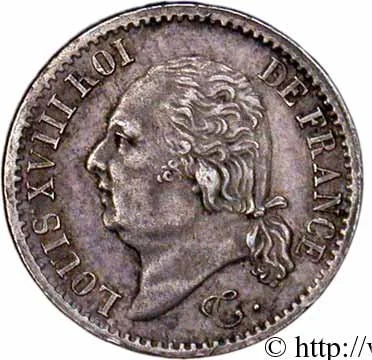
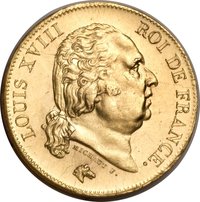
Headless portrait of Louis XVIII, hair tied with a headband, encircled by the inscription "Louis XVIII Roi de France." Engraver's initial (cursive T) below.
Inscription:
LOUIS XVIII ROI DE FRANCE
Translation:
LOUIS XVIII KING OF FRANCE
Script: Latin
Language: French
Engraver: Pierre-Joseph Tiolier
Reverse
Description:
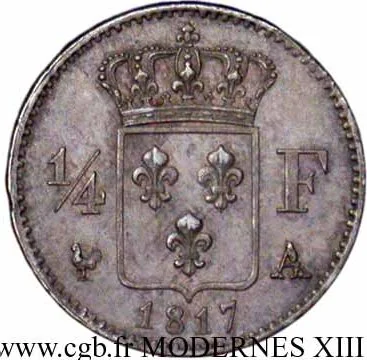
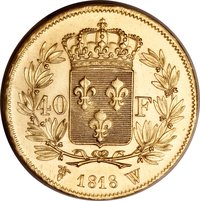
Shield crown with "¼ F" between mint marks, date below.
Inscription:
1/4 F
1817 A
1817 A
Script: Latin
Engraver: Pierre-Joseph Tiolier
Edge
Plain
Mints
| Name | Mark |
|---|---|
| Monnaie de Paris | A |
| Rouen | B |
| Strasbourg | BB |
| Lyon | D |
| Limoges | I |
| Bayonne | L |
| Toulouse | M |
| Marseille | MA |
| Perpignan | Q |
| Nantes | T |
| Lille | W |
Mintings
| Year | Mint Mark | Mintage | Quality | Collection |
|---|---|---|---|---|
| 1817 | A | 100,044 | ||
| 1817 | B | 21,140 | ||
| 1817 | BB | 3,766 | ||
| 1817 | D | 11,539 | ||
| 1817 | I | 16,292 | ||
| 1817 | L | 14,394 | ||
| 1817 | M | 4,308 | ||
| 1817 | MA | 2,126 | ||
| 1817 | Q | 12,704 | ||
| 1817 | T | 7,600 | ||
| 1817 | W | 14,264 | ||
| 1818 | A | 28,156 | ||
| 1818 | B | 15,921 | ||
| 1818 | W | 3,288 | ||
| 1819 | A | 11,320 | ||
| 1819 | B | 15,413 | ||
| 1819 | W | 3,164 | ||
| 1820 | A | 11,544 | ||
| 1820 | W | 5,882 | ||
| 1821 | A | 21,924 | ||
| 1822 | A | 35,840 | ||
| 1822 | B | 29,779 | ||
| 1822 | W | 4,480 | ||
| 1823 | W | 16,389 | ||
| 1823 | A | 43,624 | ||
| 1823 | B | 12,948 | ||
| 1823 | I | 1,858 | ||
| 1823 | L | 11,731 | ||
| 1823 | M | 3,988 | ||
| 1823 | Q | 10,784 | ||
| 1824 | A | 82,622 | ||
| 1824 | B | 18,198 | ||
| 1824 | L | 26,042 | ||
| 1824 | M | 7,762 | ||
| 1824 | W | 10,542 |
Historical background
France in 1817 was navigating a precarious and complex monetary landscape in the wake of the Napoleonic Wars. The Bourbon Restoration under Louis XVIII inherited a severe financial crisis, characterized by a massive public debt and a chaotic circulation of multiple forms of money. The most pressing issue was the legacy of the assignats and mandats territoriaux—paper currencies from the Revolutionary era that had hyperinflated and become worthless. While these were gone, their memory bred a deep public distrust of paper money, leaving the country reliant on a scarce supply of gold and silver coinage for significant transactions.
The actual currency in circulation was a confusing mixture. Alongside precious metal coins, there were various forms of private and public credit, including notes from the Bank of France (founded in 1800) and a plethora of commercial bills. However, the Bank of France's notes were not yet fully established as a trusted national paper currency; they were primarily used in Paris and major commercial centers. In the provinces, transactions were often conducted using foreign coins, old pre-Revolutionary coins, and even barter, reflecting a fractured and inefficient monetary system that hampered economic recovery and national unity.
Recognizing this instability as a threat to both economic revival and political legitimacy, the government of the Duc de Richelieu, advised by Minister of Finance Baron Louis, pursued a policy of rigorous deflation and a return to "sound money." Their goal was to restore the franc germinal, the bimetallic (gold and silver) standard established by Napoleon in 1803, which had been abandoned during the war. This meant strictly controlling the issuance of paper money, building up metal reserves, and ultimately redeeming the vast state debt in hard currency—a painful but, in their view, necessary process to re-establish international credit and long-term monetary stability for the restored monarchy.
The actual currency in circulation was a confusing mixture. Alongside precious metal coins, there were various forms of private and public credit, including notes from the Bank of France (founded in 1800) and a plethora of commercial bills. However, the Bank of France's notes were not yet fully established as a trusted national paper currency; they were primarily used in Paris and major commercial centers. In the provinces, transactions were often conducted using foreign coins, old pre-Revolutionary coins, and even barter, reflecting a fractured and inefficient monetary system that hampered economic recovery and national unity.
Recognizing this instability as a threat to both economic revival and political legitimacy, the government of the Duc de Richelieu, advised by Minister of Finance Baron Louis, pursued a policy of rigorous deflation and a return to "sound money." Their goal was to restore the franc germinal, the bimetallic (gold and silver) standard established by Napoleon in 1803, which had been abandoned during the war. This meant strictly controlling the issuance of paper money, building up metal reserves, and ultimately redeeming the vast state debt in hard currency—a painful but, in their view, necessary process to re-establish international credit and long-term monetary stability for the restored monarchy.
🌟 Limited