

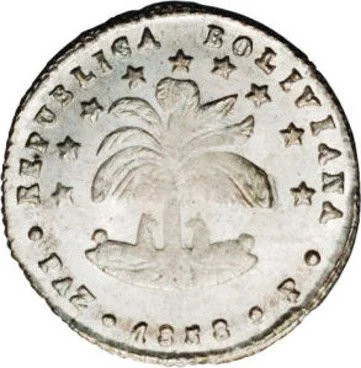
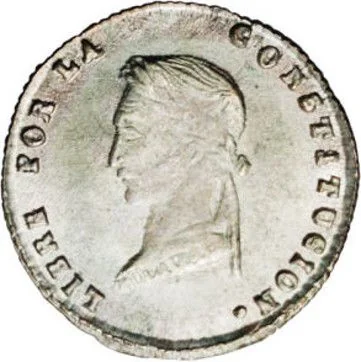
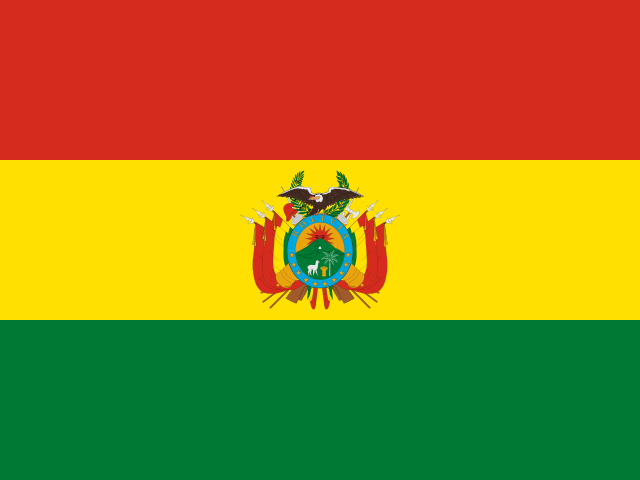
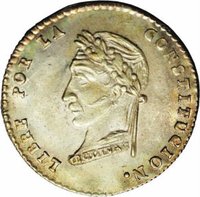
Obverse
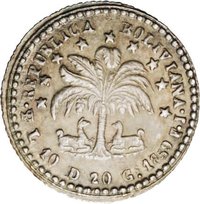
Reverse
Edge
Categories
| Animal> Camel |
| Person> Military leader |
| Person> Politician |
| Plant> Tree |
| Symbol> Wreath |
Mintings
| Year | Mint Mark | Mintage | Quality | Collection |
|---|---|---|---|---|
| 1858 | PAZ | — | ||
| 1859 | PAZ | 2 |
Historical background
In 1858, Bolivia’s currency situation was characterized by chronic instability and severe scarcity of circulating coinage. Following independence in 1825, the nation struggled to establish a unified monetary system, with a chaotic mix of Peruvian, Bolivian, and Spanish colonial coins in circulation. The government's attempts to mint its own currency at the Potosí mint were hampered by a lack of precious metals and consistent standards, leading to widespread counterfeiting and a deep public distrust in the value of official coinage. This environment crippled domestic commerce and complicated tax collection, as transactions often relied on barter or foreign silver.
The root of the problem lay in Bolivia's depleted economic base. The legendary silver mines of Potosí, while still operational, were far less productive than in the colonial era, depriving the state of the bullion needed to back a robust currency. Furthermore, political instability—with numerous changes in government and a recent civil war (1857-1858)—meant that fiscal and monetary policy was inconsistent and poorly enforced. The state treasury was perpetually empty, leading to the debasement of coinage and the issuance of low-value copper coins (señalillos) that the public was forced to use despite their lack of intrinsic worth.
Consequently, by 1858, Bolivia was on the brink of a monetary reform that would soon follow. The pressing need for a stable medium of exchange to foster internal trade and attract foreign investment set the stage for the comprehensive currency law of 1859. This law would introduce the Boliviano as the new decimal-based national currency, replacing the old scudo system, and would temporarily stabilize the monetary situation by establishing clearer standards and seeking to centralize control over minting, though long-term stability would remain elusive for decades.
The root of the problem lay in Bolivia's depleted economic base. The legendary silver mines of Potosí, while still operational, were far less productive than in the colonial era, depriving the state of the bullion needed to back a robust currency. Furthermore, political instability—with numerous changes in government and a recent civil war (1857-1858)—meant that fiscal and monetary policy was inconsistent and poorly enforced. The state treasury was perpetually empty, leading to the debasement of coinage and the issuance of low-value copper coins (señalillos) that the public was forced to use despite their lack of intrinsic worth.
Consequently, by 1858, Bolivia was on the brink of a monetary reform that would soon follow. The pressing need for a stable medium of exchange to foster internal trade and attract foreign investment set the stage for the comprehensive currency law of 1859. This law would introduce the Boliviano as the new decimal-based national currency, replacing the old scudo system, and would temporarily stabilize the monetary situation by establishing clearer standards and seeking to centralize control over minting, though long-term stability would remain elusive for decades.
✨ Legendary