

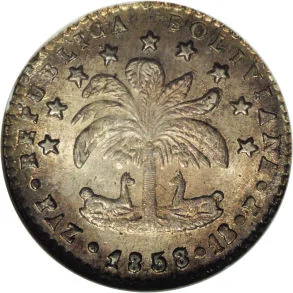
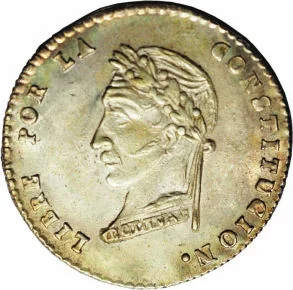
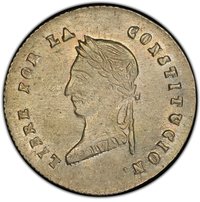
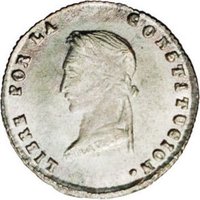
Obverse
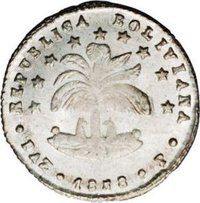
Reverse
Edge
Categories
| Animal> Camel |
| Person> Military leader |
| Person> Politician |
| Plant> Tree |
| Symbol> Wreath |
Mintings
| Year | Mint Mark | Mintage | Quality | Collection |
|---|---|---|---|---|
| 1857 | PAZ | — | ||
| 1858 | PAZ | — | ||
| 1859 | PAZ | — |
Historical background
In 1857, Bolivia’s currency situation was characterized by profound instability and scarcity, a direct legacy of the economic devastation following the War of the Pacific (1879-1884) and earlier internal conflicts. While the war itself was still in the future, the mid-19th century foundation for this later crisis was being laid. The national economy was heavily reliant on silver mining, but production from the famed Cerro Rico of Potosí had declined significantly from its colonial peak. This resulted in a chronic shortage of minted coinage, as the state lacked the bullion to produce sufficient quantities of sound money.
Consequently, the monetary system was a chaotic mix of foreign and debased currencies. Peruvian and Chilean coins, alongside Bolivian silver pesos of varying purity, circulated unevenly across the country's isolated regions. Most debilitating was the widespread circulation of moneda feble (weak money), which were debased silver coins intentionally minted with less precious metal content than their face value. This practice, aimed at generating short-term revenue for the cash-strapped government, destroyed public trust in the currency, fueled price inflation, and crippled commercial transactions, as merchants heavily discounted the weak coins.
The government of President José María Linares (1857-1861) recognized this monetary anarchy as a primary obstacle to national recovery. Upon taking office in 1857, Linares's administration made fiscal and monetary reform a central pillar, condemning the previous practice of moneda feble as a form of fraud. His efforts focused on restoring fiscal discipline, combating corruption, and laying the groundwork for a unified and trustworthy currency system. Thus, 1857 stands as a year of acute crisis but also as the beginning of a concerted, though long and difficult, attempt to impose monetary order on Bolivia’s fractured economy.
Consequently, the monetary system was a chaotic mix of foreign and debased currencies. Peruvian and Chilean coins, alongside Bolivian silver pesos of varying purity, circulated unevenly across the country's isolated regions. Most debilitating was the widespread circulation of moneda feble (weak money), which were debased silver coins intentionally minted with less precious metal content than their face value. This practice, aimed at generating short-term revenue for the cash-strapped government, destroyed public trust in the currency, fueled price inflation, and crippled commercial transactions, as merchants heavily discounted the weak coins.
The government of President José María Linares (1857-1861) recognized this monetary anarchy as a primary obstacle to national recovery. Upon taking office in 1857, Linares's administration made fiscal and monetary reform a central pillar, condemning the previous practice of moneda feble as a form of fraud. His efforts focused on restoring fiscal discipline, combating corruption, and laying the groundwork for a unified and trustworthy currency system. Thus, 1857 stands as a year of acute crisis but also as the beginning of a concerted, though long and difficult, attempt to impose monetary order on Bolivia’s fractured economy.
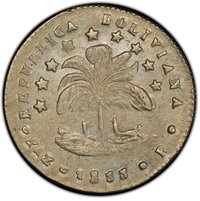
💎 Extremely Rare