

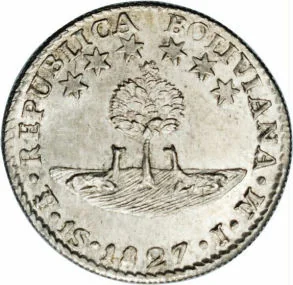
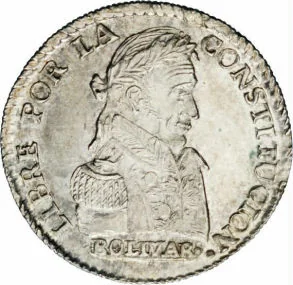
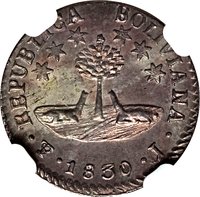
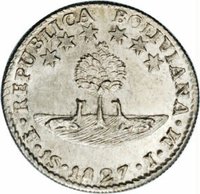
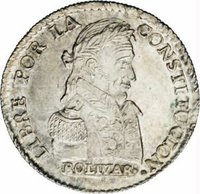
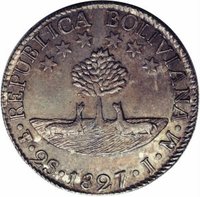
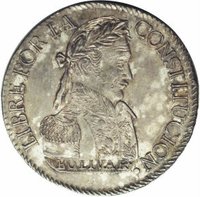
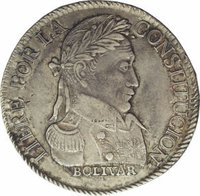
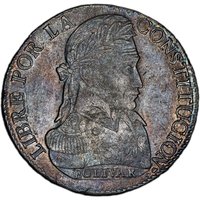
Obverse
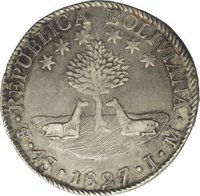
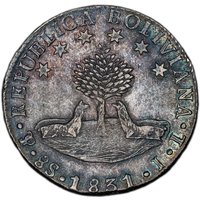
Reverse
Edge
Categories
| Plant> Tree |
| Symbol> Wreath |
| Animal> Camel |
| Person> Military leader |
| Person> Politician |
Mintings
| Year | Mint Mark | Mintage | Quality | Collection |
|---|---|---|---|---|
| 1827 | PTS | — | ||
| 1828 | PTS | — | ||
| 1829 | PTS | — |
Historical background
Following its hard-fought independence in 1825, Bolivia entered 1827 facing profound monetary disarray, a direct legacy of the colonial and wartime periods. The new republic inherited a chaotic mix of coins from the Potosí mint, Spanish colonial reales, and various foreign currencies, particularly Peruvian and Argentine coins, all circulating at fluctuating and unreliable values. This fragmentation severely hampered domestic trade, state finances, and the establishment of economic sovereignty, as the government of President Antonio José de Sucre lacked a unified national currency to anchor the economy.
Recognizing this crisis, the Sucre administration took decisive action in 1827 by promulgating the Ley Monetaria (Monetary Law) on July 20th. This foundational legislation formally decimalized the Bolivian monetary system, establishing the Boliviano as the principal unit, divided into 100 centavos. Crucially, the law mandated the minting of new, high-quality national coinage at the Potosí mint, featuring the republic's coat of arms to symbolize its newfound sovereignty. The initial issues included silver coins of 8, 4, 2, 1, and ½ bolivianos, as well as gold escudos.
The reform of 1827 was a critical first step toward stability, but its full implementation faced immediate challenges. The scarcity of precious metals and the technical limitations of the Potosí mint meant production was initially slow, unable to quickly displace the plethora of older coins still in circulation. Consequently, while 1827 marked the official birth of the Bolivian national currency and provided a clear legal framework, the practical reality for much of the population remained a complex and unstable multi-currency environment, a problem that would persist for years as the fledgling state worked to consolidate its monetary authority.
Recognizing this crisis, the Sucre administration took decisive action in 1827 by promulgating the Ley Monetaria (Monetary Law) on July 20th. This foundational legislation formally decimalized the Bolivian monetary system, establishing the Boliviano as the principal unit, divided into 100 centavos. Crucially, the law mandated the minting of new, high-quality national coinage at the Potosí mint, featuring the republic's coat of arms to symbolize its newfound sovereignty. The initial issues included silver coins of 8, 4, 2, 1, and ½ bolivianos, as well as gold escudos.
The reform of 1827 was a critical first step toward stability, but its full implementation faced immediate challenges. The scarcity of precious metals and the technical limitations of the Potosí mint meant production was initially slow, unable to quickly displace the plethora of older coins still in circulation. Consequently, while 1827 marked the official birth of the Bolivian national currency and provided a clear legal framework, the practical reality for much of the population remained a complex and unstable multi-currency environment, a problem that would persist for years as the fledgling state worked to consolidate its monetary authority.
Series: 1827 Bolivia circulation coins
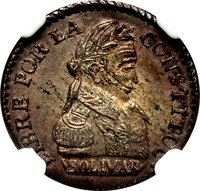
💎 Extremely Rare