

200 Escudos – Portugal
Portugal
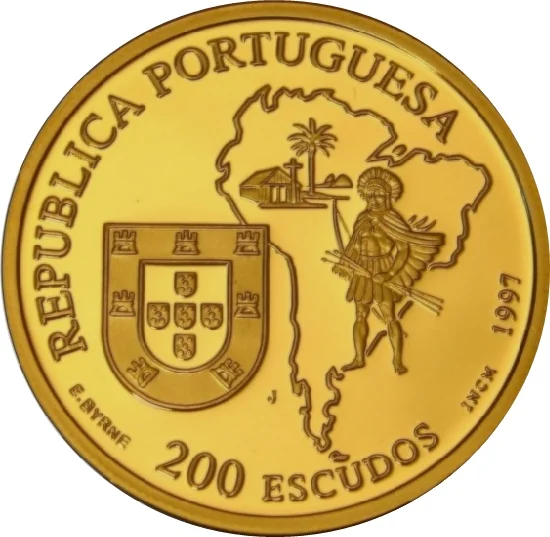
Obverse
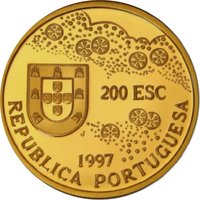
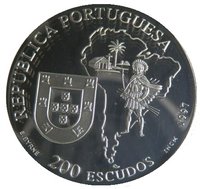
Description:
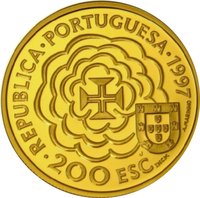
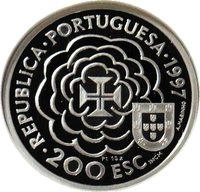
South America map topped by a man and a palm tree.
Inscription:
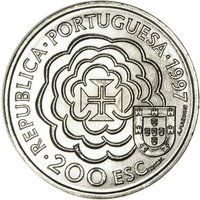
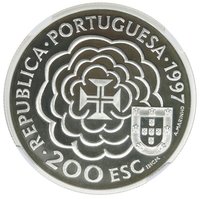
REPUBLICA PORTUGUESA
200 ESCUDOS
E. BYRNE INCM 1997
200 ESCUDOS
E. BYRNE INCM 1997
Translation:
PORTUGUESE REPUBLIC
200 ESCUDOS
E. BYRNE INCM 1997
200 ESCUDOS
E. BYRNE INCM 1997
Script: Latin
Languages: Portuguese, English
Engraver: Eloísa Byrne
Reverse
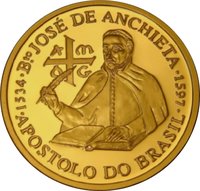
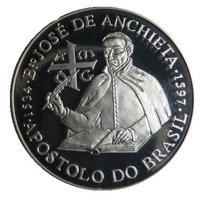
Description:
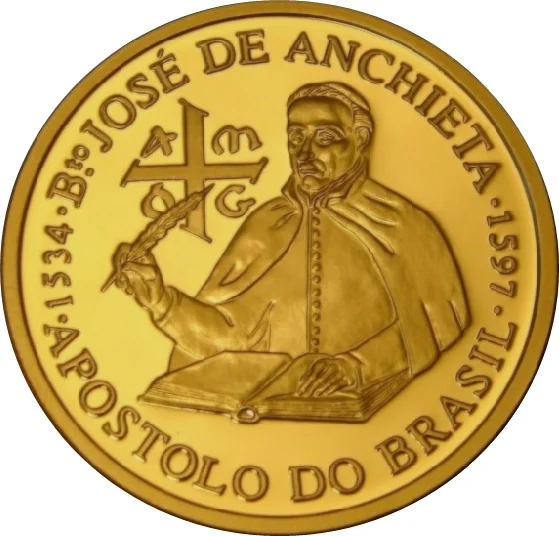
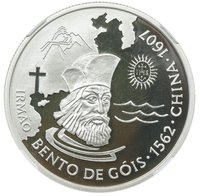
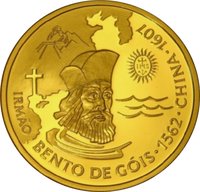
Left-facing portrait in a cloak, holding a book down with the left hand and raising a quill with the right.
Inscription:
1534 . BTO JOSÉ DE ANCHIETA 1597
APOSTOLO DO BRASIL
APOSTOLO DO BRASIL
Translation:
1534. BTO JOSÉ DE ANCHIETA 1597
APOSTLE OF BRAZIL
APOSTLE OF BRAZIL
Script: Latin
Languages: Portuguese, Latin
Engraver: Eloísa Byrne
Edge
Reeded
Legend:
B.to JOSÉ DE ANCHIETA
1534·1597
APOSTOLO DO BRASIL
1534·1597
APOSTOLO DO BRASIL
Translation:
To the Blessed José de Anchieta
1534-1597
Apostle of Brazil
1534-1597
Apostle of Brazil
Languages: Latin, Portuguese
Mints
| Name | Mark |
|---|---|
| Imprensa Nacional - Casa da Moeda | INCM |
Mintings
| Year | Mint Mark | Mintage | Quality | Collection |
|---|---|---|---|---|
| 1997 | INCM | 5,000 | Proof |
Historical background
In 1997, Portugal was in a period of significant monetary transition, firmly on the path toward European Economic and Monetary Union (EMU). The country was a committed member of the European Union's Exchange Rate Mechanism (ERM), which required it to maintain its currency, the escudo, within a narrow band of fluctuation against other European currencies, particularly the German Deutsche Mark. This discipline was crucial for meeting the strict convergence criteria—including targets for inflation, interest rates, budget deficits, and public debt—outlined in the Maastricht Treaty for adopting a single European currency.
Domestically, the government, led by Prime Minister António Guterres, pursued tight fiscal and monetary policies to ensure qualification for the first wave of the euro. Inflation and interest rates had fallen dramatically from their highs in the early 1990s, but challenges remained, particularly regarding the public debt-to-GDP ratio, which was among the highest in the EU. The escudo was stable, having been devalued within the ERM in 1992 and 1995, and by 1997 it was operating without serious tension, as markets were confident in Portugal's euro adoption prospects.
Thus, the currency situation in 1997 was one of anticipation and preparation. The escudo was effectively functioning as a proxy for the future euro, with its value pegged through the ERM. National and economic discourse was focused not on exchange rate policy but on the irreversible process of "euroization," involving public information campaigns and logistical planning for the physical introduction of euro notes and coins, which would ultimately occur on January 1, 2002, after a fixed conversion rate was set in 1999.
Domestically, the government, led by Prime Minister António Guterres, pursued tight fiscal and monetary policies to ensure qualification for the first wave of the euro. Inflation and interest rates had fallen dramatically from their highs in the early 1990s, but challenges remained, particularly regarding the public debt-to-GDP ratio, which was among the highest in the EU. The escudo was stable, having been devalued within the ERM in 1992 and 1995, and by 1997 it was operating without serious tension, as markets were confident in Portugal's euro adoption prospects.
Thus, the currency situation in 1997 was one of anticipation and preparation. The escudo was effectively functioning as a proxy for the future euro, with its value pegged through the ERM. National and economic discourse was focused not on exchange rate policy but on the irreversible process of "euroization," involving public information campaigns and logistical planning for the physical introduction of euro notes and coins, which would ultimately occur on January 1, 2002, after a fixed conversion rate was set in 1999.
✨ Legendary