

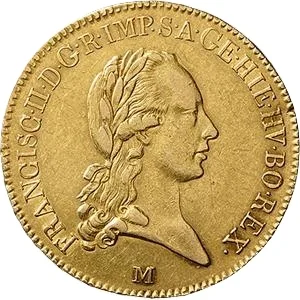
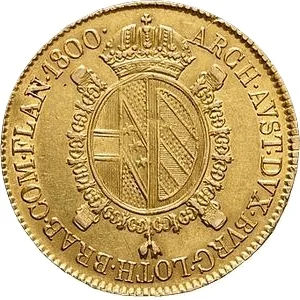
½ sovrano – Milan
Add to wishlist
Italy
Context
Material
References
KM: #
Numista: #81872
Value
Bullion value: $774.93
Obverse
Reverse
Description:
Crowned oval shield.
Inscription:
ARCH. AVST. DVX. BVRG. LOTH. BRAB. COM. FLAN.
Script: Latin
Edge
Categories
| Symbols> Coat of Arms |
Mints
| Name | Mark |
|---|---|
| Milan | — |
Mintings
| Year | Mint Mark | Mintage | Quality | Collection |
|---|---|---|---|---|
| 1800 | M | — |
Historical background
In 1800, Milan found itself at the heart of a profound monetary transformation, caught between its Habsburg past and its Napoleonic future. Following the French invasion of 1796, the region was first organized as the Cisalpine Republic, a French client state. This political shift triggered a chaotic currency situation where old Austrian coins—like the lira, soldo, and denaro of the Milanese monetary system—circulated alongside new French-minted coins and hastily produced local issues. The government also introduced a paper currency, the mandato, but it rapidly depreciated due to over-issuance and a lack of public confidence, leading to severe inflation and a preference for hard specie.
The situation crystallized in 1800 after Napoleon's decisive victory at Marengo, which solidified French control. The subsequent establishment of the Italian Republic in 1802 (with Napoleon as president and Milan as its capital) initiated a formal currency reform. The new state sought to standardize the monetary chaos by introducing a decimal-based system explicitly modelled on the French franc. The lira was redefined as the basic unit, subdivided into 100 centesimi, and was pegged at par with the French franc to facilitate trade and integration within the Continental System.
Thus, by the end of the Napoleonic era, Milan's currency landscape had been fundamentally reshaped. The old Austrian system was fully replaced by a modern, decimal currency aligned with France, which would later form the foundation for the unified lira of the Kingdom of Italy in the 1860s. The transition, however, was economically painful, marked by the instability of the late 1790s and the forceful integration of Lombardy into France's economic sphere, demonstrating how currency in this period was a direct instrument of political power and imperial ambition.
The situation crystallized in 1800 after Napoleon's decisive victory at Marengo, which solidified French control. The subsequent establishment of the Italian Republic in 1802 (with Napoleon as president and Milan as its capital) initiated a formal currency reform. The new state sought to standardize the monetary chaos by introducing a decimal-based system explicitly modelled on the French franc. The lira was redefined as the basic unit, subdivided into 100 centesimi, and was pegged at par with the French franc to facilitate trade and integration within the Continental System.
Thus, by the end of the Napoleonic era, Milan's currency landscape had been fundamentally reshaped. The old Austrian system was fully replaced by a modern, decimal currency aligned with France, which would later form the foundation for the unified lira of the Kingdom of Italy in the 1860s. The transition, however, was economically painful, marked by the instability of the late 1790s and the forceful integration of Lombardy into France's economic sphere, demonstrating how currency in this period was a direct instrument of political power and imperial ambition.
✨ Legendary