

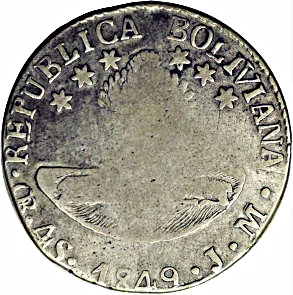
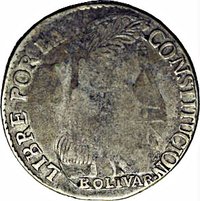
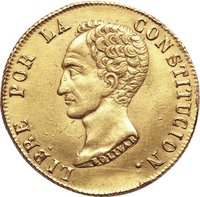
Obverse
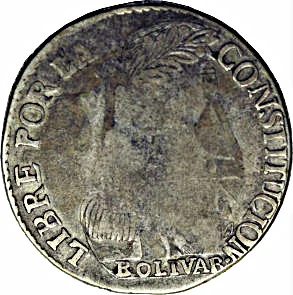
Reverse
Edge
Mints
| Name | Mark |
|---|---|
| Oruro | — |
Mintings
| Year | Mint Mark | Mintage | Quality | Collection |
|---|---|---|---|---|
| 1849 | OR | 1 |
Historical background
In 1849, Bolivia’s currency situation was characterized by profound instability and scarcity, a direct legacy of the economic devastation following the War of the Confederation (1836-39) and the ongoing political turbulence of the post-independence era. The national treasury was chronically empty, and the country lacked a unified, trusted coinage system. While the Bolivian peso was the official unit of account, its value was highly unstable and it circulated alongside a confusing array of foreign coins, primarily Peruvian and Chilean silver, as well as Spanish colonial pieces. This monetary fragmentation crippled domestic commerce and state finances.
The government of President José Miguel de Velasco, facing this crisis, was essentially operating on a bimetallic standard in theory but a system of bullion by weight in practice. The intrinsic value of silver coins, determined by their metal content and weight, was more important than their face value. Chronic shortages of minted currency led to widespread use of fiado (credit) in urban trade and barter in rural areas. Attempts to establish a stable currency were undermined by a lack of silver to mint and a profound loss of public confidence in any government-issued money, a sentiment rooted in past episodes of arbitrary devaluation.
Consequently, 1849 represents a low point in Bolivia's monetary history, a period of ad-hoc survival rather than systematic policy. The fundamental issues were the state's inability to control its money supply, the reliance on volatile silver imports, and the absence of a central banking authority. True monetary reform would only begin to materialize in the subsequent decades with the growth of the silver mining industry, particularly from the Cerro Rico of Potosí and new discoveries, which eventually provided the bullion needed to support a more stable national coinage.
The government of President José Miguel de Velasco, facing this crisis, was essentially operating on a bimetallic standard in theory but a system of bullion by weight in practice. The intrinsic value of silver coins, determined by their metal content and weight, was more important than their face value. Chronic shortages of minted currency led to widespread use of fiado (credit) in urban trade and barter in rural areas. Attempts to establish a stable currency were undermined by a lack of silver to mint and a profound loss of public confidence in any government-issued money, a sentiment rooted in past episodes of arbitrary devaluation.
Consequently, 1849 represents a low point in Bolivia's monetary history, a period of ad-hoc survival rather than systematic policy. The fundamental issues were the state's inability to control its money supply, the reliance on volatile silver imports, and the absence of a central banking authority. True monetary reform would only begin to materialize in the subsequent decades with the growth of the silver mining industry, particularly from the Cerro Rico of Potosí and new discoveries, which eventually provided the bullion needed to support a more stable national coinage.
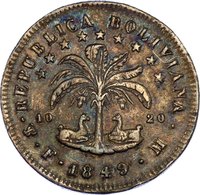
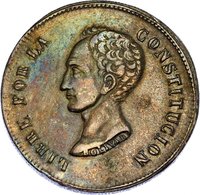
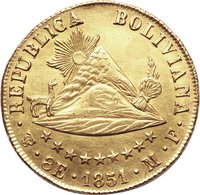
✨ Legendary