

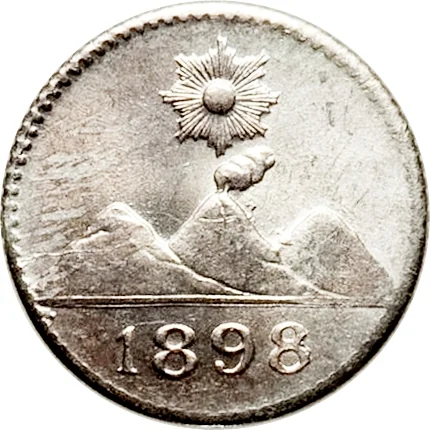
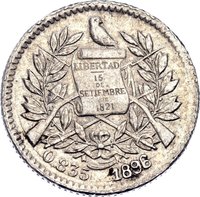
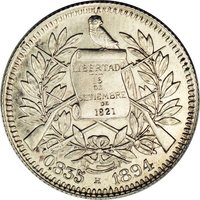
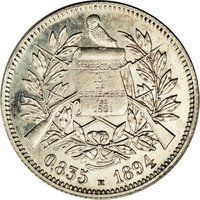
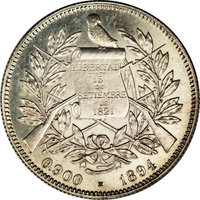
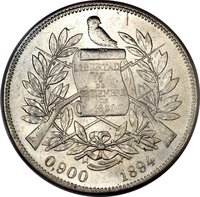
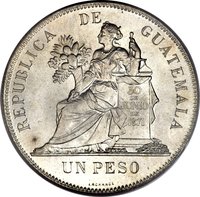
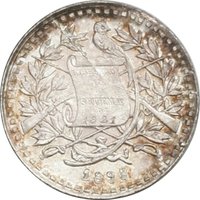
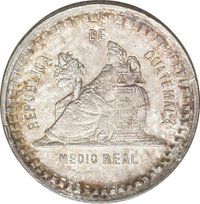
Obverse
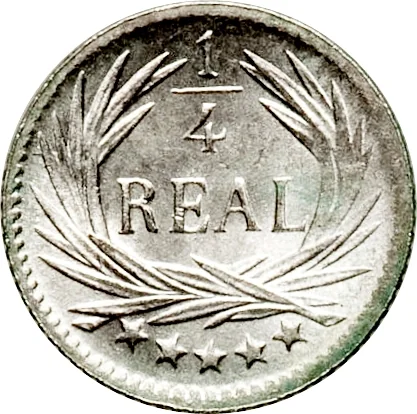
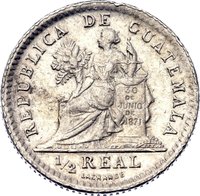
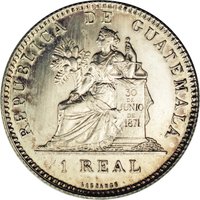
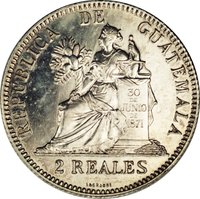
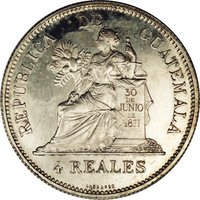
Reverse
Edge
Reeded
Mints
| Name | Mark |
|---|---|
| Casa de Moneda de Guatemala | — |
| Heaton and Sons / The Mint Birmingham | H |
Mintings
Historical background
In 1894, Guatemala's currency situation was characterized by a complex and unstable bimetallic system, a legacy of the colonial era and early independence. The official currency was the peso, subdivided into 8 reales, but the economy operated with a confusing mix of Spanish, Mexican, and other Latin American silver coins, alongside gold coins like the escudo. The critical problem was the fixed legal exchange rate between gold and silver (1:16), which did not reflect the plummeting global market value of silver due to increased production, particularly from new mines in the United States. This discrepancy led to Gresham's Law in practice: "bad" (undervalued) silver money drove "good" (overvalued) gold money out of circulation, as people hoarded or exported gold, leaving the domestic economy reliant on depreciating silver.
This monetary instability created severe economic distortions. The government's revenues, collected in devalued silver, fell in real terms against its gold-denominated foreign debts and obligations for imports. This fiscal strain was exacerbated by the global "Panic of 1893," which depressed coffee prices—Guatemala's primary export—further reducing state income. Internally, the fluctuating value of silver caused price confusion, hindered long-term contracts, and created uncertainty for both local businesses and foreign investors, whose capital was desperately sought for infrastructure projects under the long-standing rule of President Manuel Estrada Cabrera.
The situation culminated in decisive action later in the decade, paving the way for the major monetary reform of 1912. While the Law of Monetary Unification was still years away, the pressures of 1894 made the necessity for change increasingly apparent to the political and coffee-growing elite. The eventual solution would be the abandonment of silver and the adoption of a gold standard, with the US dollar heavily influencing the creation of a new national currency, the quetzal, to provide the stability that the 1894 system so clearly lacked.
This monetary instability created severe economic distortions. The government's revenues, collected in devalued silver, fell in real terms against its gold-denominated foreign debts and obligations for imports. This fiscal strain was exacerbated by the global "Panic of 1893," which depressed coffee prices—Guatemala's primary export—further reducing state income. Internally, the fluctuating value of silver caused price confusion, hindered long-term contracts, and created uncertainty for both local businesses and foreign investors, whose capital was desperately sought for infrastructure projects under the long-standing rule of President Manuel Estrada Cabrera.
The situation culminated in decisive action later in the decade, paving the way for the major monetary reform of 1912. While the Law of Monetary Unification was still years away, the pressures of 1894 made the necessity for change increasingly apparent to the political and coffee-growing elite. The eventual solution would be the abandonment of silver and the adoption of a gold standard, with the US dollar heavily influencing the creation of a new national currency, the quetzal, to provide the stability that the 1894 system so clearly lacked.
Series: 1894 Guatemala circulation coins
🌱 Common