

2 Euro – Slovakia
Circulating commemorative coins
Commemoration: Slovak Presidency of the Council of the European Union
Slovakia
Obverse
Description:
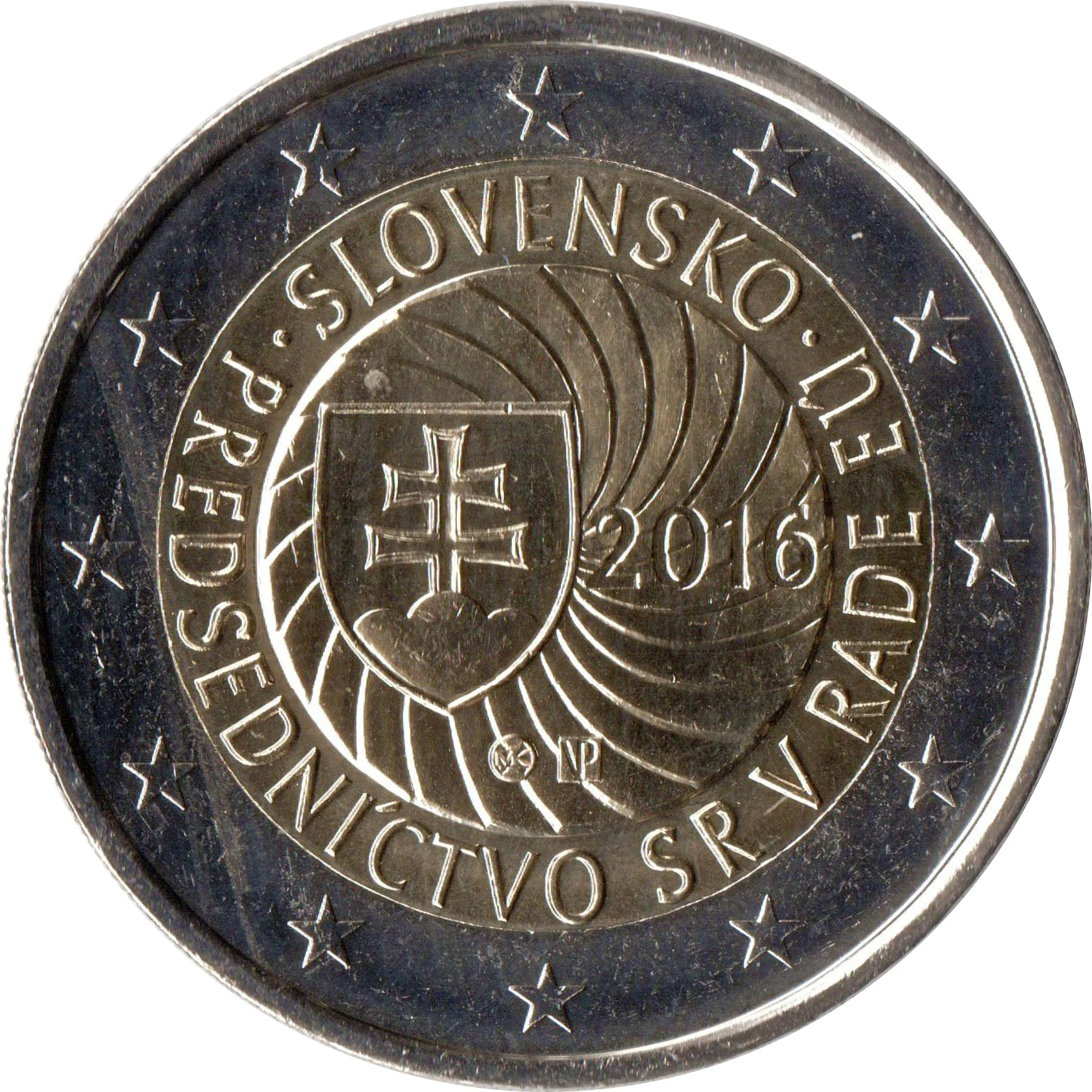
The design features the Slovak coat of arms on a background of centripetal lines, symbolizing the country's role during its 2016 Presidency of the Council of the European Union. To the right is the year ‘2016’. Around the inner edge are the inscriptions ‘SLOVENSKO’ and ‘PREDSEDNÍCTVO SR V RADE EÚ’, separated by symbols. The Kremnica Mint mark (‘MK’) and designer Vladimír Pavlica's initials (‘VP’) appear at the bottom. The outer ring bears the twelve stars of the European Union.
Inscription:
·SLOVENSKO· PREDSEDNÍCTVO SR V RADE EÚ
VP
2016
VP
2016
Translation:
SLOVAKIA PRESIDENCY OF THE SLOVAK REPUBLIC IN THE COUNCIL OF THE EU
2016
2016
Script: Latin
Language: Slovak
Engraver: Vladimír Pavlica
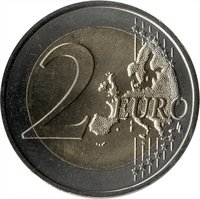
Reverse
Edge
Country name in Slovak language with two stars and a linden leaf in the middle
Legend:
SLOVENSKÁ REPUBLIKA
Translation:
Slovak Republic
Language: Slovak
Categories
| Map |
| Symbols> Coat of Arms |
| Symbol> Cross |
Mints
| Name | Mark |
|---|---|
| Kremnica | (MK) |
Mintings
| Year | Mint Mark | Mintage | Quality | Collection |
|---|---|---|---|---|
| 2016 | MK | 1,000,000 | ||
| 2016 | MK | 15,800 | BU | |
| 2016 | MK | 1,000 | Proof |
Historical background
In 2016, Slovakia was a stable member of the Eurozone, having adopted the euro as its official currency on January 1, 2009. This meant the country no longer had an independent monetary policy, as its interest rates and broader monetary strategy were set by the European Central Bank (ECB) in Frankfurt. The primary domestic currency discussion in 2016, therefore, revolved not around exchange rates but around the practical and political implications of euro membership. The year saw ongoing public debate about the perceived benefits of price transparency and reduced transaction costs versus criticisms, often from populist and nationalist parties, regarding the loss of monetary sovereignty and the symbolic connection to the former national currency, the Slovak koruna.
Economically, Slovakia was experiencing strong growth in 2016, with GDP expanding by over 3%, significantly outpacing the Eurozone average. This robust performance was largely driven by a surge in automotive exports and increased EU fund absorption. The common currency was generally seen as a stabilizing factor that facilitated this export-led growth by eliminating foreign exchange risk within its main European market. However, the ECB's ultra-loose monetary policy, including negative interest rates and quantitative easing, was a point of contention. While it supported borrowing and investment, it also raised concerns among some Slovak policymakers about potential asset bubbles and the penalization of savers.
Politically, the euro remained a largely settled issue within the mainstream, supported by the governing center-left Smer-SD party and most of the opposition. However, the rise of the populist-nationalist ĽSNS (People's Party Our Slovakia), which openly advocated for a return to the koruna, kept the topic in the public discourse. Furthermore, the aftermath of the Greek debt crisis and the ongoing migration crisis in Europe fueled broader skepticism about EU integration, which occasionally spilled over into criticism of the single currency. Thus, in 2016, Slovakia's currency situation was characterized by operational stability and economic benefits under the euro, juxtaposed with a persistent, though minority, political undercurrent questioning its long-term desirability.
Economically, Slovakia was experiencing strong growth in 2016, with GDP expanding by over 3%, significantly outpacing the Eurozone average. This robust performance was largely driven by a surge in automotive exports and increased EU fund absorption. The common currency was generally seen as a stabilizing factor that facilitated this export-led growth by eliminating foreign exchange risk within its main European market. However, the ECB's ultra-loose monetary policy, including negative interest rates and quantitative easing, was a point of contention. While it supported borrowing and investment, it also raised concerns among some Slovak policymakers about potential asset bubbles and the penalization of savers.
Politically, the euro remained a largely settled issue within the mainstream, supported by the governing center-left Smer-SD party and most of the opposition. However, the rise of the populist-nationalist ĽSNS (People's Party Our Slovakia), which openly advocated for a return to the koruna, kept the topic in the public discourse. Furthermore, the aftermath of the Greek debt crisis and the ongoing migration crisis in Europe fueled broader skepticism about EU integration, which occasionally spilled over into criticism of the single currency. Thus, in 2016, Slovakia's currency situation was characterized by operational stability and economic benefits under the euro, juxtaposed with a persistent, though minority, political undercurrent questioning its long-term desirability.
Series: Slovakia 2 euro commemoratives
🌱 Very Common