

5 kopecks – Russian Empire
Add to wishlist
Russia
Context
Years: 1860–1866
Country: Russia
Issuer: Russian Empire
Ruler: Alexander II
Currency:
(1700—1917)
Demonetized: Yes
Total mintage: 1,730,038
Material
References
Y: #
Numista: #80845
Value
Bullion value: $1.86
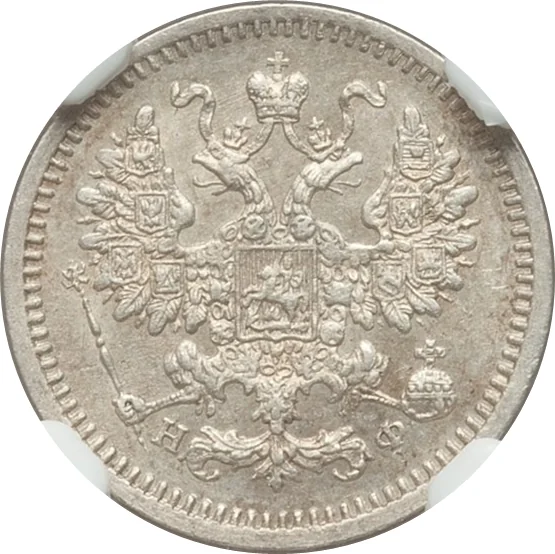
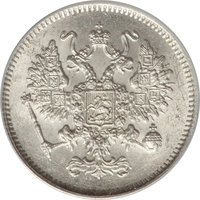
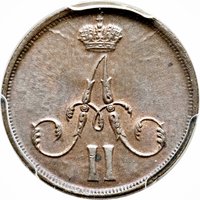
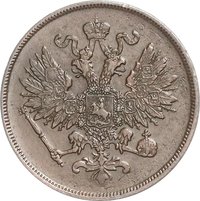
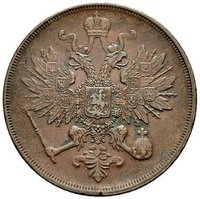
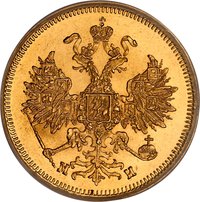
Obverse
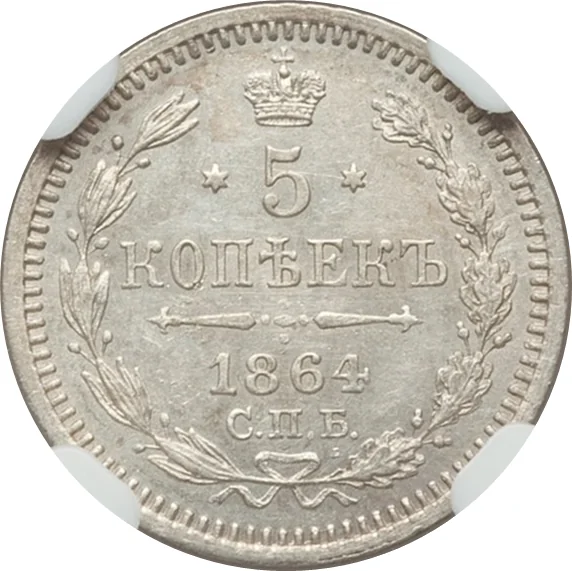
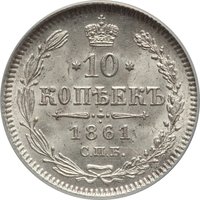
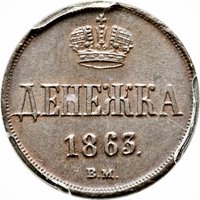
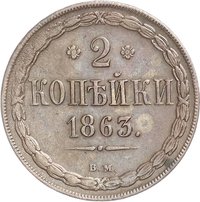
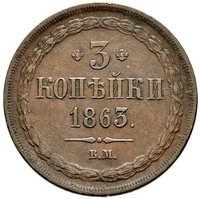
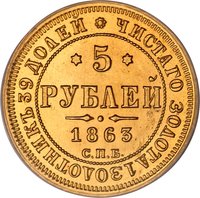
Reverse
Edge
Dotted
Mintings
| Year | Mint Mark | Mintage | Quality | Collection |
|---|---|---|---|---|
| 1860 | СПБ | 180,003 | BU | |
| 1861 | СПБ | 320,004 | BU | |
| 1862 | СПБ | 400,009 | BU | |
| 1863 | СПБ | 200,003 | BU | |
| 1864 | СПБ | 240,003 | BU | |
| 1865 | СПБ | 190,003 | BU | |
| 1866 | СПБ | 200,013 | BU |
Historical background
By 1860, the currency system of the Russian Empire was a complex and strained hybrid of metallic and paper money, reflecting the state's financial pressures. The foundation was the silver ruble, but in practice, the economy relied heavily on depreciated paper assignats (assignatsii), first introduced in the late 18th century to fund wars. These notes were not freely convertible into silver and circulated at a significant discount, leading to a dual system of "silver rubles" for stable accounting and "assignat rubles" for daily transactions. This created confusion, hampered commerce, and signaled the state's fiscal weakness, especially following the costly Crimean War (1853-1856).
The government recognized the urgent need for reform. A fixed exchange rate between assignats and silver had been attempted in the 1840s under Finance Minister Georg von Cancrin, but the Crimean War forced massive new printings of paper money to cover deficits, causing inflation and further devaluation. By 1860, the ruble was unstable on international markets, hindering foreign investment and economic modernization. The newly established State Bank (Gosudarstvenny Bank), founded in that very year, was a critical institutional step toward stabilizing the currency and centralizing financial control.
Thus, the currency situation in 1860 stood at a pivotal crossroads. It was characterized by the lingering burdens of war finance, an unwieldy dual monetary system, and a clear recognition that stability was essential for the empire's future, particularly with the monumental Emancipation of the Serfs looming in 1861. The stage was set for the major monetary reforms that would follow in the 1860s and 1890s, which aimed to restore confidence by establishing a gold standard and eliminating the depreciated paper assignats.
The government recognized the urgent need for reform. A fixed exchange rate between assignats and silver had been attempted in the 1840s under Finance Minister Georg von Cancrin, but the Crimean War forced massive new printings of paper money to cover deficits, causing inflation and further devaluation. By 1860, the ruble was unstable on international markets, hindering foreign investment and economic modernization. The newly established State Bank (Gosudarstvenny Bank), founded in that very year, was a critical institutional step toward stabilizing the currency and centralizing financial control.
Thus, the currency situation in 1860 stood at a pivotal crossroads. It was characterized by the lingering burdens of war finance, an unwieldy dual monetary system, and a clear recognition that stability was essential for the empire's future, particularly with the monumental Emancipation of the Serfs looming in 1861. The stage was set for the major monetary reforms that would follow in the 1860s and 1890s, which aimed to restore confidence by establishing a gold standard and eliminating the depreciated paper assignats.
💎 Very Rare