

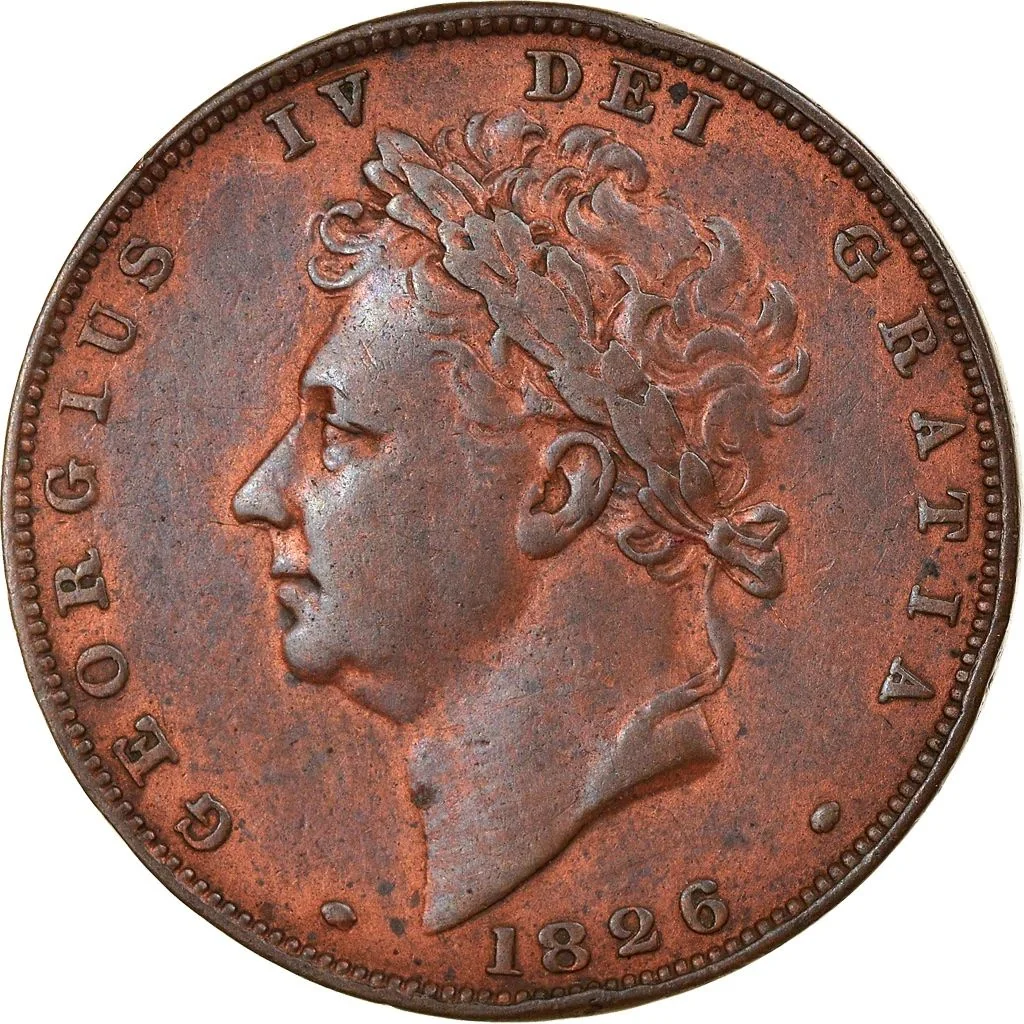
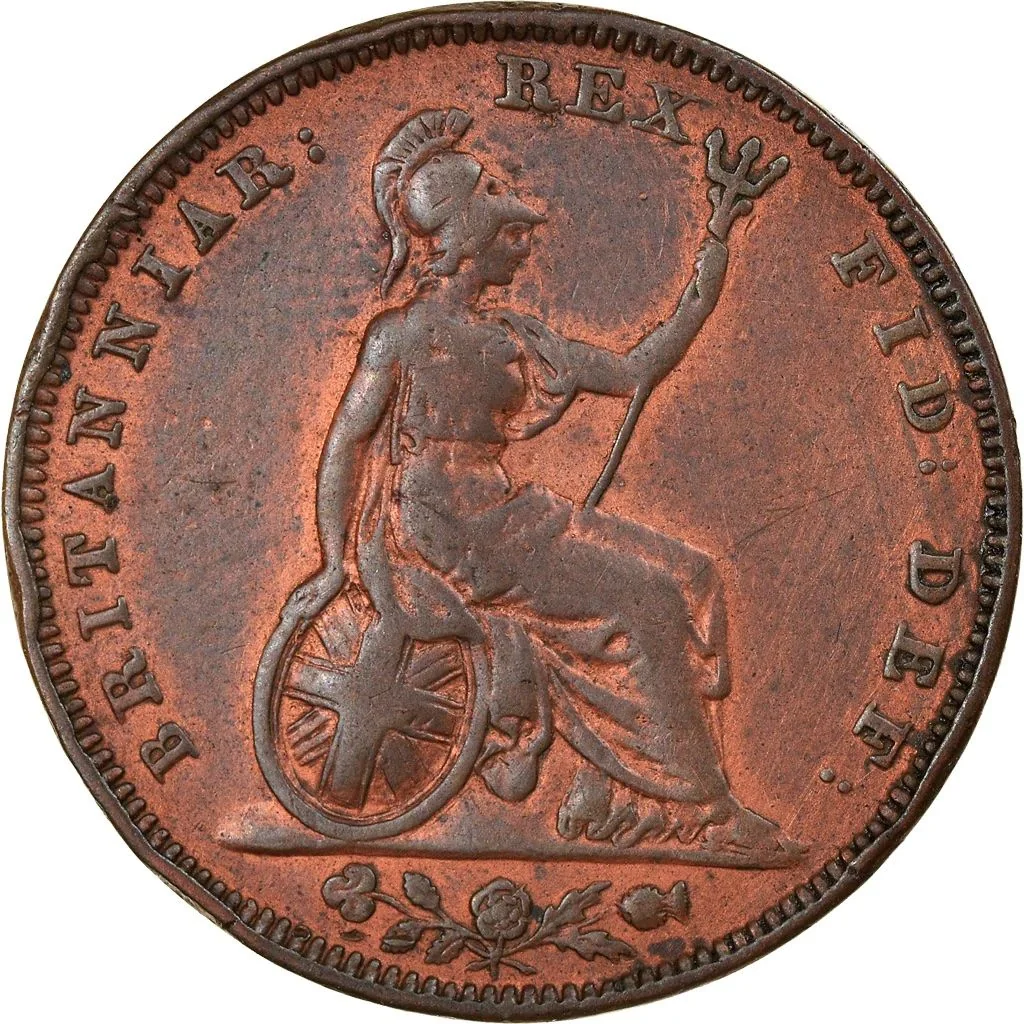
1 Farthing – United Kingdom
United Kingdom
Context
Years: 1826–1831
Issuer: United Kingdom 
Ruler: George IV
Currency:
(1158—1970)
Demonetization: 31 December 1869
Total mintage: 15,267,600
Material
References
KM: #Click to copy to clipboard697
Numista: #8082
Obverse
Description:
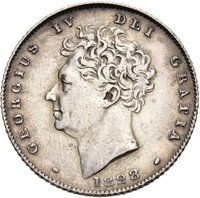
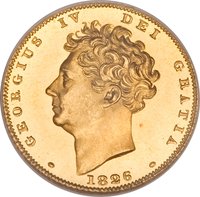
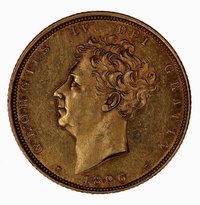
King George IV left-facing portrait, legend surrounding, date beneath.
Inscription:
GEORGIUS IV DEI GRATIA
· 1826 ·
· 1826 ·
Translation:
George IV by the Grace of God
Script: Latin
Language: Latin
Engraver: William Wyon
Reverse
Edge
Plain
Mints
| Name | Mark |
|---|---|
| Royal Mint (Tower Hill) | — |
Mintings
| Year | Mint Mark | Mintage | Quality | Collection |
|---|---|---|---|---|
| 1826 | — | 6,666,200 | ||
| 1826 | — | — | Proof | |
| 1827 | — | 2,365,400 | ||
| 1828 | — | 2,365,400 | ||
| 1829 | — | 1,505,200 | ||
| 1830 | — | 2,365,400 | ||
| 1831 | — | — | Proof |
Historical background
In 1826, the United Kingdom's currency system was in a state of significant transition and regional inconsistency. The official unit was the pound sterling, but the physical money in circulation was a complex patchwork. Gold sovereigns, introduced in 1817, were the principal coin, but they coexisted with a proliferation of private and regional banknotes. Hundreds of country banks issued their own paper money, leading to widespread instability; bank failures were common, often leaving holders with worthless notes. This fragility had been starkly exposed by the economic crises following the Napoleonic Wars, creating a pressing need for reform.
The key legislative response in 1826 was a trio of Bank Acts designed to consolidate and stabilise the currency. The most impactful measure forbade the issuance of banknotes under £5 in England and Wales, aiming to drive small-denomination paper out of circulation and promote the use of gold coin for everyday transactions. Furthermore, the Bank of England was granted the power to open branches in major provincial cities, breaking its long confinement to London. These branches could issue the Bank's own notes, which were considered more secure, thereby gradually supplanting the unreliable notes of country banks and creating a more uniform national paper currency.
These reforms marked a decisive step towards a modern, centralised monetary system. By restricting small notes and expanding the reach of the Bank of England, the government sought to reduce systemic risk, curb inflationary pressures, and build public confidence in the currency. However, the situation remained distinct in Scotland and Ireland, where banks retained the right to issue their own lower-denomination notes, preserving a key difference within the Union. Thus, 1826 stands as a pivotal year where Parliament began to assert greater central control over England's money, laying essential groundwork for the banking reforms that would follow in the decades ahead.
The key legislative response in 1826 was a trio of Bank Acts designed to consolidate and stabilise the currency. The most impactful measure forbade the issuance of banknotes under £5 in England and Wales, aiming to drive small-denomination paper out of circulation and promote the use of gold coin for everyday transactions. Furthermore, the Bank of England was granted the power to open branches in major provincial cities, breaking its long confinement to London. These branches could issue the Bank's own notes, which were considered more secure, thereby gradually supplanting the unreliable notes of country banks and creating a more uniform national paper currency.
These reforms marked a decisive step towards a modern, centralised monetary system. By restricting small notes and expanding the reach of the Bank of England, the government sought to reduce systemic risk, curb inflationary pressures, and build public confidence in the currency. However, the situation remained distinct in Scotland and Ireland, where banks retained the right to issue their own lower-denomination notes, preserving a key difference within the Union. Thus, 1826 stands as a pivotal year where Parliament began to assert greater central control over England's money, laying essential groundwork for the banking reforms that would follow in the decades ahead.
🌱 Common