

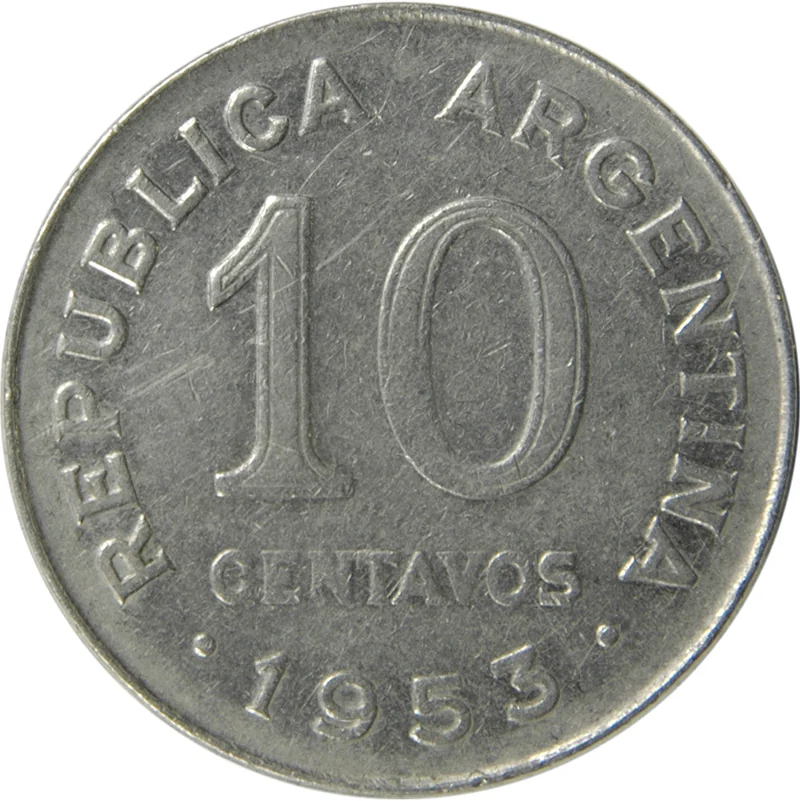
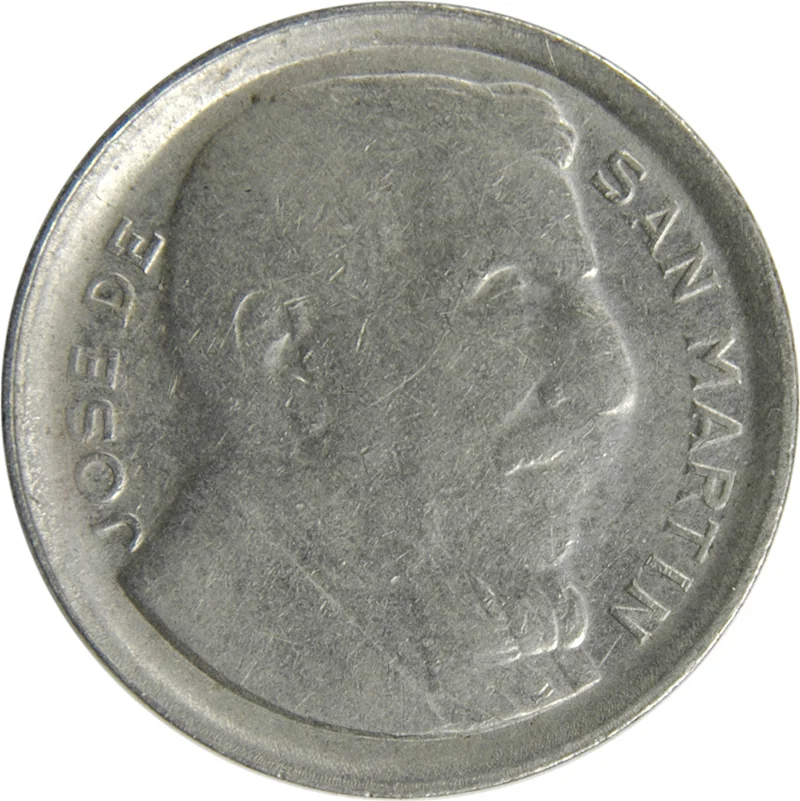
10 centavos – Argentina
Add to wishlist
Argentina
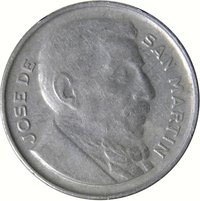
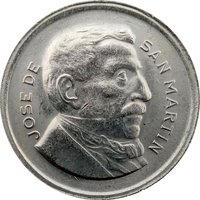
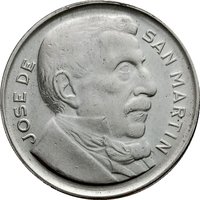
Obverse
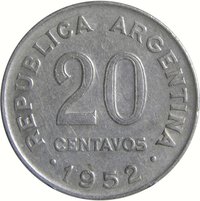
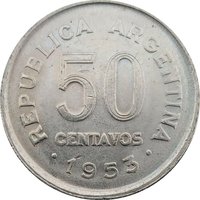
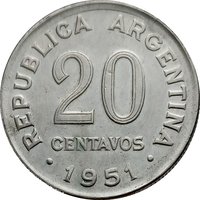
Reverse
Description:
Portrait of General José de San Martín facing right.
Inscription:
JOSE DE SAN MARTIN
Script: Latin
Engraver: Mario Baiardi
Edge
Plain
Categories
| Person> Military leader |
| Person> Politician |
Mintings
| Year | Mint Mark | Mintage | Quality | Collection |
|---|---|---|---|---|
| 1952 | — | 33,240,000 | ||
| 1953 | — | 106,685,000 |
Historical background
In 1952, Argentina's currency situation was defined by the economic policies of President Juan Perón's first administration, which had prioritized rapid industrialization and social welfare programs since 1946. Financed largely by the massive foreign exchange reserves accumulated during World War II from agricultural exports, the government had embarked on expansive spending. By the early 1950s, these reserves were severely depleted. The overvalued official exchange rate for the peso, maintained by strict capital controls, created a growing disparity with black market rates, undermining export competitiveness and encouraging capital flight.
The economy faced severe strain from a combination of factors: a devastating drought in 1951-52 crippled the vital agricultural sector, slashing export earnings precisely when they were needed most. Simultaneously, the costs of Perón's nationalization projects and social programs led to large fiscal deficits, which were increasingly monetized by the Central Bank. This resulted in persistent and rising inflation, eroding the peso's purchasing power. The government responded with a complex system of multiple exchange rates and import restrictions to conserve dwindling dollar reserves, but these measures bred inefficiency and shortages.
Consequently, 1952 marked a pivotal year of economic reckoning. Perón was forced to announce an "Economic Emergency" and shift towards austerity with his Second Five-Year Plan, aiming to stabilize the currency and attract foreign investment. While immediate hyperinflation was avoided, the structural imbalances—fiscal deficits, a distorted exchange regime, and inflation—remained deeply embedded. The currency instability of 1952 thus signaled the end of the post-war boom and the beginning of a long-term cycle of economic crises that would plague Argentina for decades.
The economy faced severe strain from a combination of factors: a devastating drought in 1951-52 crippled the vital agricultural sector, slashing export earnings precisely when they were needed most. Simultaneously, the costs of Perón's nationalization projects and social programs led to large fiscal deficits, which were increasingly monetized by the Central Bank. This resulted in persistent and rising inflation, eroding the peso's purchasing power. The government responded with a complex system of multiple exchange rates and import restrictions to conserve dwindling dollar reserves, but these measures bred inefficiency and shortages.
Consequently, 1952 marked a pivotal year of economic reckoning. Perón was forced to announce an "Economic Emergency" and shift towards austerity with his Second Five-Year Plan, aiming to stabilize the currency and attract foreign investment. While immediate hyperinflation was avoided, the structural imbalances—fiscal deficits, a distorted exchange regime, and inflation—remained deeply embedded. The currency instability of 1952 thus signaled the end of the post-war boom and the beginning of a long-term cycle of economic crises that would plague Argentina for decades.
Series: 1952 Argentina circulation coins
🌱 Very Common