

Obverse
Description:
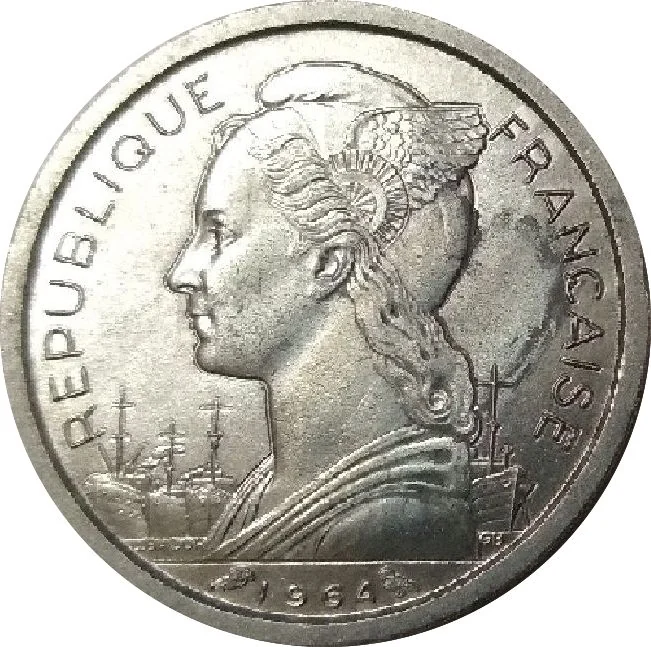
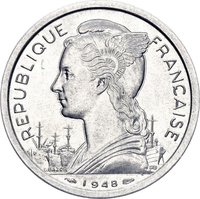
Marianne in winged cap, facing left, with four ships behind and date below.
Inscription:
REPUBLIQUE FRANÇAISE
L.BAZOR GB
1964
L.BAZOR GB
1964
Translation:
FRENCH REPUBLIC
L.BAZOR GB
1964
L.BAZOR GB
1964
Script: Latin
Language: French
Engraver: Lucien Georges Bazor
Reverse
Description:
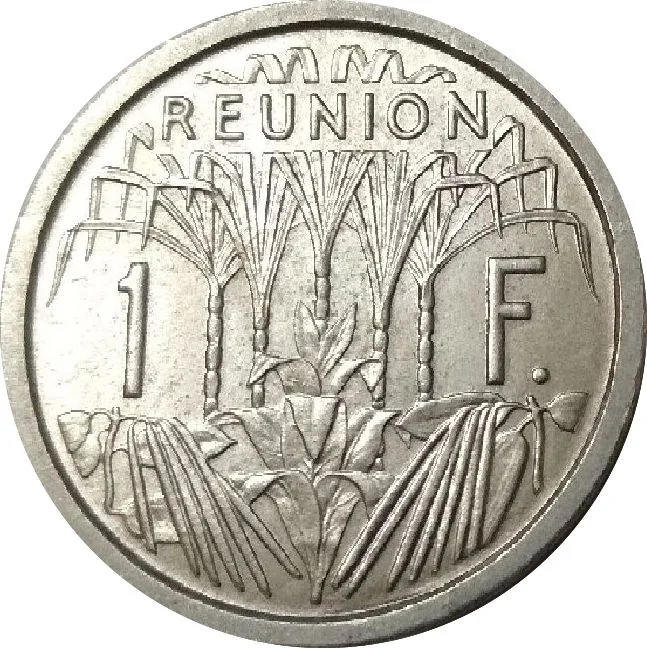
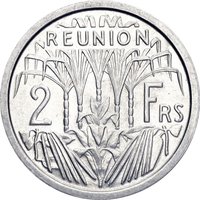
Sugar cane shares issuer name above.
Inscription:
REUNION
1 F.
1 F.
Script: Latin
Engraver: Lucien Georges Bazor
Edge
Plain
Mints
| Name | Mark |
|---|---|
| Monnaie de Paris | — |
Mintings
| Year | Mint Mark | Mintage | Quality | Collection |
|---|---|---|---|---|
| 1948 | — | 3,000,000 | ||
| 1964 | — | 1,000,000 | ||
| 1968 | — | 450,000 | ||
| 1969 | — | 500,000 | ||
| 1971 | — | 800,000 | ||
| 1973 | — | 500,000 |
Historical background
In 1948, the currency situation in Réunion was defined by its status as an overseas department of France, a change formalized just one year prior in 1947. As an integral part of the French Republic, the island operated fully within the French monetary system. The official legal tender was the French Franc (FRF), issued and controlled by the Banque de France, with no local or separate colonial currency. This integration meant that monetary policy, including the supply of money and the fight against postwar inflation, was directed entirely from Paris.
The immediate postwar period was one of significant economic hardship and currency instability, even in the metropole. Réunion, heavily dependent on imports and still recovering from wartime isolation, faced severe shortages and high prices. The franc itself had undergone a major devaluation in late 1945 and was subject to ongoing inflationary pressures. For the population of Réunion, the "currency situation" was therefore less about the type of money used and more about its severe scarcity and declining purchasing power, exacerbating the island's profound social and economic challenges.
Furthermore, 1948 fell within the era of the Franc Zone, a currency bloc that managed exchange controls and facilitated the flow of capital between France and its territories. For Réunion, this guaranteed a fixed and stable parity with the metropolitan franc, ensuring monetary continuity with the mainland. However, this system also tightly bound the island's economy to France's, limiting autonomous financial tools. Thus, while the currency itself was stable in name, the broader economic reality for Réunion in 1948 was one of grappling with the consequences of France's own postwar reconstruction and inflation within a rigidly integrated monetary framework.
The immediate postwar period was one of significant economic hardship and currency instability, even in the metropole. Réunion, heavily dependent on imports and still recovering from wartime isolation, faced severe shortages and high prices. The franc itself had undergone a major devaluation in late 1945 and was subject to ongoing inflationary pressures. For the population of Réunion, the "currency situation" was therefore less about the type of money used and more about its severe scarcity and declining purchasing power, exacerbating the island's profound social and economic challenges.
Furthermore, 1948 fell within the era of the Franc Zone, a currency bloc that managed exchange controls and facilitated the flow of capital between France and its territories. For Réunion, this guaranteed a fixed and stable parity with the metropolitan franc, ensuring monetary continuity with the mainland. However, this system also tightly bound the island's economy to France's, limiting autonomous financial tools. Thus, while the currency itself was stable in name, the broader economic reality for Réunion in 1948 was one of grappling with the consequences of France's own postwar reconstruction and inflation within a rigidly integrated monetary framework.
🌱 Very Common