

Obverse
Description:
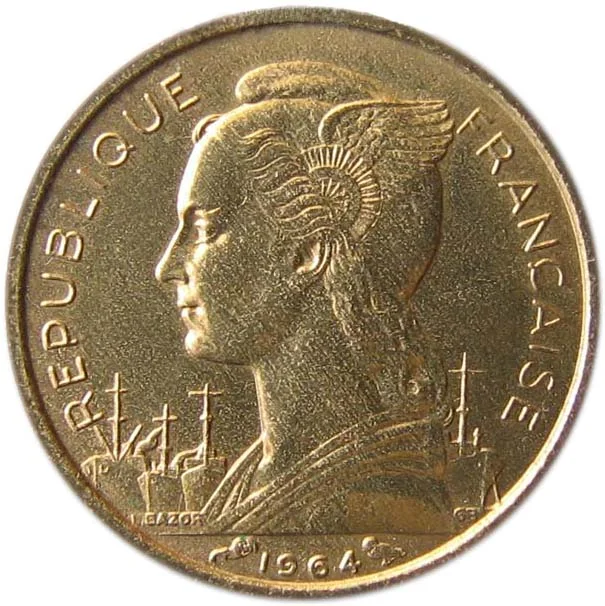
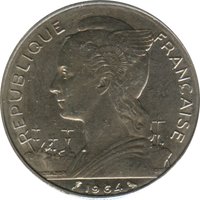
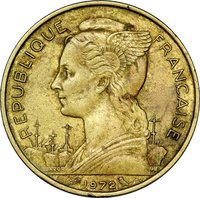
Marianne faces left in a winged Phrygian cap, with four ships behind her and the date below.
Inscription:
REPUBLIQUE FRANÇAISE
L.BAZOR GB
1964
L.BAZOR GB
1964
Translation:
FRENCH REPUBLIC
L.BAZOR GB
1964
L.BAZOR GB
1964
Script: Latin
Language: French
Engraver: Lucien Georges Bazor
Reverse
Description:
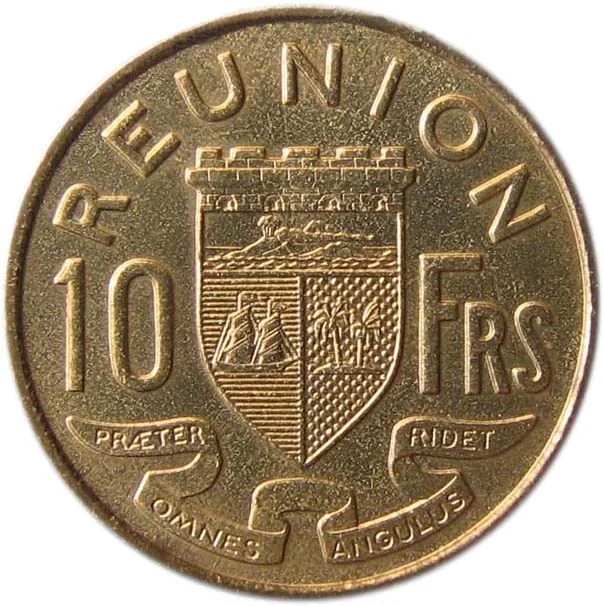
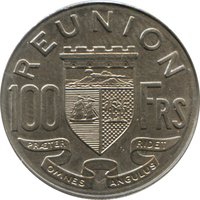
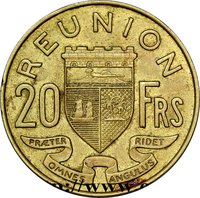
Shield of Saint-Denis divides value, motto "PRAETER OMNES ANGULUS RIDET" on ribbon below.
Inscription:
REUNION
10 FRS
PRAETER OMNES ANGULUS RIDET
10 FRS
PRAETER OMNES ANGULUS RIDET
Script: Latin
Engraver: Lucien Georges Bazor
Edge
Plain
Categories
| Transportation> Watercraft |
Mints
| Name | Mark |
|---|---|
| Monnaie de Paris | — |
Mintings
| Year | Mint Mark | Mintage | Quality | Collection |
|---|---|---|---|---|
| 1969 | — | 300,000 | ||
| 1970 | — | 300,000 | ||
| 1971 | — | 200,000 | ||
| 1972 | — | 400,000 | ||
| 1973 | — | 700,000 |
Historical background
In 1969, Réunion's currency situation was firmly integrated within the French monetary system. As an overseas department (département d'outre-mer) of France since 1946, the island did not have an independent currency. The legal tender was the French franc (FRF), issued and controlled by the Banque de France. This meant Réunion had no central bank or monetary policy of its own; its financial conditions were directly dictated by economic developments and decisions made in metropolitan France.
Economically, this integration presented both stability and challenges. The use of the franc provided price stability, eliminated exchange rate risk with the mainland, and facilitated trade and subsidy flows crucial to the island's economy, which was heavily dependent on sugar exports and French public spending. However, it also meant Réunion had no ability to devalue its currency to boost competitiveness or to set interest rates tailored to its local economic needs, which often differed significantly from those of Europe. The island's economy was characterized by a high cost of living, structural trade deficits, and reliance on imports.
Therefore, the "currency situation" in 1969 was essentially one of absence—the absence of a local currency. The financial landscape was defined by the operations of French commercial banks and the public Treasury, managing franc-denominated transactions. This period solidified the framework that would remain until the adoption of the euro in 1999, embedding Réunion ever deeper into France's financial and economic orbit.
Economically, this integration presented both stability and challenges. The use of the franc provided price stability, eliminated exchange rate risk with the mainland, and facilitated trade and subsidy flows crucial to the island's economy, which was heavily dependent on sugar exports and French public spending. However, it also meant Réunion had no ability to devalue its currency to boost competitiveness or to set interest rates tailored to its local economic needs, which often differed significantly from those of Europe. The island's economy was characterized by a high cost of living, structural trade deficits, and reliance on imports.
Therefore, the "currency situation" in 1969 was essentially one of absence—the absence of a local currency. The financial landscape was defined by the operations of French commercial banks and the public Treasury, managing franc-denominated transactions. This period solidified the framework that would remain until the adoption of the euro in 1999, embedding Réunion ever deeper into France's financial and economic orbit.
🌱 Fairly Common