

1 Franc – Monaco
Monaco
Context
Years: 1960–1995
Issuer: Monaco 
Ruler: Rainier III
Currency:
(1960—2001)
Demonetized: Yes
Total mintage: 2,896,500
Material
References
KM: #Click to copy to clipboard140
Numista: #806
Value
Exchange value: 1 MCF
Obverse
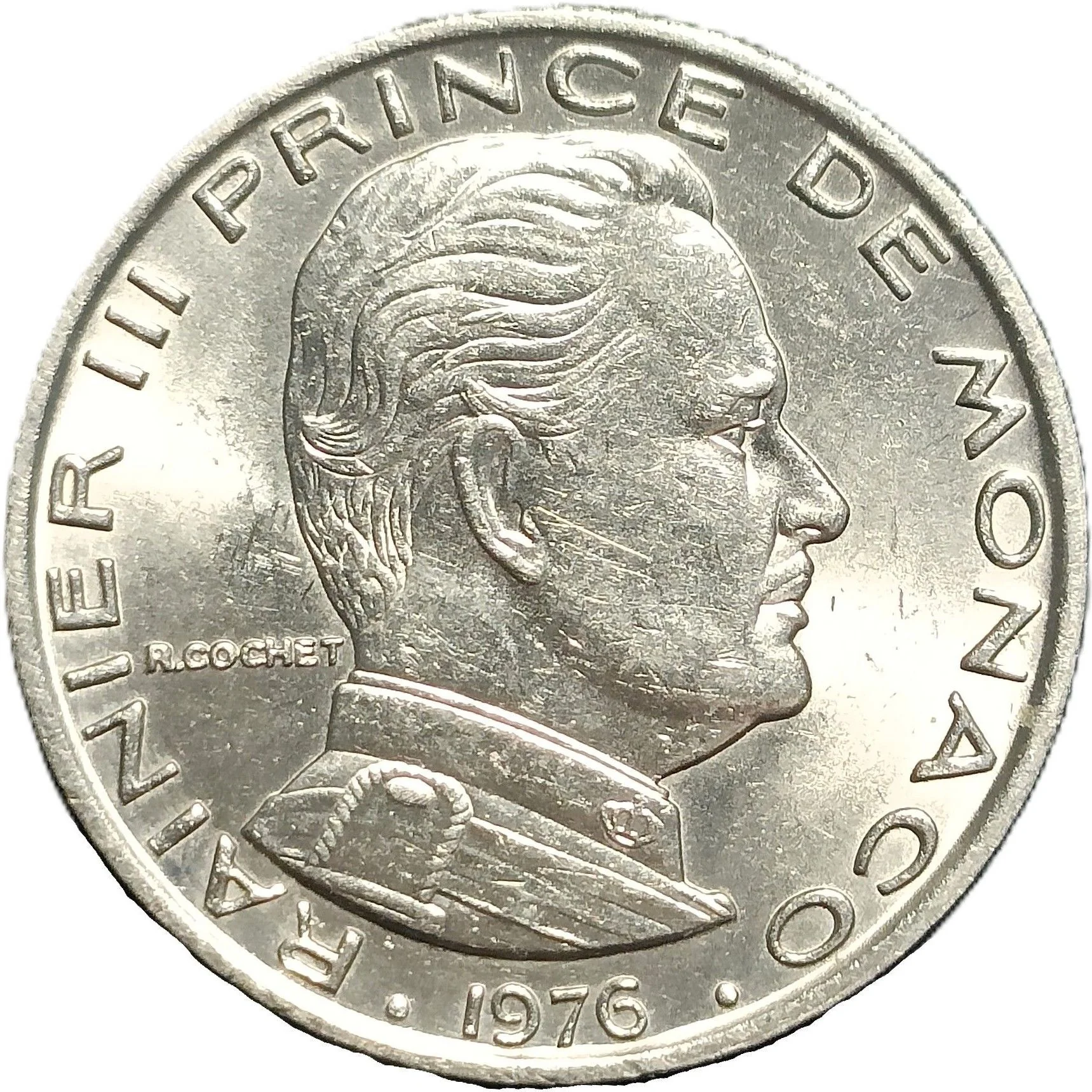
Description:
Portrait of Rainier III, facing right.
Inscription:
RAINIER III PRINCE DE MONACO
R.COCHET
· 1974 ·
R.COCHET
· 1974 ·
Translation:
Rainier III Prince of Monaco
R.Cochet
· 1974 ·
R.Cochet
· 1974 ·
Script: Latin
Language: French
Engraver: Robert Cochet
Reverse
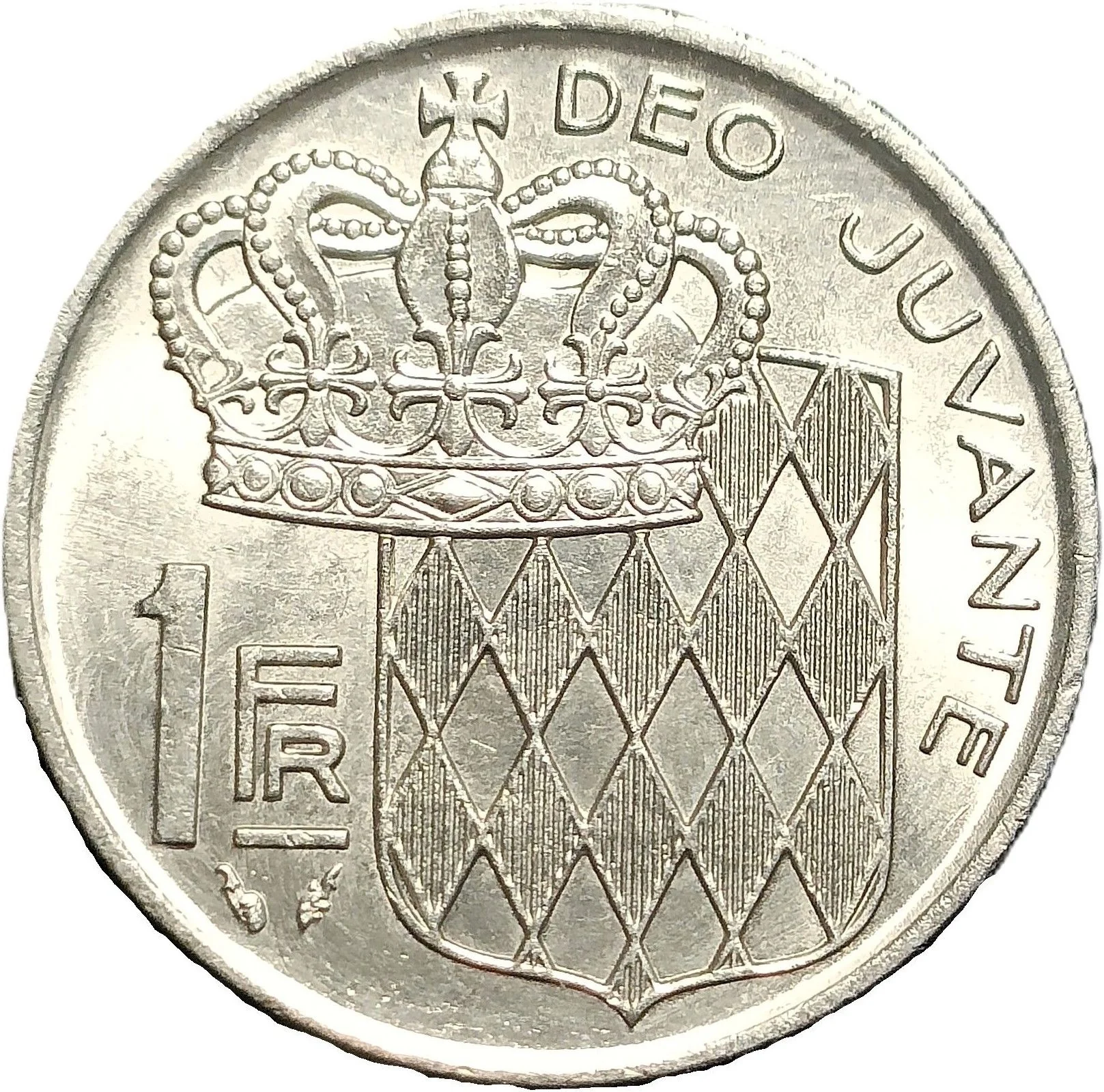
Description:
Crown & Crest
Inscription:
DEO JUVANTE
1 FR
1 FR
Translation:
With God's Help
Francis I
Francis I
Script: Latin
Language: Latin
Engraver: Robert Cochet
Edge
Reeded
Mints
| Name | Mark |
|---|---|
| Monnaie de Paris | — |
Mintings
| Year | Mint Mark | Mintage | Quality | Collection |
|---|---|---|---|---|
| 1960 | — | 500,000 | ||
| 1966 | — | 175,000 | ||
| 1968 | — | 250,000 | ||
| 1974 | — | 187,500 | ||
| 1975 | — | 187,500 | ||
| 1976 | — | 187,500 | ||
| 1977 | — | 188,000 | ||
| 1978 | — | 283,000 | ||
| 1979 | — | 283,000 | ||
| 1982 | — | 525,000 | ||
| 1986 | — | 50,000 | ||
| 1989 | — | 50,000 | ||
| 1995 | — | 30,000 | In sets |
Historical background
In 1960, Monaco's currency situation was intrinsically linked to that of France, operating under a formal monetary union established by treaty. The principality did not issue its own independent currency for general circulation. Instead, the legal tender was the French Franc, and the monetary policy was entirely dictated by the Banque de France. This arrangement was a cornerstone of the broader economic and customs union between the two states, which granted Monaco the use of the French Franc in exchange for conforming to French financial regulations and ceding rights to coin money.
However, Monaco retained the limited, symbolic right to issue its own coinage. These Monegasque francs, minted in limited quantities, were legal tender within the principality and had a fixed 1:1 parity with the French Franc. They featured the effigy of Prince Rainier III and national symbols but were primarily intended for collectors and ceremonial purposes rather than day-to-day commerce, where French banknotes and coins dominated. This coinage served as an important marker of national sovereignty within the strict confines of the monetary union.
The year 1960 fell within a period of relative monetary stability for the Franc zone, preceding the economic turbulence of the late 1960s. For Monaco, this arrangement provided immense economic stability and seamless financial integration with its much larger neighbor, which was essential for its growing banking and tourism sectors. The system functioned smoothly, requiring no significant monetary policy decisions from the Monegasque government, as its fiscal prosperity was securely anchored to the French economy and its currency.
However, Monaco retained the limited, symbolic right to issue its own coinage. These Monegasque francs, minted in limited quantities, were legal tender within the principality and had a fixed 1:1 parity with the French Franc. They featured the effigy of Prince Rainier III and national symbols but were primarily intended for collectors and ceremonial purposes rather than day-to-day commerce, where French banknotes and coins dominated. This coinage served as an important marker of national sovereignty within the strict confines of the monetary union.
The year 1960 fell within a period of relative monetary stability for the Franc zone, preceding the economic turbulence of the late 1960s. For Monaco, this arrangement provided immense economic stability and seamless financial integration with its much larger neighbor, which was essential for its growing banking and tourism sectors. The system functioned smoothly, requiring no significant monetary policy decisions from the Monegasque government, as its fiscal prosperity was securely anchored to the French economy and its currency.
🌱 Very Common