

100 francs – Monaco
Add to wishlist
Monaco
Context
Year: 1956
Issuer: Monaco
Ruler: Rainier III
Currency:
(1837—1960)
Demonetized: Yes
Total mintage: 500,000
Material
Diameter: 24 mm
Weight: 6 g
Thickness: 1.8 mm
Shape: Round
Composition: Copper-nickel
Technique: Milled
Alignment: Coin alignment
flip
References
KM: #
Numista: #5132
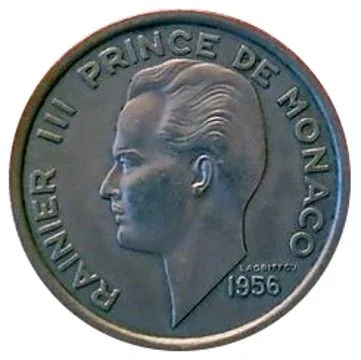
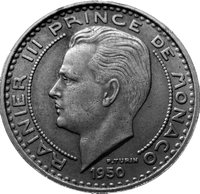
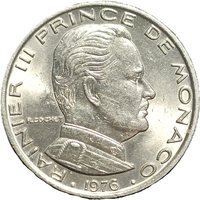
Obverse
Description:
Turn left.
Inscription:
RAINIER III PRINCE DE MONACO
LAGRIFFOUL
1956
LAGRIFFOUL
1956
Script: Latin
Engraver: Henri Lagriffoul
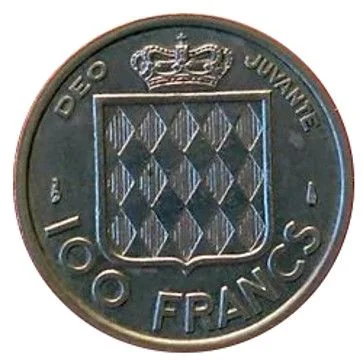
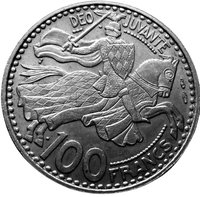
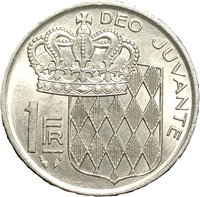
Reverse
Description:
Crowned shield's base.
Inscription:
DEO JUVANTE
100 FRANCS
100 FRANCS
Script: Latin
Engraver: Henri Lagriffoul
Edge
Reeded
Mints
| Name | Mark |
|---|---|
| Monnaie de Paris | — |
Mintings
| Year | Mint Mark | Mintage | Quality | Collection |
|---|---|---|---|---|
| 1956 | — | 500,000 |
Historical background
In 1956, Monaco's currency situation was intrinsically linked to that of France, operating under the provisions of the 1865 Latin Monetary Union and subsequent bilateral agreements. The principality, while politically sovereign, did not issue its own independent circulating currency. Instead, it used the French franc as its official legal tender, a relationship formalized in a 1945 monetary convention that placed Monaco within the French franc zone. This meant French coins and banknotes circulated freely, and Monegasque authorities had limited rights to mint their own coinage, which was strictly denominated in francs and centimes and pegged 1:1 with the French currency.
However, Monaco did exercise a symbolic and economically beneficial prerogative: the right to strike its own distinct, low-denomination coinage. These Monegasque francs, featuring the effigy of Prince Rainier III, who had ascended in 1949, were legal tender within the principality and, by agreement, also in France. This coinage served as an important marker of national identity and provided the state with seigniorage revenue—the profit made from issuing currency. In practice, the system was one of a de facto currency board, where the Monegasque franc was fully backed by and interchangeable with its French counterpart.
The year 1956 itself was significant, as it was the year of Prince Rainier's marriage to Grace Kelly, an event that focused global attention on the principality. Economically, the period was one of stability and growth, with the currency arrangement providing a secure financial foundation for Monaco's burgeoning tourism and development. The stable peg to the French franc facilitated commerce and investment, shielding Monaco from exchange rate volatility. This seamless monetary integration would remain a cornerstone of Monegasque economic policy until the eventual adoption of the Euro by both France and Monaco decades later.
However, Monaco did exercise a symbolic and economically beneficial prerogative: the right to strike its own distinct, low-denomination coinage. These Monegasque francs, featuring the effigy of Prince Rainier III, who had ascended in 1949, were legal tender within the principality and, by agreement, also in France. This coinage served as an important marker of national identity and provided the state with seigniorage revenue—the profit made from issuing currency. In practice, the system was one of a de facto currency board, where the Monegasque franc was fully backed by and interchangeable with its French counterpart.
The year 1956 itself was significant, as it was the year of Prince Rainier's marriage to Grace Kelly, an event that focused global attention on the principality. Economically, the period was one of stability and growth, with the currency arrangement providing a secure financial foundation for Monaco's burgeoning tourism and development. The stable peg to the French franc facilitated commerce and investment, shielding Monaco from exchange rate volatility. This seamless monetary integration would remain a cornerstone of Monegasque economic policy until the eventual adoption of the Euro by both France and Monaco decades later.
🌱 Very Common