

100 francs – France
Add to wishlist
France
Obverse
Description:
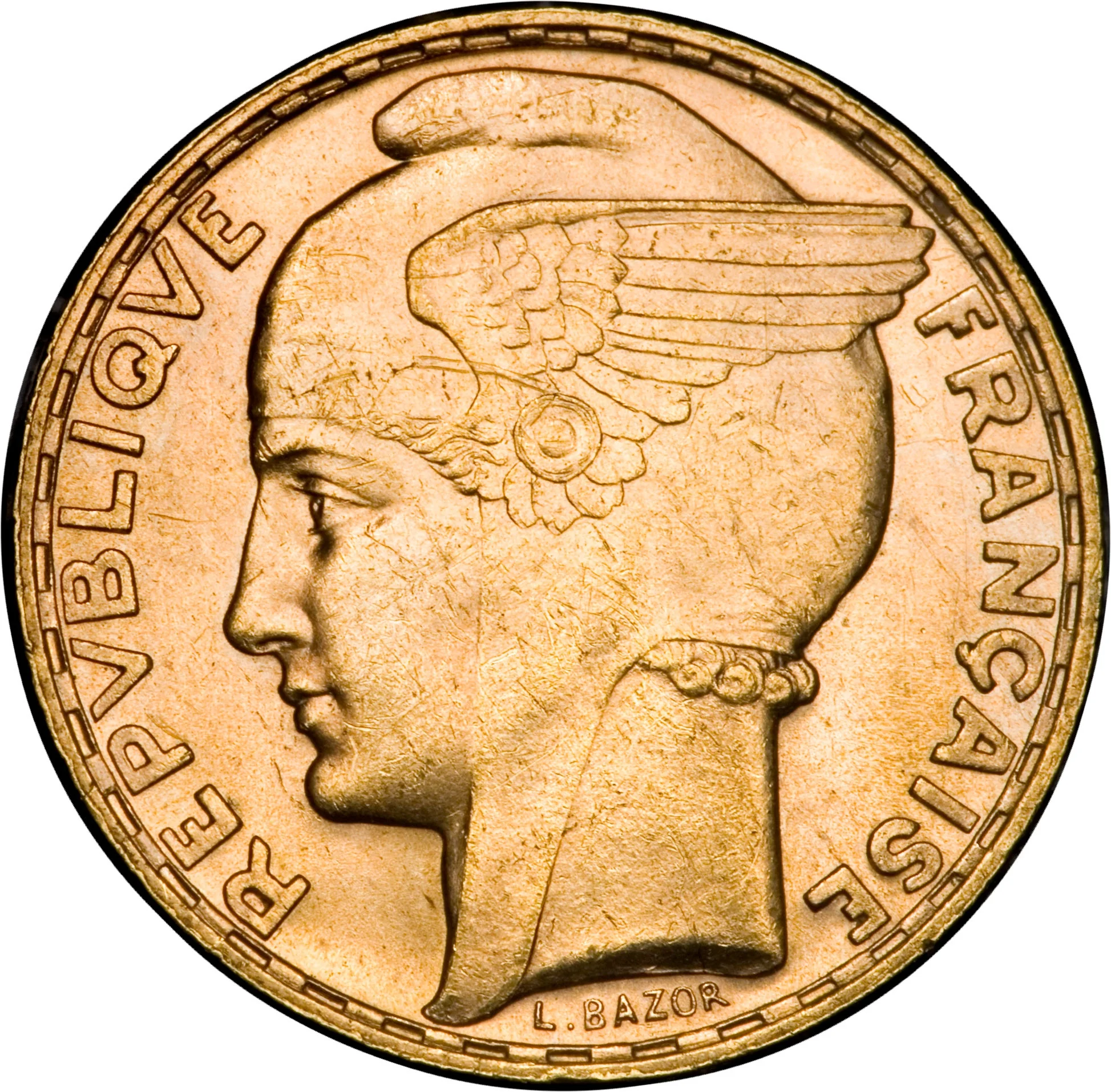
Liberty wearing a winged, cockade-adorned Phrygian cap; signed L. BAZOR.
Inscription:
REPVBLIQUE FRANÇAISE
L. BAZOR
L. BAZOR
Translation:
FRENCH REPUBLIC
L. BAZOR
L. BAZOR
Script: Latin
Language: French
Engraver: Lucien Georges Bazor
Reverse
Description:
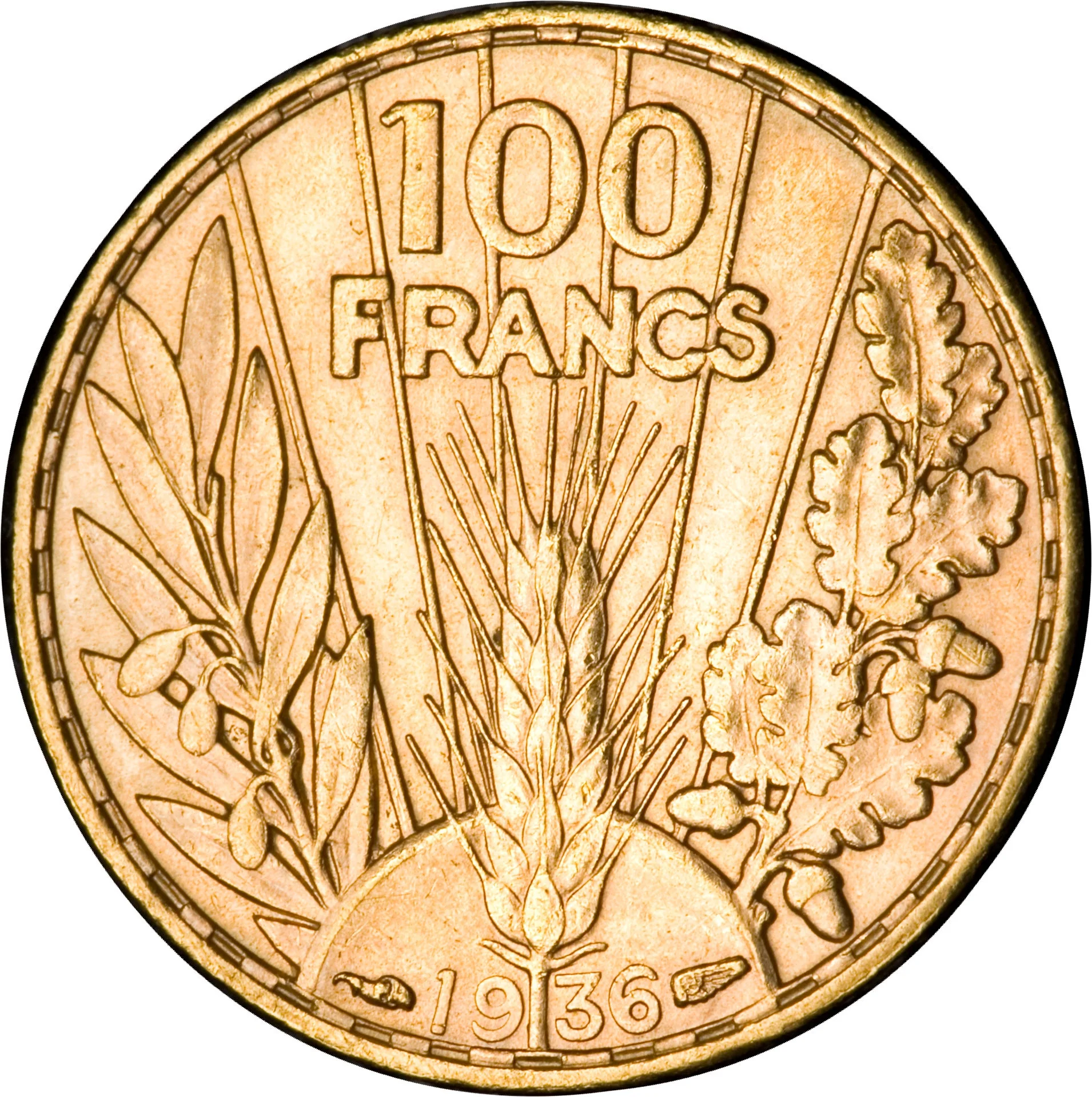
A globe with an ear of corn, an olive branch, and an oak branch; 1935 below.
Inscription:
100
FRANCS
19 36
FRANCS
19 36
Script: Latin
Engraver: Lucien Georges Bazor
Edge
Embossed inscription
Legend:
**LIBERTE * ÉGALITÉ *FRATERNITÉ
Translation:
LIBERTY * EQUALITY * FRATERNITY
Language: French
Mints
| Name | Mark |
|---|---|
| Monnaie de Paris | — |
Mintings
| Year | Mint Mark | Mintage | Quality | Collection |
|---|---|---|---|---|
| 1929 | — | — | ||
| 1932 | — | 50 | ||
| 1933 | — | 300 | ||
| 1934 | — | 10 | ||
| 1935 | — | — | ||
| 1936 | — | 7,688,641 |
Historical background
In 1929, France presented a stark contrast to many of its contemporaries, particularly the United States and Germany, as it entered the year with a currency perceived as strong and an economy seemingly stable. This was largely the legacy of the Poincaré franc, established in 1928 after a severe crisis earlier in the decade. Premier Raymond Poincaré had overseen a drastic devaluation and re-pegging of the franc, defining a new franc worth 20% of its pre-1914 gold value. This "Franc Germinal" was backed by a legally established gold standard, which restored confidence, attracted significant gold inflows, and gave France a substantial gold reserve.
However, this strength was built on a fragile and somewhat paradoxical foundation. The franc was deliberately undervalued in 1928, making French exports cheap and contributing to a persistent trade surplus. This, combined with high interest rates, drew in foreign capital and gold, but at the cost of stifling domestic investment and consumption. The economy remained structurally rigid, with a large, inefficient agricultural sector and protected industries. While the Wall Street Crash of October 1929 did not immediately devastate France as it did the US, the nation was highly vulnerable to the coming collapse in global trade and the chain reaction of financial crises.
Consequently, France initially experienced the Great Depression with a delay, entering what was termed the "years of illusion" (1929-1931). The apparent monetary stability and bulging gold reserves masked underlying economic weaknesses. The overvalued gold-backed franc would soon become a straitjacket, as the government and the Bank of France prioritized maintaining the gold standard over stimulating the economy. This rigid adherence, while the UK abandoned gold in 1931 and the US devalued in 1933, would ultimately isolate France, prolong its depression, and lead to severe deflation and political instability later in the 1930s.
However, this strength was built on a fragile and somewhat paradoxical foundation. The franc was deliberately undervalued in 1928, making French exports cheap and contributing to a persistent trade surplus. This, combined with high interest rates, drew in foreign capital and gold, but at the cost of stifling domestic investment and consumption. The economy remained structurally rigid, with a large, inefficient agricultural sector and protected industries. While the Wall Street Crash of October 1929 did not immediately devastate France as it did the US, the nation was highly vulnerable to the coming collapse in global trade and the chain reaction of financial crises.
Consequently, France initially experienced the Great Depression with a delay, entering what was termed the "years of illusion" (1929-1931). The apparent monetary stability and bulging gold reserves masked underlying economic weaknesses. The overvalued gold-backed franc would soon become a straitjacket, as the government and the Bank of France prioritized maintaining the gold standard over stimulating the economy. This rigid adherence, while the UK abandoned gold in 1931 and the US devalued in 1933, would ultimately isolate France, prolong its depression, and lead to severe deflation and political instability later in the 1930s.
💎 Very Rare