

10 francs – Monaco
Add to wishlist
Monaco
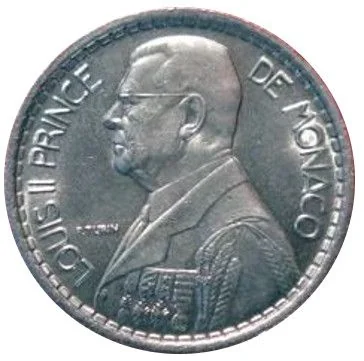
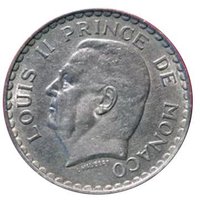
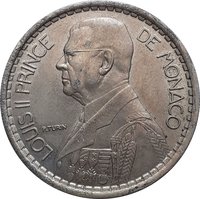
Obverse
Description:
Louis II, right-facing bust
Inscription:
LOUIS II PRINCE DE MONACO
P. TURIN
P. TURIN
Translation:
Louis II Prince of Monaco
P. Turin
P. Turin
Script: Latin
Language: French
Engraver: Pierre Turin
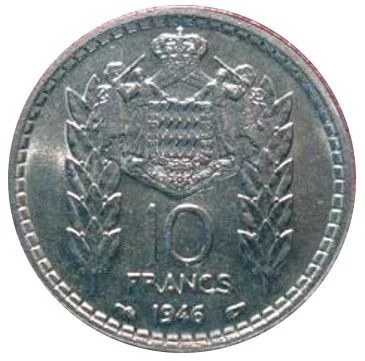
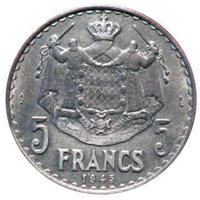
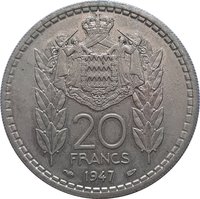
Reverse
Description:
"Latin motto."
Inscription:
10
FRANCS
1946
FRANCS
1946
Translation:
10 Francs
1946
1946
Script: Latin
Language: French
Engraver: Pierre Turin
Edge
Reeded
Categories
| Symbols> Coat of Arms |
Mints
| Name | Mark |
|---|---|
| Monnaie de Paris | — |
Mintings
| Year | Mint Mark | Mintage | Quality | Collection |
|---|---|---|---|---|
| 1946 | — | 1,000,000 |
Historical background
In 1946, Monaco's currency situation was directly tied to its complex political and economic relationship with France, a connection solidified by the 1918 Franco-Monégasque Treaty. This treaty, born from Monaco's precarious position post-World War I, made French currency the official legal tender of the Principality. Consequently, the Monégasque franc was pegged at par with the French franc, and Monaco effectively operated within France's monetary zone, with its currency supply and policy dictated by the French central bank.
The immediate post-World War II period presented severe challenges, as France itself was grappling with rampant inflation and a deeply devalued franc due to wartime destruction, occupation costs, and a large public debt. Monaco, despite its neutrality during the war, was not insulated from these economic shocks. The Principality's economy, heavily reliant on tourism and the casino, was stagnant, and the weak purchasing power of the franc directly impacted daily life and recovery efforts. There were no independent Monégasque monetary instruments; the currency in circulation was French, and any adjustments were contingent upon decisions made in Paris.
Therefore, the currency "situation" in 1946 was one of passive dependence. Monaco had no scope for autonomous monetary policy to stimulate its own economy or control inflation. Its financial fate was intrinsically linked to France's struggle to stabilize and reform its own currency, a process that would culminate in major reforms, including a significant devaluation and the introduction of a new franc (the "franc lourd") in the late 1950s. For Monaco in 1946, the primary economic concerns were navigating the hardships of the weak franc and rebuilding its tourist-based economy within the constraints of a monetary system it did not control.
The immediate post-World War II period presented severe challenges, as France itself was grappling with rampant inflation and a deeply devalued franc due to wartime destruction, occupation costs, and a large public debt. Monaco, despite its neutrality during the war, was not insulated from these economic shocks. The Principality's economy, heavily reliant on tourism and the casino, was stagnant, and the weak purchasing power of the franc directly impacted daily life and recovery efforts. There were no independent Monégasque monetary instruments; the currency in circulation was French, and any adjustments were contingent upon decisions made in Paris.
Therefore, the currency "situation" in 1946 was one of passive dependence. Monaco had no scope for autonomous monetary policy to stimulate its own economy or control inflation. Its financial fate was intrinsically linked to France's struggle to stabilize and reform its own currency, a process that would culminate in major reforms, including a significant devaluation and the introduction of a new franc (the "franc lourd") in the late 1950s. For Monaco in 1946, the primary economic concerns were navigating the hardships of the weak franc and rebuilding its tourist-based economy within the constraints of a monetary system it did not control.
🌱 Very Common