

10 Centimes – Belgian Congo
Context
Year: 1909
Country: Rwanda and Urundi Belgian Congo
Issuer: Belgian Congo
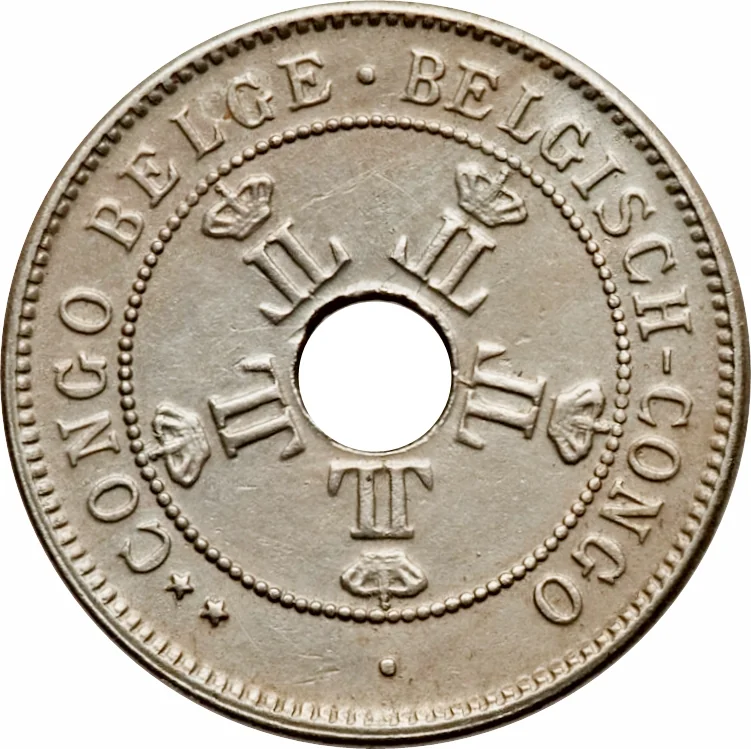
Ruler: Leopold II
Currency:
(1908—1960)
Demonetized: Yes
Material
Diameter: 22 mm
Weight: 4 g
Shape: Round with a round hole
Composition: Copper-nickel
Technique: Milled
Alignment: Coin alignment
flip
References
KM: #Click to copy to clipboard13
Numista: #8022
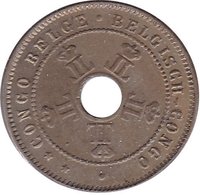
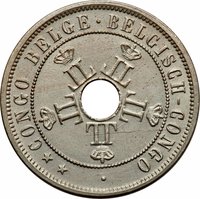
Obverse
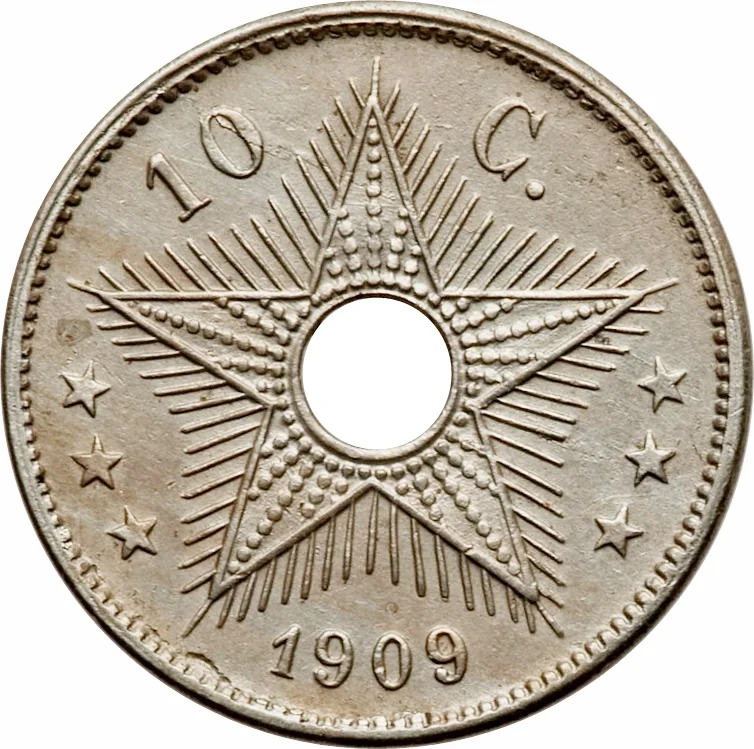
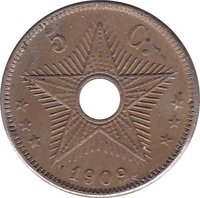
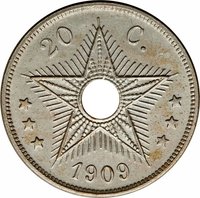
Reverse
Description:
Shining star flanked by three smaller stars on each side.
Inscription:
*** 10 C. ***
1909
1909
Script: Latin
Edge
Plain
Mintings
| Year | Mint Mark | Mintage | Quality | Collection |
|---|---|---|---|---|
| 1909 | — | — |
Historical background
By 1909, the currency situation in the Belgian Congo was a complex and transitional system, still heavily influenced by its early colonial exploitation under King Leopold II’s Congo Free State (1885-1908). The primary official currency was the Congolese franc, which was pegged at par to the Belgian franc and integrated into the Latin Monetary Union. However, this European-style coinage circulated alongside a multitude of other mediums, creating a fragmented monetary landscape. In remote areas and for daily wages, trade was still conducted using traditional commodities like brass rods (mitako) and pieces of cloth (pagnes), which functioned as de facto currency. Furthermore, imported currencies, particularly British shillings from neighboring East Africa, remained in common use, especially in the eastern regions.
This monetary plurality was a direct legacy of the concessionary companies and the brutal rubber-and-ivory economy of the Leopoldian era, which had often paid workers and collected taxes in kind or with low-denomination tokens. The Belgian state, having formally annexed the territory in 1908, inherited this chaotic system and sought to standardize and modernize it as part of its "civilizing mission" and to facilitate deeper economic integration. The year 1909 fell within this early period of administrative reform, where the colonial government was actively promoting the use of its coinage to assert control and simplify taxation and trade.
Consequently, the currency situation in 1909 was one of active flux. While the Congolese franc was the legal tender and the instrument of state finance, large segments of the indigenous economy operated on a parallel system. The colonial administration’s challenge was to displace the established commodity currencies and foreign coins, a process that would take decades and was intrinsically linked to the broader project of imposing a wage-labor economy and expanding the reach of the colonial state into the daily economic life of the Congolese population.
This monetary plurality was a direct legacy of the concessionary companies and the brutal rubber-and-ivory economy of the Leopoldian era, which had often paid workers and collected taxes in kind or with low-denomination tokens. The Belgian state, having formally annexed the territory in 1908, inherited this chaotic system and sought to standardize and modernize it as part of its "civilizing mission" and to facilitate deeper economic integration. The year 1909 fell within this early period of administrative reform, where the colonial government was actively promoting the use of its coinage to assert control and simplify taxation and trade.
Consequently, the currency situation in 1909 was one of active flux. While the Congolese franc was the legal tender and the instrument of state finance, large segments of the indigenous economy operated on a parallel system. The colonial administration’s challenge was to displace the established commodity currencies and foreign coins, a process that would take decades and was intrinsically linked to the broader project of imposing a wage-labor economy and expanding the reach of the colonial state into the daily economic life of the Congolese population.
⭐ Somewhat Rare