

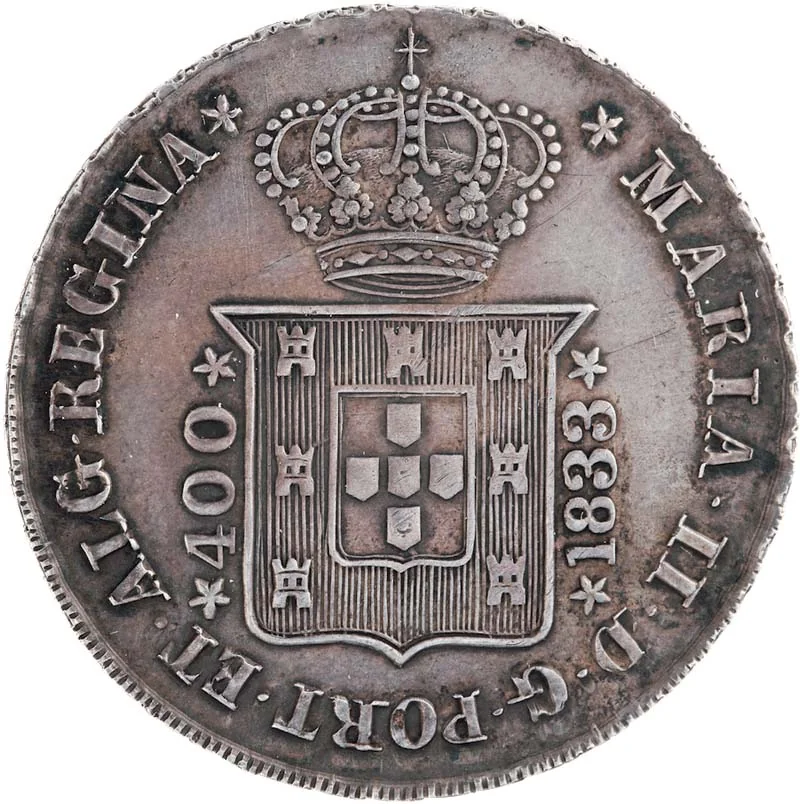
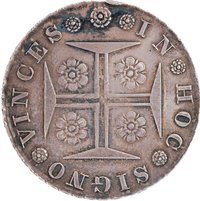
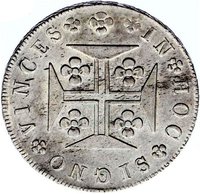
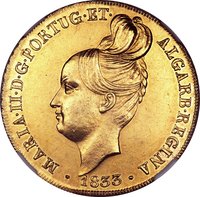
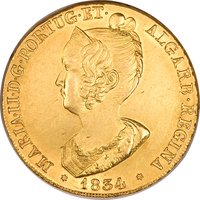
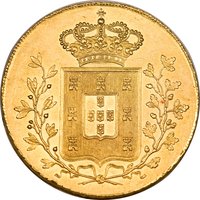
Obverse
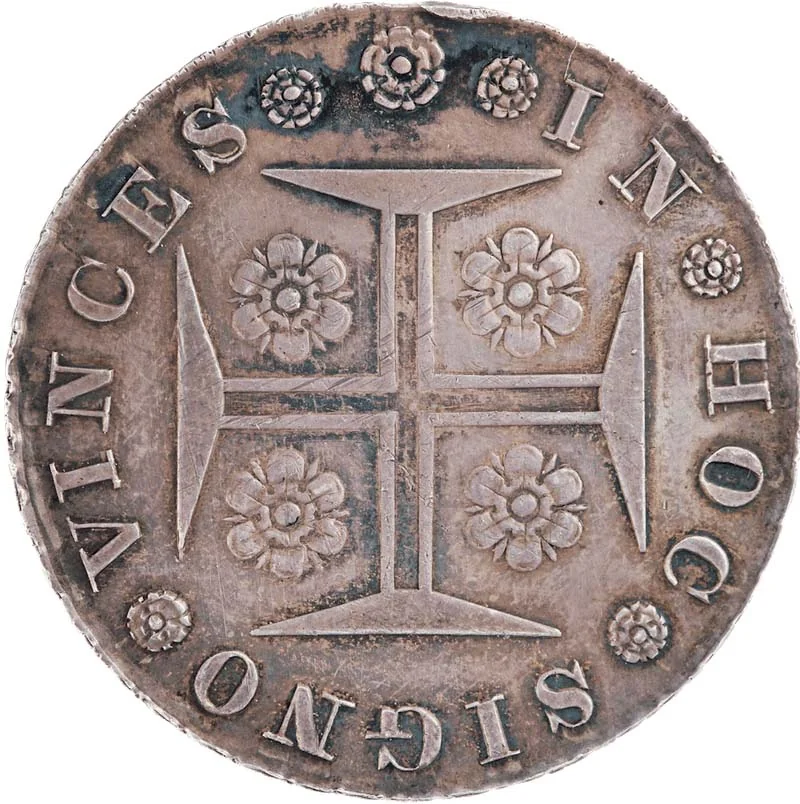
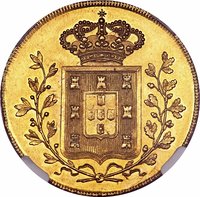
Reverse
Edge
Rope shaped
Mints
| Name | Mark |
|---|---|
| Porto | — |
Mintings
| Year | Mint Mark | Mintage | Quality | Collection |
|---|---|---|---|---|
| 1833 | — | — |
Historical background
In 1833, Portugal was in the throes of the Liberal Wars (1828-1834), a civil war between the liberal constitutionalists, led by Pedro IV (Emperor Pedro I of Brazil), and the absolutist forces of his brother, Miguel I. This conflict had catastrophic effects on the nation's economy and currency. The country was effectively split, with the liberals controlling key Atlantic ports like Porto and the Azores, while the Miguelists held Lisbon and much of the interior. This division shattered the national economy, disrupting trade, tax collection, and the authority of a single monetary issuer, leading to financial chaos.
The currency situation was dire and fragmented. Both regimes issued their own coinage to finance their military campaigns, leading to a parallel circulation of "liberal" and "Miguelist" coins of the same nominal value but fluctuating real worth based on territorial control. Furthermore, the massive cost of the war forced both sides to resort to debasement—reducing the precious metal content in coins—and to printing paper money with little to no backing. The Banco de Lisboa, the country's first bank of issue founded in 1821, saw its paper notes plummet in value due to over-issuance to fund the liberal cause, creating rampant inflation and a severe loss of public confidence in the monetary system.
Consequently, by 1833, Portugal suffered from a severe monetary crisis characterized by a heterogeneous and untrusted mix of depreciated paper, debased coinage from two competing authorities, and a return to primitive barter in some regions. The fundamental problem was not one of a specific currency reform but of a complete absence of unified sovereign authority. The resolution of the currency crisis was therefore intrinsically tied to the outcome of the war itself, awaiting a final military victory to re-establish a single national government capable of imposing monetary order and stability.
The currency situation was dire and fragmented. Both regimes issued their own coinage to finance their military campaigns, leading to a parallel circulation of "liberal" and "Miguelist" coins of the same nominal value but fluctuating real worth based on territorial control. Furthermore, the massive cost of the war forced both sides to resort to debasement—reducing the precious metal content in coins—and to printing paper money with little to no backing. The Banco de Lisboa, the country's first bank of issue founded in 1821, saw its paper notes plummet in value due to over-issuance to fund the liberal cause, creating rampant inflation and a severe loss of public confidence in the monetary system.
Consequently, by 1833, Portugal suffered from a severe monetary crisis characterized by a heterogeneous and untrusted mix of depreciated paper, debased coinage from two competing authorities, and a return to primitive barter in some regions. The fundamental problem was not one of a specific currency reform but of a complete absence of unified sovereign authority. The resolution of the currency crisis was therefore intrinsically tied to the outcome of the war itself, awaiting a final military victory to re-establish a single national government capable of imposing monetary order and stability.
Series: 1833 Portugal circulation coins
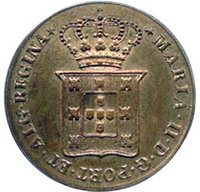
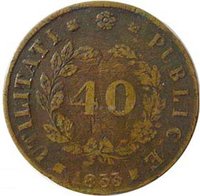
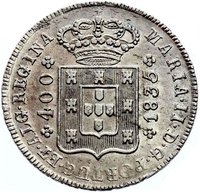
✨ Legendary