

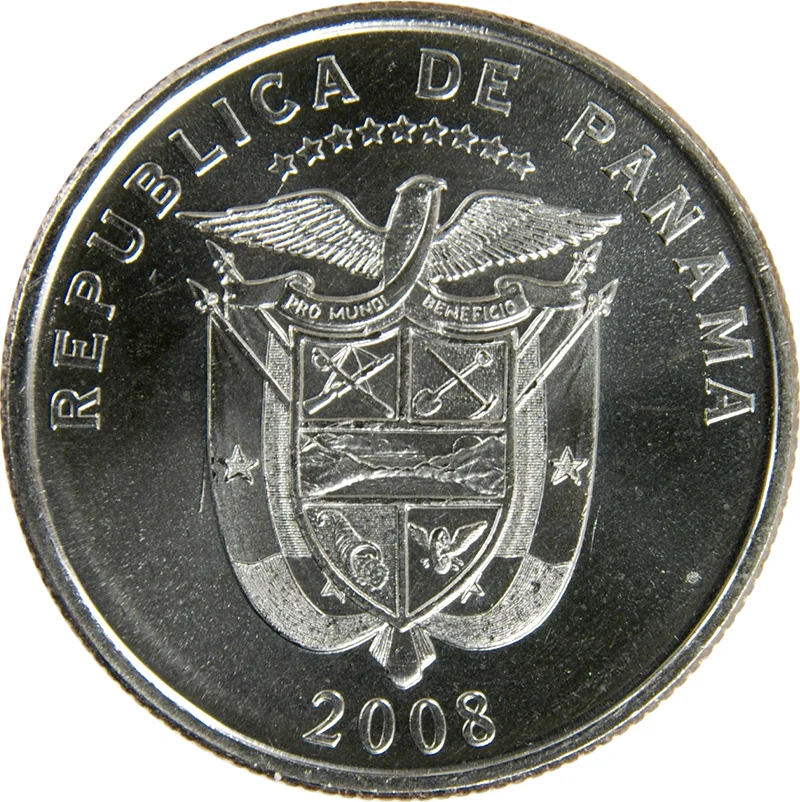
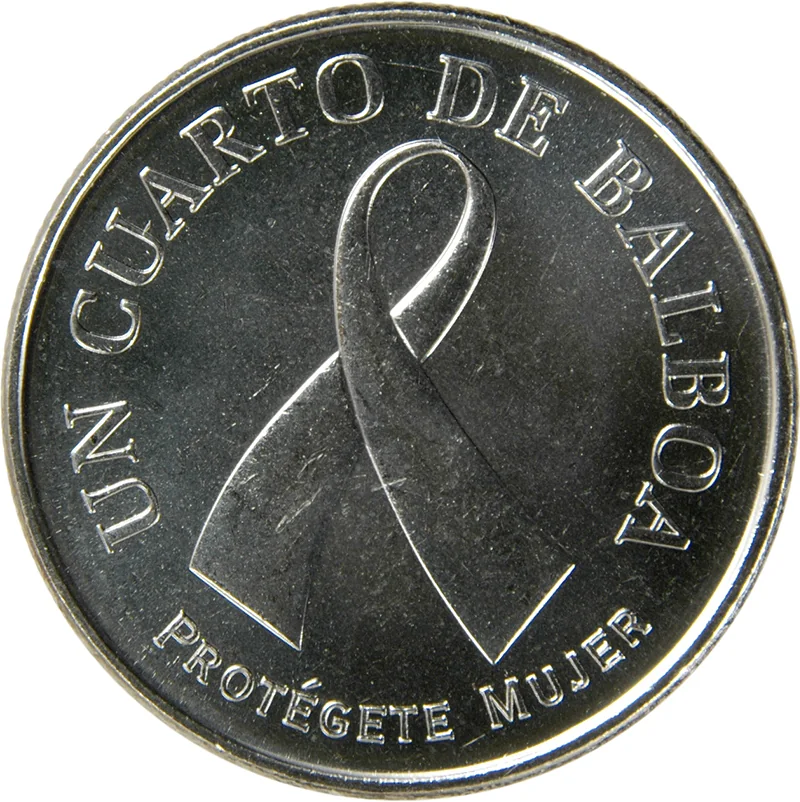
¼ balboa – Panama
Add to wishlist
Circulating commemorative coins
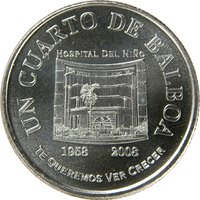
Commemoration: Breast Cancer Awareness
Panama
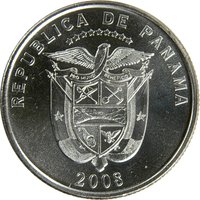
Obverse
Reverse
Edge
Reeded
Categories
| Symbols> Coat of Arms |
| Health |
Mints
| Name | Mark |
|---|---|
| Royal Canadian Mint of Winnipeg | — |
Mintings
| Year | Mint Mark | Mintage | Quality | Collection |
|---|---|---|---|---|
| 2008 | — | 14,000,000 |
Historical background
Panama’s currency situation in 2008 was defined by its unique and long-standing monetary framework, which remained a notable source of stability during the global financial crisis. Unlike other nations in the region, Panama is fully dollarized, having used the US dollar as its official paper currency since 1904. This means there is no independent central bank to set monetary policy or act as a lender of last resort; the US Federal Reserve effectively dictates monetary conditions. Consequently, Panama had no exchange rate risk or need for foreign reserves to defend a local currency, which insulated it from the speculative attacks and devaluations that affected neighboring countries during periods of turmoil.
The year 2008 tested this system as the global crisis tightened US dollar liquidity worldwide. Panama’s economy, heavily reliant on the US-dollar-denominated Panama Canal and a booming banking and services sector, faced a credit crunch as international financing channels froze. While the country did not experience a currency crisis per se, it confronted a liquidity crisis within its banking system. The government addressed this not through monetary policy—which it lacked—but through fiscal measures and by encouraging private banks to utilize lines of credit from international institutions. The National Bank of Panama, a state-owned commercial bank, also played a role in providing liquidity to the financial system.
Despite the severe global shock, Panama’s dollarization proved to be a double-edged sword in 2008. On one hand, it provided undeniable stability, maintaining public and investor confidence and avoiding the inflationary spirals seen elsewhere. On the other hand, it removed crucial policy tools, leaving the economy vulnerable to the Fed’s decisions and external liquidity conditions. Ultimately, the currency regime’s stability, combined with aggressive public investment and the ongoing Canal expansion project, allowed Panama’s economy to recover relatively quickly, posting positive GDP growth by 2009 while many developed economies remained in recession.
The year 2008 tested this system as the global crisis tightened US dollar liquidity worldwide. Panama’s economy, heavily reliant on the US-dollar-denominated Panama Canal and a booming banking and services sector, faced a credit crunch as international financing channels froze. While the country did not experience a currency crisis per se, it confronted a liquidity crisis within its banking system. The government addressed this not through monetary policy—which it lacked—but through fiscal measures and by encouraging private banks to utilize lines of credit from international institutions. The National Bank of Panama, a state-owned commercial bank, also played a role in providing liquidity to the financial system.
Despite the severe global shock, Panama’s dollarization proved to be a double-edged sword in 2008. On one hand, it provided undeniable stability, maintaining public and investor confidence and avoiding the inflationary spirals seen elsewhere. On the other hand, it removed crucial policy tools, leaving the economy vulnerable to the Fed’s decisions and external liquidity conditions. Ultimately, the currency regime’s stability, combined with aggressive public investment and the ongoing Canal expansion project, allowed Panama’s economy to recover relatively quickly, posting positive GDP growth by 2009 while many developed economies remained in recession.
🌱 Very Common