

10 Gulden – Netherlands
Circulating commemorative coins
Commemoration: Jan Steen
Netherlands
Context
Year: 1996
Issuer: Netherlands 
Ruler: Beatrix
Currency:
(1817—2001)
Demonetized: Yes
Total mintage: 1,551,000
Material
References
KM: #Click to copy to clipboard223
Numista: #7964
Value
Exchange value: 10 NLG
Bullion value: $33.94
Inflation-adjusted value: 19.11 NLG
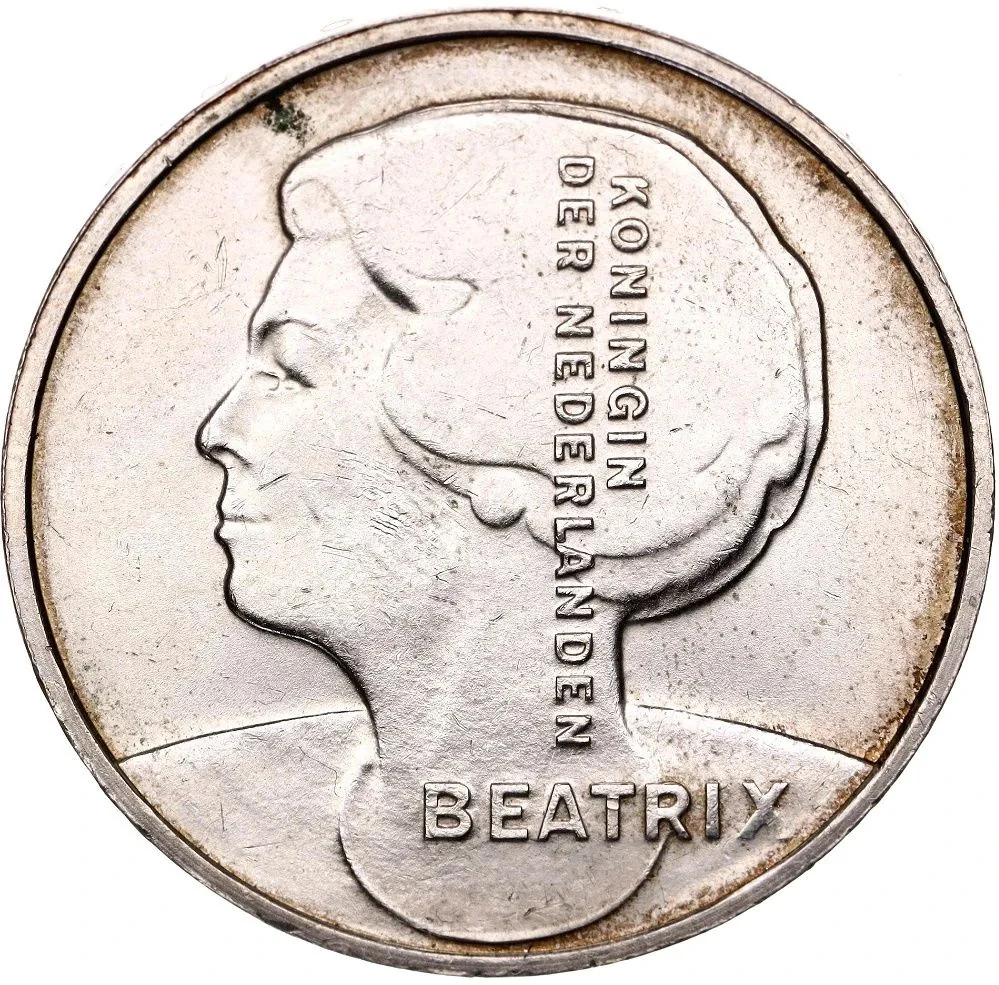
Obverse
Description:
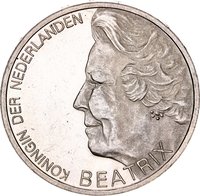
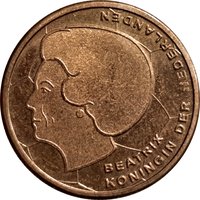
Queen Beatrix bust, left-facing.
Inscription:
BEATRIX KONINGIN DER NEDERLANDEN
Translation:
Beatrix Queen of the Netherlands
Script: Latin
Language: Dutch
Engraver: Eric Claus
Reverse
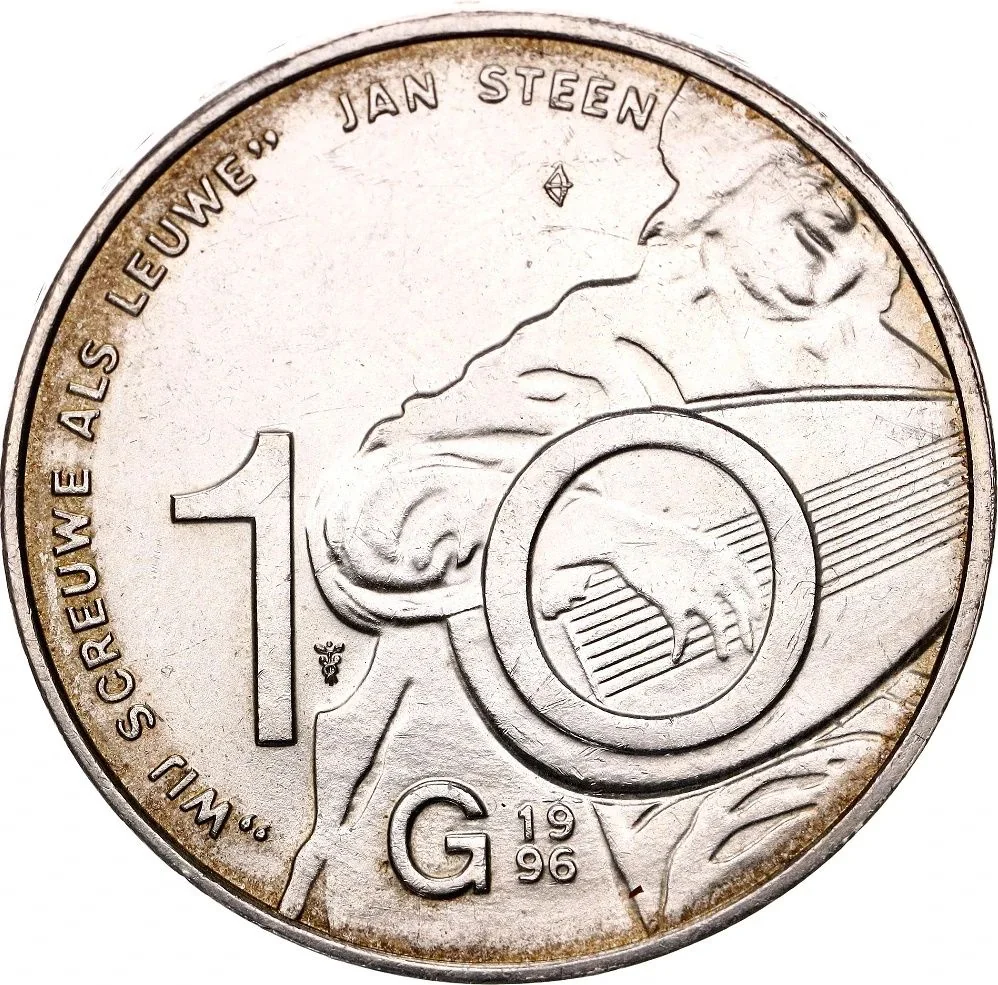
Description:
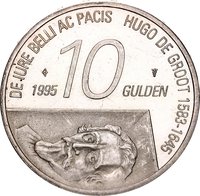
Jan Steen playing the lute.
Inscription:
"WIJ SCREUWE ALS LEUWE"
JAN STEEN
10 G
1996
JAN STEEN
10 G
1996
Translation:
We roar like lions
JAN STEEN
10 G
1996
JAN STEEN
10 G
1996
Script: Latin
Language: Dutch
Engraver: Eric Claus
Edge
Mints
| Name | Mark |
|---|---|
| Royal Dutch Mint | — |
Mintings
| Year | Mint Mark | Mintage | Quality | Collection |
|---|---|---|---|---|
| 1996 | — | 1,526,000 | ||
| 1996 | — | 25,000 | Proof |
Historical background
In 1996, the Netherlands was a core member of the European Union's economic and monetary integration project, operating within the Exchange Rate Mechanism (ERM) of the European Monetary System (EMS). The Dutch guilder, often referred to as the "little dollar" due to its historical stability, was firmly pegged to the Deutsche Mark (DM) at a central rate of 1.12627 guilders per DM. This unwavering peg, maintained since 1983, was a cornerstone of Dutch monetary policy, providing low inflation and interest rates while anchoring the country's economy closely to its largest trading partner, Germany.
The year fell within a crucial period following the 1992-93 ERM crises, which had forced several currencies like the British pound and Italian lira to devalue or exit the mechanism. The guilder, however, had weathered this turbulence without devaluation, reinforcing its reputation as one of Europe's hardest currencies. By 1996, the focus had shifted from defending parities to the final planning stages for Economic and Monetary Union (EMU). The Netherlands was actively preparing for the scheduled 1999 launch of the single currency, the euro, working to meet the strict Maastricht Treaty convergence criteria on inflation, interest rates, budget deficits, and public debt.
Consequently, the domestic currency situation in 1996 was one of remarkable stability and forward-looking transition. The guilder's effective function as a satellite of the Deutsche Mark meant the Dutch central bank largely followed the interest rate policies set by the Bundesbank. Public and political debate was less about the value of the guilder and more focused on the practical and national implications of adopting the euro, ensuring the country would be a founding member of the currency union that would ultimately replace the guilder in 2002.
The year fell within a crucial period following the 1992-93 ERM crises, which had forced several currencies like the British pound and Italian lira to devalue or exit the mechanism. The guilder, however, had weathered this turbulence without devaluation, reinforcing its reputation as one of Europe's hardest currencies. By 1996, the focus had shifted from defending parities to the final planning stages for Economic and Monetary Union (EMU). The Netherlands was actively preparing for the scheduled 1999 launch of the single currency, the euro, working to meet the strict Maastricht Treaty convergence criteria on inflation, interest rates, budget deficits, and public debt.
Consequently, the domestic currency situation in 1996 was one of remarkable stability and forward-looking transition. The guilder's effective function as a satellite of the Deutsche Mark meant the Dutch central bank largely followed the interest rate policies set by the Bundesbank. Public and political debate was less about the value of the guilder and more focused on the practical and national implications of adopting the euro, ensuring the country would be a founding member of the currency union that would ultimately replace the guilder in 2002.
🌱 Fairly Common