

2 Rubles (Violinist D.F. Oistrakh) – Russian Federation
Non-circulating coins
Commemoration: The 100th Anniversary of the Birthday of the Violinist D.F. Oistrakh
Russia
Context
Year: 2008
Country: Russia 
Issuer: Russian Federation
Issuing organization: Central Bank of Russia
Period:
(since 1991)
Currency:
(since 1998)
Total mintage: 5,000
Material
References
Value
Exchange value: 2 RUB
Bullion value: $44.70
Inflation-adjusted value: 8.65 RUB
Obverse
Description:
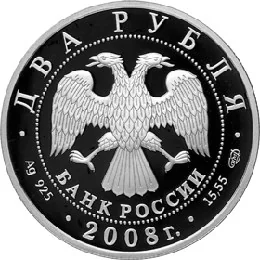
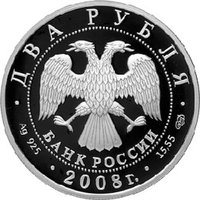
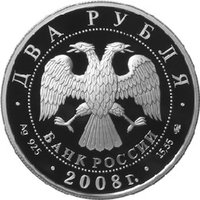
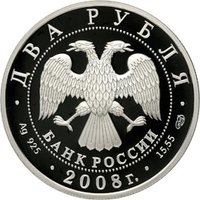
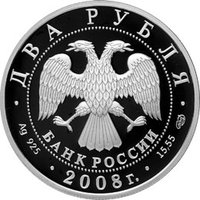
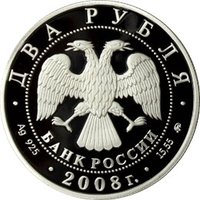
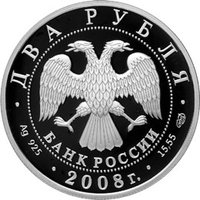
Center: Bank of Russia emblem (two-headed eagle, wings down, with "БАНК РОССИИ" below) within a dotted circle. Rim inscriptions: top - "ДВА РУБЛЯ"; bottom left - metal and fineness; center - "2008 г."; bottom right - metal content and mint mark.
Inscription:
ДВА РУБЛЯ
БАНК РОССИИ
• Ag 925 • 2008 г. • 15,55 СПМД
БАНК РОССИИ
• Ag 925 • 2008 г. • 15,55 СПМД
Translation:
TWO RUBLES
BANK OF RUSSIA
• Ag 925 • 2008 • 15.55 SPMD
BANK OF RUSSIA
• Ag 925 • 2008 • 15.55 SPMD
Script: Cyrillic
Language: Russian
Designer and engraver: Alexander Vasilyevich Baklanov
Reverse
Description:
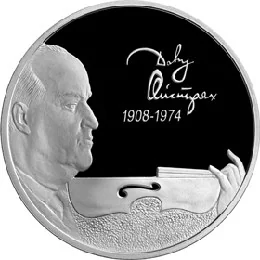
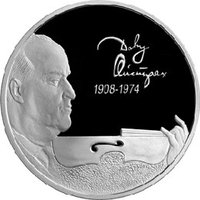
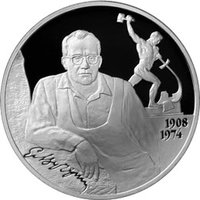
Left: a portrait of David Oistrakh holding a violin. Above, on the mirrored surface, is his facsimile signature "ДАВИД ОЙСТРАХ" and the dates 1908–1974.
Inscription:
Давид
Ойстрах
1908-1974
Ойстрах
1908-1974
Translation:
David
Oistrakh
1908-1974
Oistrakh
1908-1974
Script: Cyrillic (cursive)
Edge
195 corrugations
Categories
| Art> Music |
| Event> Birth anniversary |
Mints
| Name | Mark |
|---|---|
| Saint Petersburg | (СПМД) |
Mintings
| Year | Mint Mark | Mintage | Quality | Collection |
|---|---|---|---|---|
| 2008 | СПМД | 5,000 | Proof |
Historical background
The Russian Federation entered 2008 with a currency situation characterized by significant strength and stability, largely driven by a prolonged boom in global oil and gas prices. The Russian ruble was effectively managed within a crawling peg against a dual-currency basket (55% USD, 45% EUR), allowing for gradual, controlled appreciation. This policy, combined with massive capital inflows, led to a substantial accumulation of foreign exchange reserves, which peaked at nearly $600 billion in mid-2008—the third-largest in the world at the time. This robust position created an atmosphere of confidence, with authorities focused on fighting inflation and reducing the dollarization of the economy.
However, the global financial crisis dramatically reversed this situation in the latter half of the year. As oil prices collapsed from historic highs of over $140 per barrel to around $40 by year's end, and global credit markets froze, Russia faced a perfect storm. Investor confidence evaporated, leading to massive capital flight estimated at $130 billion in the last quarter alone. Intense pressure on the ruble forced the Central Bank of Russia (CBR) to intervene heavily, spending over $200 billion of its reserves in a costly defense of the currency's trading band to prevent a disorderly devaluation and a banking crisis.
By December 2008, the unsustainable drain on reserves compelled the CBR to enact a controlled, stepwise devaluation of the ruble. It gradually widened the trading band for the dual-currency basket 19 times, allowing the ruble to depreciate by approximately 30% against the USD since its summer peak. This move marked a stark end to the era of a strong, managed ruble, transitioning the economy into a period of crisis management, recession, and a new reality of a significantly weaker national currency as 2009 began.
However, the global financial crisis dramatically reversed this situation in the latter half of the year. As oil prices collapsed from historic highs of over $140 per barrel to around $40 by year's end, and global credit markets froze, Russia faced a perfect storm. Investor confidence evaporated, leading to massive capital flight estimated at $130 billion in the last quarter alone. Intense pressure on the ruble forced the Central Bank of Russia (CBR) to intervene heavily, spending over $200 billion of its reserves in a costly defense of the currency's trading band to prevent a disorderly devaluation and a banking crisis.
By December 2008, the unsustainable drain on reserves compelled the CBR to enact a controlled, stepwise devaluation of the ruble. It gradually widened the trading band for the dual-currency basket 19 times, allowing the ruble to depreciate by approximately 30% against the USD since its summer peak. This move marked a stark end to the era of a strong, managed ruble, transitioning the economy into a period of crisis management, recession, and a new reality of a significantly weaker national currency as 2009 began.
✨ Legendary