


Obverse
Description:
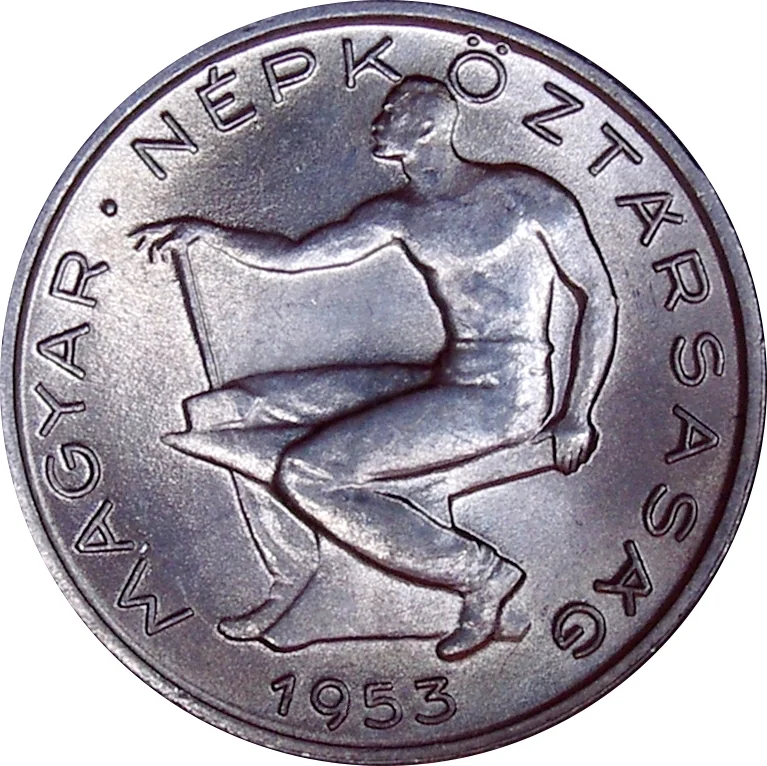
Blacksmith sitting on anvil.
Inscription:
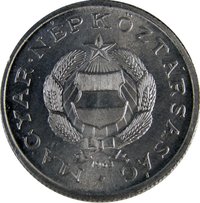
MAGYAR · NÉPKÖZTÁRSASÁG
1953
1953
Translation:
HUNGARIAN PEOPLE'S REPUBLIC
1953
1953
Script: Latin
Language: Hungarian
Designer: József Reményi
Reverse
Description:
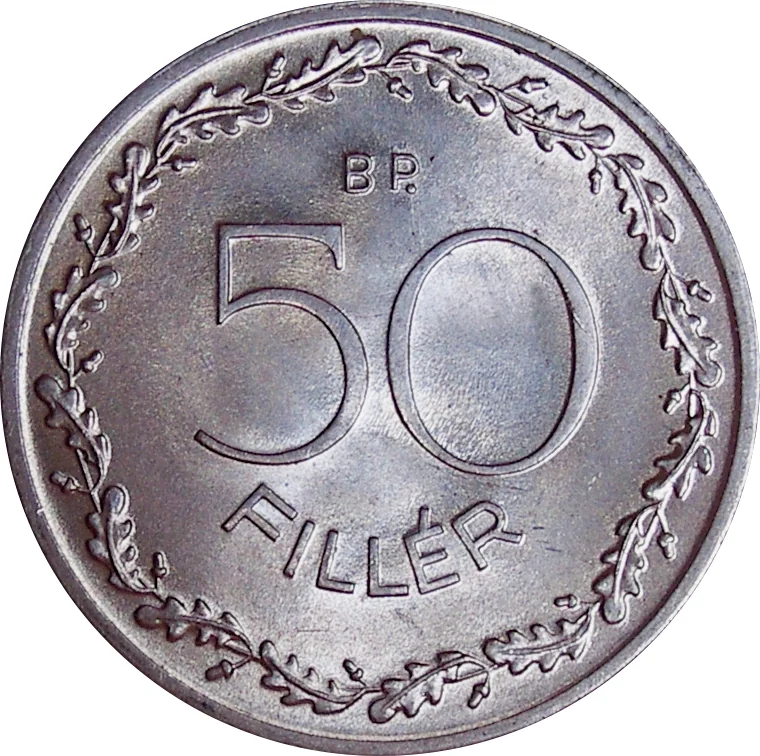
Wreath product group ring
Inscription:
BP.
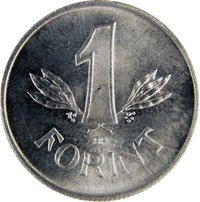
50
FILLÉR
50
FILLÉR
Translation:
Fifty
Fillér
Fillér
Script: Latin
Language: Hungarian
Designer: József Reményi
Edge
Plain
Mints
| Name | Mark |
|---|---|
| Hungarian mint | BP. |
Historical background
In 1953, Hungary's currency situation was a direct reflection of its centrally planned economy under Stalinist rule, tightly controlled by the Hungarian Working People's Party. The official currency, the Forint (HUF), was maintained at an artificially strong and fixed exchange rate by the National Bank of Hungary, divorced from market realities. This overvaluation was used as a tool for economic planning, facilitating the import of key industrial materials and machinery for the state's forced industrialization drive, while severely limiting the availability of consumer goods for the population.
Internally, the currency regime was characterized by severe shortages, repressed inflation, and a growing black market. While prices for basic goods were officially controlled, scarcity meant that citizens often had to turn to illegal traders where the forint's real purchasing power was far lower. This created a dual economic reality: the facade of stability presented by the state and the harsh daily struggle of households. The government's focus on heavy industry and military spending, at the expense of agriculture and light industry, led to chronic underinvestment in consumer sectors, further eroding the forint's practical value and public trust.
The situation in 1953 was at a precarious point, following the death of Stalin and coinciding with Imre Nagy's brief "New Course" premiership, which began in July. Nagy's reforms implicitly acknowledged the currency's dysfunction by promising a shift away from forced industrialization toward more consumer goods and agricultural investment. However, these were early, tentative steps that did not fundamentally alter the rigid monetary system. The underlying economic distortions and the pressure built up within the planned economy would continue to fester, contributing to the profound crisis that culminated in the 1956 Hungarian Revolution.
Internally, the currency regime was characterized by severe shortages, repressed inflation, and a growing black market. While prices for basic goods were officially controlled, scarcity meant that citizens often had to turn to illegal traders where the forint's real purchasing power was far lower. This created a dual economic reality: the facade of stability presented by the state and the harsh daily struggle of households. The government's focus on heavy industry and military spending, at the expense of agriculture and light industry, led to chronic underinvestment in consumer sectors, further eroding the forint's practical value and public trust.
The situation in 1953 was at a precarious point, following the death of Stalin and coinciding with Imre Nagy's brief "New Course" premiership, which began in July. Nagy's reforms implicitly acknowledged the currency's dysfunction by promising a shift away from forced industrialization toward more consumer goods and agricultural investment. However, these were early, tentative steps that did not fundamentally alter the rigid monetary system. The underlying economic distortions and the pressure built up within the planned economy would continue to fester, contributing to the profound crisis that culminated in the 1956 Hungarian Revolution.
🌱 Common