

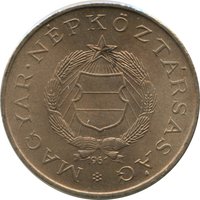
Obverse
Description:
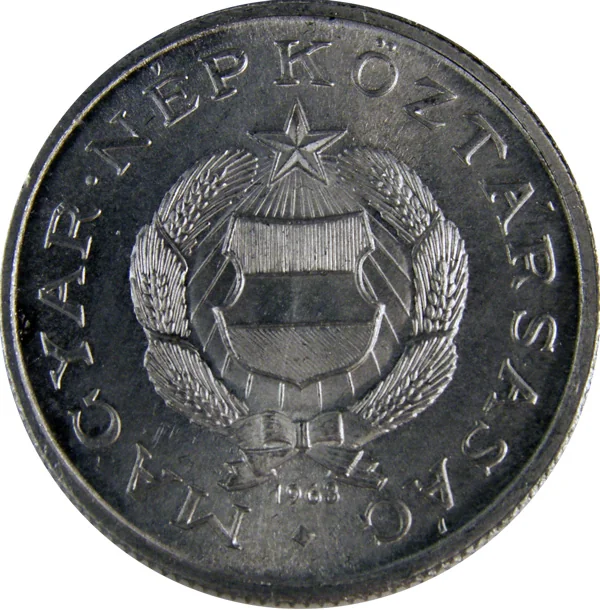
Star above PRC emblem within wreath.
Inscription:
MAGYAR · NÉPKÖZTÁRSASÁG ·
1963
1963
Translation:
HUNGARIAN PEOPLE'S REPUBLIC
1963
1963
Script: Latin
Language: Hungarian
Designer: Iván István
Reverse
Edge
Reeded
Mints
| Name | Mark |
|---|---|
| Hungarian mint | BP. |
Mintings
Historical background
Following the 1956 Revolution, Hungary's currency situation in 1957 was one of severe instability and controlled crisis management under the re-imposed communist government led by János Kádár. The economy was in shambles; production had plummeted, the budget deficit was enormous, and the Hungarian Forint (HUF) suffered from rampant, though partially suppressed, inflation. A significant black market flourished, where the Forint traded at a fraction of its official, state-mandated exchange rate, reflecting a profound lack of public confidence in both the currency and the regime.
The government's primary response was not a currency reform but a harsh austerity program combined with strict administrative controls. Prices were frozen, and the state intensified its grip on all foreign exchange transactions, maintaining an unrealistic official exchange rate while operating separate, more favorable rates for specific transactions. The core strategy was to stabilize the Forint through direct political coercion and central allocation of resources, rather than through market mechanisms or a public-facing monetary reset, which would have risked further political unrest.
Internationally, the situation was defined by dependency on the Soviet Union, which provided crucial loans to prevent total economic collapse. This external support allowed the Kádár regime to avoid the kind of dramatic hyperinflation or currency replacement seen in other post-crisis contexts. Consequently, the currency situation of 1957 was characterized by a fragile, state-propped stability, with the Forint's value artificially sustained by political decree and Soviet backing, laying the groundwork for the gradual "goulash communism" of the subsequent decade.
The government's primary response was not a currency reform but a harsh austerity program combined with strict administrative controls. Prices were frozen, and the state intensified its grip on all foreign exchange transactions, maintaining an unrealistic official exchange rate while operating separate, more favorable rates for specific transactions. The core strategy was to stabilize the Forint through direct political coercion and central allocation of resources, rather than through market mechanisms or a public-facing monetary reset, which would have risked further political unrest.
Internationally, the situation was defined by dependency on the Soviet Union, which provided crucial loans to prevent total economic collapse. This external support allowed the Kádár regime to avoid the kind of dramatic hyperinflation or currency replacement seen in other post-crisis contexts. Consequently, the currency situation of 1957 was characterized by a fragile, state-propped stability, with the Forint's value artificially sustained by political decree and Soviet backing, laying the groundwork for the gradual "goulash communism" of the subsequent decade.

🌱 Very Common