

10 cash – Danish India
Add to wishlist
India
Context
Year: 1842
Country: India
Issuer: Danish India
Ruler: Christian VIII
Currency:
(1730—1818)
Demonetized: Yes
Material
References
KM: #
Numista: #113801
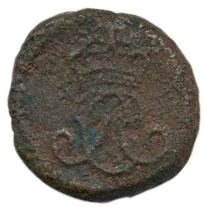
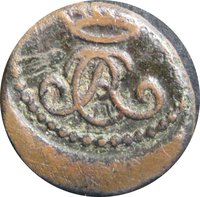
Obverse
Description:
Crowned CR monogram flanking VIII.
Script: Latin
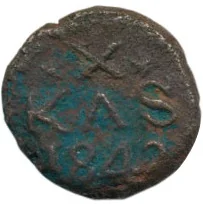
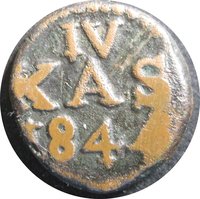
Reverse
Description:
Stars flank value and date.
Script: Latin
Edge
Mintings
| Year | Mint Mark | Mintage | Quality | Collection |
|---|---|---|---|---|
| 1842 | — | — |
Historical background
In 1842, the currency situation in Danish India, comprising the enclaves of Tranquebar (Tharangambadi), Serampore (Frederiksnagore), and the Nicobar Islands, was characterized by a complex and often chaotic multiplicity of circulating coins. The official Danish currency, the rigsdaler, was theoretically in use, but in practice, it competed with a plethora of other silver coins that dominated regional trade. The most significant of these was the British East India Company's silver rupee, which served as the de facto standard for larger transactions due to British economic dominance across the subcontinent. Alongside these, various older Indian and European silver coins, including the French roupie and the Dutch rijksdaalder, remained in circulation, creating a challenging environment for commerce and administration.
This monetary pluralism led to persistent problems of exchange rate fluctuations and valuation disputes. Merchants and colonial officials were forced to constantly refer to published lists of equivalencies, which assigned fluctuating values to dozens of coin types based on their weight, silver purity, and wear. The lack of a single, authoritative currency hampered efficient revenue collection for the Danish crown and created opportunities for arbitrage and loss. Furthermore, the Danish administration struggled with a chronic shortage of small-denomination coins for everyday transactions, a gap often filled by cut or damaged pieces of larger coins or by informal credit systems.
By 1842, this untenable situation was pushing the Danish colonial administration toward a decisive reform. The inherent inefficiencies and the growing gravitational pull of the British Indian monetary system made maintaining a distinct Danish currency increasingly impractical. Consequently, the Danish authorities were moving towards officially demonetizing the older heterogeneous coins and formally adopting the British Indian rupee and its subsidiary coinage. This shift, which would be solidified in the coming years, reflected the broader decline of Danish commercial influence in India and the practical necessity of aligning with the region's dominant economic power.
This monetary pluralism led to persistent problems of exchange rate fluctuations and valuation disputes. Merchants and colonial officials were forced to constantly refer to published lists of equivalencies, which assigned fluctuating values to dozens of coin types based on their weight, silver purity, and wear. The lack of a single, authoritative currency hampered efficient revenue collection for the Danish crown and created opportunities for arbitrage and loss. Furthermore, the Danish administration struggled with a chronic shortage of small-denomination coins for everyday transactions, a gap often filled by cut or damaged pieces of larger coins or by informal credit systems.
By 1842, this untenable situation was pushing the Danish colonial administration toward a decisive reform. The inherent inefficiencies and the growing gravitational pull of the British Indian monetary system made maintaining a distinct Danish currency increasingly impractical. Consequently, the Danish authorities were moving towards officially demonetizing the older heterogeneous coins and formally adopting the British Indian rupee and its subsidiary coinage. This shift, which would be solidified in the coming years, reflected the broader decline of Danish commercial influence in India and the practical necessity of aligning with the region's dominant economic power.
✨ Legendary