

50 stotinki – Bulgaria
Add to wishlist
Circulating commemorative coins
Commemoration: Universiade at Sofia
Bulgaria
Context
Year: 1977
Issuer: Bulgaria
Period:
(1946—1990)
Currency:
(1962—1999)
Demonetized: Yes
Total mintage: 2,000,000
Material
Diameter: 23.3 mm
Weight: 4.1 g
Thickness: 1.49 mm
Shape: Round
Composition: Copper-nickel
Technique: Milled
Alignment: Medal alignment
flip
References
KM: #
Numista: #7877
Value
Exchange value: 0.50 BGL
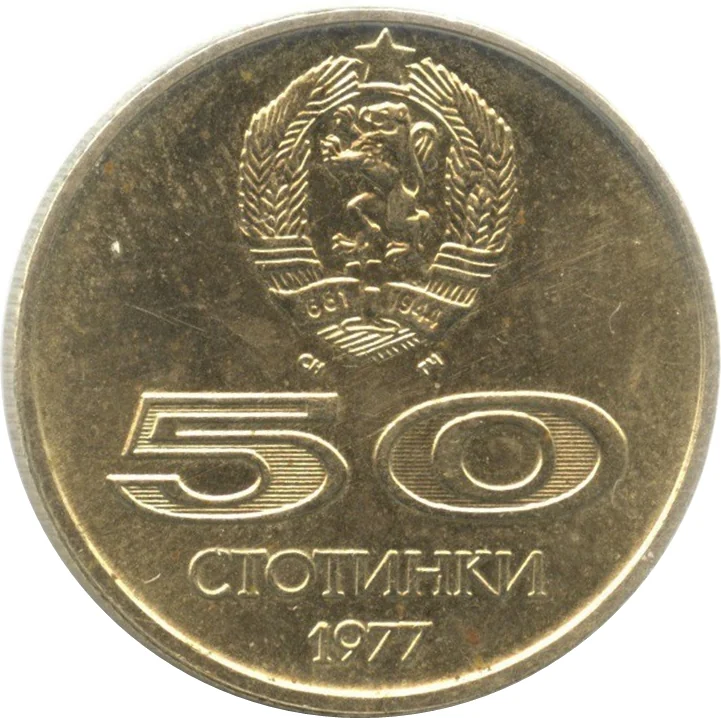
Obverse
Description:
Bulgarian arms with denomination below and date at bottom.
Inscription:
681 1944
СН ГЧ
50
CTOTИHKИ
1977
СН ГЧ
50
CTOTИHKИ
1977
Translation:
USSR
50
KOPEKS
1977
50
KOPEKS
1977
Script: Cyrillic
Designers: Stefan Nenov, Georgi Chapkunov
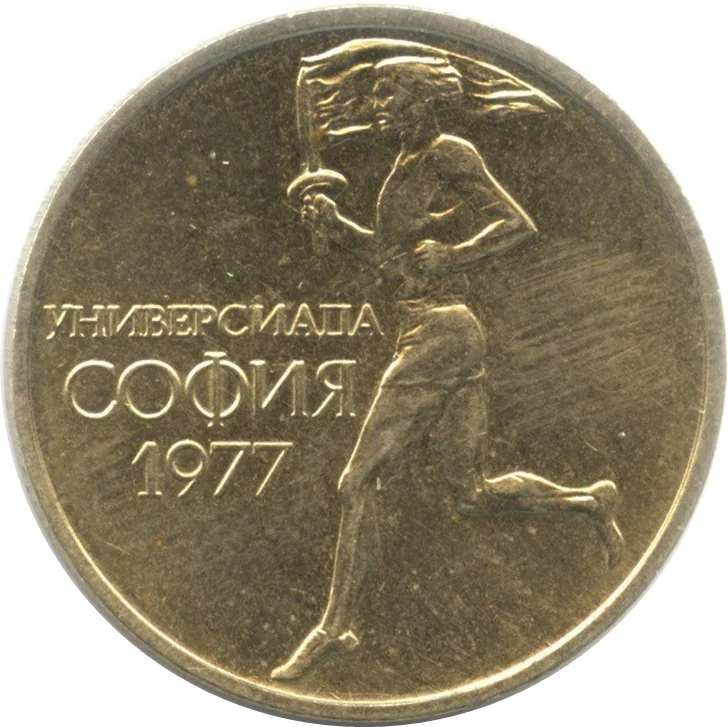
Reverse
Description:
A torchbearer running.
Inscription:
УНИВЕРСИАДА
СОФИЯ
1977
СОФИЯ
1977
Translation:
UNIVERSIADE
SOFIA
1977
SOFIA
1977
Script: Cyrillic
Designers: Stefan Nenov, Georgi Chapkunov
Edge
Reeded
Mints
| Name | Mark |
|---|---|
| Bulgarian Mint | — |
Mintings
| Year | Mint Mark | Mintage | Quality | Collection |
|---|---|---|---|---|
| 1977 | — | 2,000,000 |
Historical background
In 1977, Bulgaria operated under a rigid centrally planned economy as a loyal member of the Soviet-led Council for Mutual Economic Assistance (COMECON). The official national currency was the Lev (BGN), which was pegged at a fixed, artificial exchange rate to the Soviet Ruble, not to Western currencies like the US Dollar. This rate was set by the Bulgarian State and the Bulgarian National Bank, with no influence from market forces, making the official exchange rate largely a tool for accounting within the planned system rather than for international convertibility.
The domestic currency situation was characterized by a severe dichotomy between the official economy and the black market. While the official rate was approximately 0.90 Leva to 1 US Dollar, the real value of the Lev was significantly weaker. A thriving black market for foreign currency, especially US Dollars and Deutsche Marks, existed to service the needs of citizens and entities requiring hard currency for travel or access to scarce imported goods. This parallel market operated at rates several times higher than the official peg, revealing the vast gap between the state's proclaimed economic stability and the currency's actual purchasing power on the global stage.
Internationally, the Lev was a non-convertible currency, meaning it could not be freely exchanged for other currencies outside the COMECON bloc. Bulgaria's foreign trade was conducted primarily through bilateral agreements and clearing accounts within COMECON, often using the "transferable Ruble" as an accounting unit. Transactions with Western nations were limited and required careful state management of hard currency reserves. Thus, in 1977, Bulgaria's currency situation was one of strict state control, isolation from global financial markets, and an underlying pressure that manifested in a pervasive shadow economy for foreign exchange.
The domestic currency situation was characterized by a severe dichotomy between the official economy and the black market. While the official rate was approximately 0.90 Leva to 1 US Dollar, the real value of the Lev was significantly weaker. A thriving black market for foreign currency, especially US Dollars and Deutsche Marks, existed to service the needs of citizens and entities requiring hard currency for travel or access to scarce imported goods. This parallel market operated at rates several times higher than the official peg, revealing the vast gap between the state's proclaimed economic stability and the currency's actual purchasing power on the global stage.
Internationally, the Lev was a non-convertible currency, meaning it could not be freely exchanged for other currencies outside the COMECON bloc. Bulgaria's foreign trade was conducted primarily through bilateral agreements and clearing accounts within COMECON, often using the "transferable Ruble" as an accounting unit. Transactions with Western nations were limited and required careful state management of hard currency reserves. Thus, in 1977, Bulgaria's currency situation was one of strict state control, isolation from global financial markets, and an underlying pressure that manifested in a pervasive shadow economy for foreign exchange.
🌱 Common