

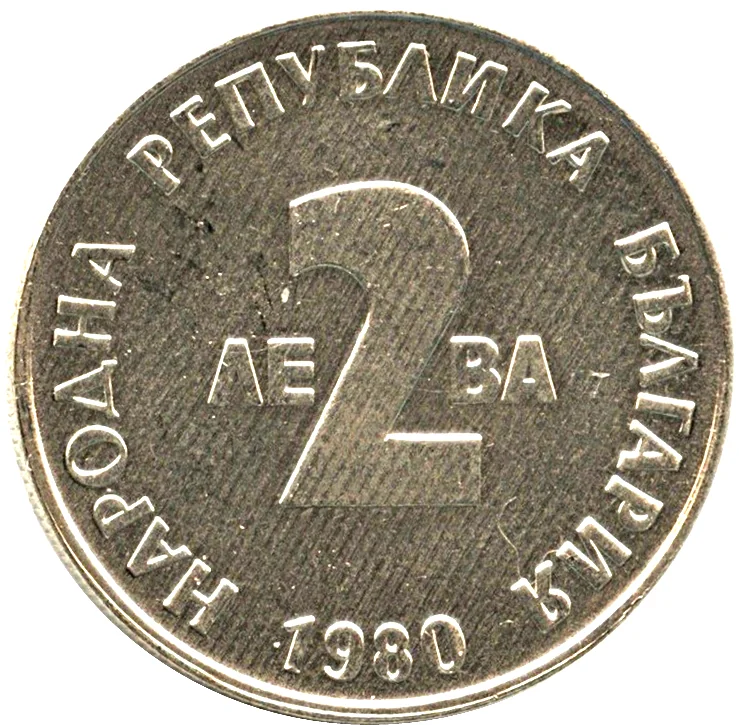
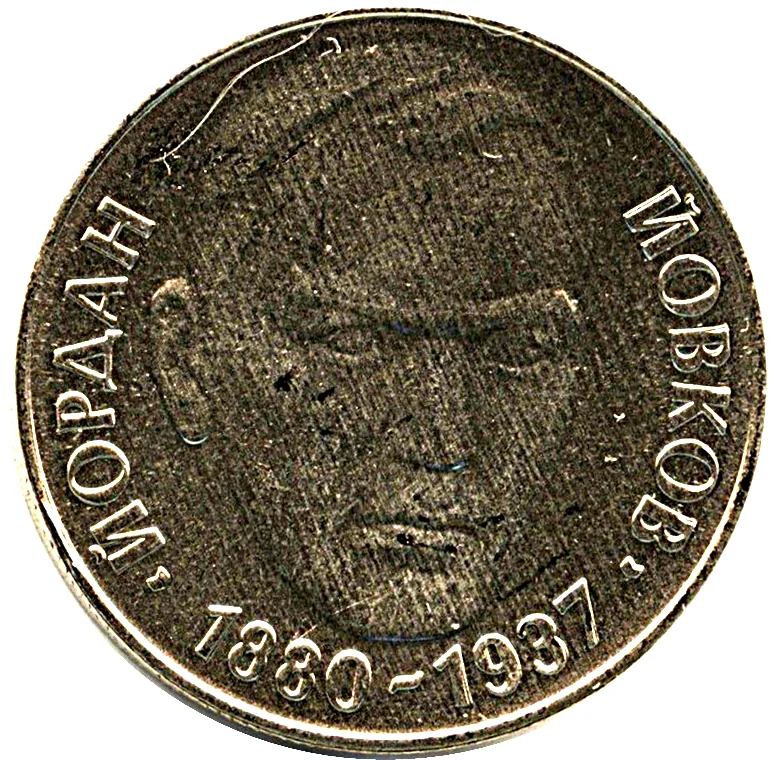
2 leva (Yordan Yovkov) – Bulgaria
Add to wishlist
Circulating commemorative coins
Commemoration: 100th Anniversary - Birth of Yordan Yovkov, Writer
Bulgaria
Context
Year: 1980
Issuer: Bulgaria
Period:
(1946—1990)
Currency:
(1962—1999)
Demonetized: Yes
Total mintage: 200,000
Material
Diameter: 30 mm
Weight: 11.3 g
Thickness: 2.25 mm
Shape: Round
Composition: Copper-nickel
Technique: Milled
Alignment: Medal alignment
flip
References
KM: #
Numista: #12367
Value
Exchange value: 2 BGL
Obverse
Reverse
Edge
Reeded
Categories
| Event> Birth anniversary |
Mints
| Name | Mark |
|---|---|
| Bulgarian Mint | — |
Mintings
| Year | Mint Mark | Mintage | Quality | Collection |
|---|---|---|---|---|
| 1980 | — | 200,000 |
Historical background
In 1980, Bulgaria's currency situation was defined by its position as a centrally planned economy within the Soviet-led Council for Mutual Economic Assistance (COMECON). The official national currency was the Lev (BGN), which existed in a non-convertible, "hard" domestic version and a separate, virtually theoretical "transferable" version for accounting in foreign trade with other socialist states. Its exchange rate against Western currencies like the US Dollar was set by the state at an artificially high and fixed rate (approximately 0.97 Leva to $1), bearing no relation to market forces or the currency's real purchasing power.
Internally, the currency system was characterized by monetary overhang and suppressed inflation. While prices for basic necessities were heavily subsidized and stable, wages were also controlled, leading to a chronic shortage of desirable consumer goods. This created a situation where citizens accumulated Lev savings they could not spend, as high-quality goods or imported items were either unavailable or required special access or hard currency. The black market for foreign currency thrived as a result, with the US Dollar trading at a rate several times higher than the official state rate, revealing the vast gap between the Lev's official and actual value.
Externally, Bulgaria's trade and currency flows were heavily oriented toward the COMECON bloc, particularly the Soviet Union, with transactions often conducted through bilateral clearing agreements rather than convertible currency. Trade with Western nations was limited and strictly controlled by the state, requiring the use of scarce hard currency reserves. Consequently, the Bulgarian Lev in 1980 functioned primarily as an internal accounting unit within a closed, shortage economy, isolated from the global financial system and masking the underlying inefficiencies that would become fully apparent in the economic crisis of the late 1980s.
Internally, the currency system was characterized by monetary overhang and suppressed inflation. While prices for basic necessities were heavily subsidized and stable, wages were also controlled, leading to a chronic shortage of desirable consumer goods. This created a situation where citizens accumulated Lev savings they could not spend, as high-quality goods or imported items were either unavailable or required special access or hard currency. The black market for foreign currency thrived as a result, with the US Dollar trading at a rate several times higher than the official state rate, revealing the vast gap between the Lev's official and actual value.
Externally, Bulgaria's trade and currency flows were heavily oriented toward the COMECON bloc, particularly the Soviet Union, with transactions often conducted through bilateral clearing agreements rather than convertible currency. Trade with Western nations was limited and strictly controlled by the state, requiring the use of scarce hard currency reserves. Consequently, the Bulgarian Lev in 1980 functioned primarily as an internal accounting unit within a closed, shortage economy, isolated from the global financial system and masking the underlying inefficiencies that would become fully apparent in the economic crisis of the late 1980s.
🌱 Fairly Common