

1 Peso – Costa Rica
Costa Rica
Context
Years: 1864–1868
Issuer: Costa Rica 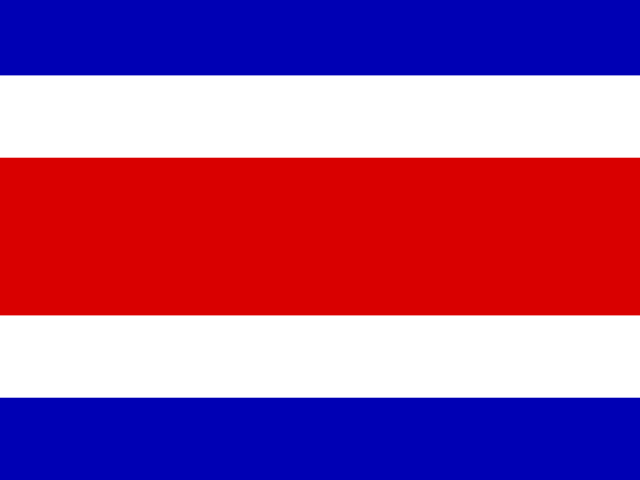
Period:
(1848—1948)
Currency:
(1863—1896)
Demonetization: 14 August 1900
Total mintage: 41,012
Material
References
KM: #Click to copy to clipboard107
Numista: #78705
Value
Bullion value: $223.21
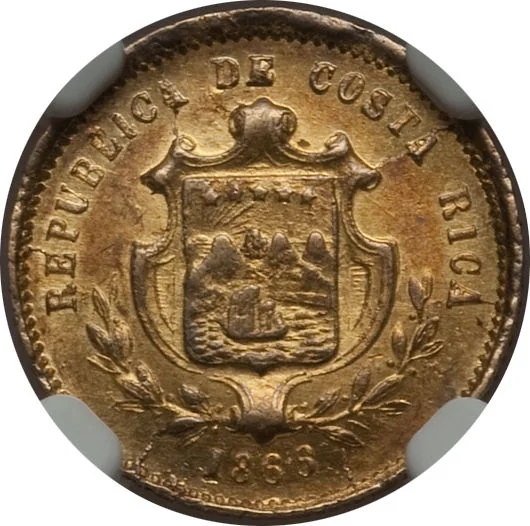
Obverse
Description:
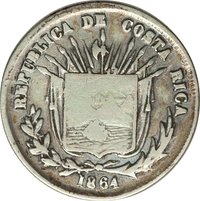
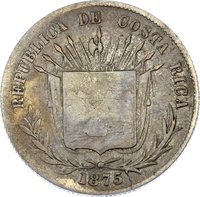
Coat of arms, legend above, date below.
Inscription:
REPUBLICA DE COSTA RICA
1866
1866
Translation:
REPUBLIC OF COSTA RICA
1866
1866
Script: Latin
Language: Spanish
Engraver: Guillermo Witting
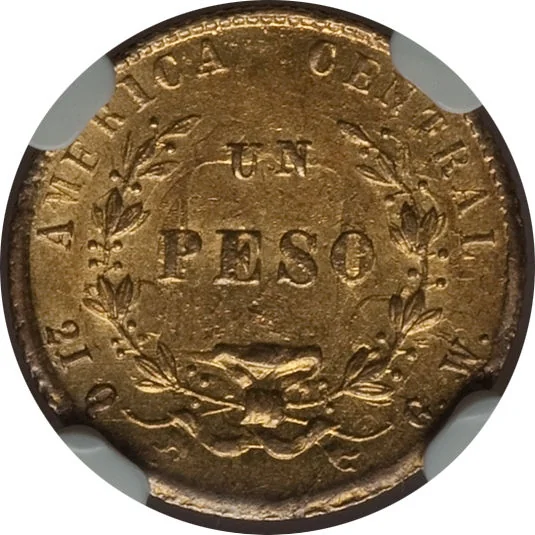
Reverse
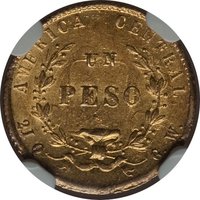
Description:
Wreath with value. Top: legend. Bottom: fineness and assayer's initials.
Inscription:
AMERICA CENTRAL
UN
PESO
21 Q G.W.
UN
PESO
21 Q G.W.
Translation:
Central America
One
Peso
21 Q G.W.
One
Peso
21 Q G.W.
Script: Latin
Language: Spanish
Engraver: Guillermo Witting
Edge
Categories
| Symbols> Coat of Arms |
| Symbol> Wreath |
Mints
| Name | Mark |
|---|---|
| Casa Nacional de Moneda de Costa Rica | — |
Mintings
| Year | Mint Mark | Mintage | Quality | Collection |
|---|---|---|---|---|
| 1864 | — | 6,383 | ||
| 1866 | — | 34,629 | ||
| 1868 | — | — |
Historical background
In 1864, Costa Rica's currency situation was characterized by significant instability and a complex mix of circulating mediums. The country lacked a unified national coinage, leading to a chaotic system where foreign coins—primarily Peruvian, Bolivian, Chilean, and Colombian silver pesos—circulated alongside locally minted low-denomination coins. The value of these foreign coins was not fixed by their precious metal content alone but was arbitrarily set by government decree, often leading to confusion and market distortion. This period fell within the long presidency of Juan Rafael Mora Porras (1849-1859), whose administration had struggled with fiscal deficits exacerbated by the costs of the 1856-1857 campaign against William Walker, leaving the state with limited capacity to reform the monetary system.
The most pressing issue was a severe shortage of fractional currency for everyday transactions. To address this, the government had authorized the minting of low-denomination copper and low-grade silver coins, such as the medios (half real) and cuartillos (quarter real). However, these coins were often underweight or of poor alloy, leading to widespread counterfeiting and public distrust. Consequently, people hoarded the higher-value, full-weight foreign silver coins, which only worsened the scarcity of usable money in the local economy. This dynamic, known as Gresham's Law ("bad money drives out good"), created a vicious cycle that hampered commerce and state revenue collection.
Ultimately, the monetary disarray of 1864 was a symptom of Costa Rica's transition from a colonial-era economy to a modern coffee-exporting state. The lack of a sovereign currency hindered economic development and integration. While full monetary reform was still years away—the first official national currency, the Costa Rican Peso, would not be established until 1864's successor law in 1896—the difficulties of this period underscored the growing need for a centralized, trusted currency system to support the nation's expanding export economy and administrative stability.
The most pressing issue was a severe shortage of fractional currency for everyday transactions. To address this, the government had authorized the minting of low-denomination copper and low-grade silver coins, such as the medios (half real) and cuartillos (quarter real). However, these coins were often underweight or of poor alloy, leading to widespread counterfeiting and public distrust. Consequently, people hoarded the higher-value, full-weight foreign silver coins, which only worsened the scarcity of usable money in the local economy. This dynamic, known as Gresham's Law ("bad money drives out good"), created a vicious cycle that hampered commerce and state revenue collection.
Ultimately, the monetary disarray of 1864 was a symptom of Costa Rica's transition from a colonial-era economy to a modern coffee-exporting state. The lack of a sovereign currency hindered economic development and integration. While full monetary reform was still years away—the first official national currency, the Costa Rican Peso, would not be established until 1864's successor law in 1896—the difficulties of this period underscored the growing need for a centralized, trusted currency system to support the nation's expanding export economy and administrative stability.
💎 Extremely Rare