

50 centavos – Costa Rica
Add to wishlist
Costa Rica
Context
Year: 1889
Issuer: Costa Rica
Period:
(1848—1948)
Currency:
(1863—1896)
Demonetization: 24 October 1896
Total mintage: 205,000
Material
References
KM: #
Numista: #78704
Value
Bullion value: $23.40
Obverse
Description:
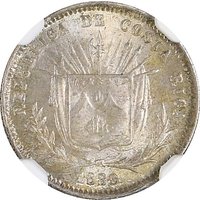
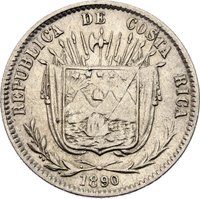
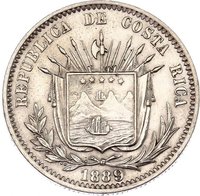
Coat of arms with wreath, legend above and date below.
Inscription:
REPUBLICA DE COSTA RICA
1889
1889
Translation:
REPUBLIC OF COSTA RICA
1889
1889
Language: Spanish
Engraver: Guillermo Witting
Reverse
Description:
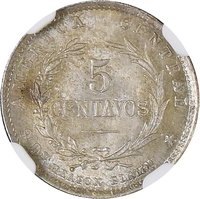
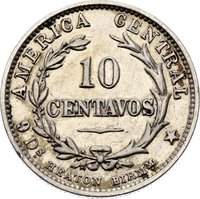
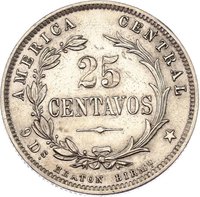
Wreath with value. Top: legend. Bottom: fineness and assayer's initials.
Inscription:
AMERICA CENTRAL
50 CENTAVOS
9 Ds. G. W.
50 CENTAVOS
9 Ds. G. W.
Translation:
Central America
50 Centavos
9 Ds. G. W.
50 Centavos
9 Ds. G. W.
Language: Spanish
Engraver: Guillermo Witting
Edge
Mints
| Name | Mark |
|---|---|
| Casa Nacional de Moneda de Costa Rica | — |
Mintings
| Year | Mint Mark | Mintage | Quality | Collection |
|---|---|---|---|---|
| 1889 | GW | 205,000 |
Historical background
In 1889, Costa Rica's currency situation was characterized by a fragmented and unstable monetary system, a direct legacy of the colonial era and early independence. The country lacked a unified national currency; instead, a confusing mix of foreign and domestic coins circulated simultaneously. The most important of these was the silver peso, often called the "peso fuerte" or "peso de plata," which was divisible into eight reales. However, these were physically scarce. In daily practice, low-value transactions relied heavily on worn Spanish colonial coins and even privately issued tokens from coffee plantations and merchants, leading to a chronic shortage of small change that hampered commerce.
This disarray was exacerbated by the government's persistent fiscal deficits and its reliance on inflationary paper money. Since the 1830s, successive administrations had issued billetes de moneda (paper notes), which were legal tender but not backed by sufficient silver or gold reserves. By 1889, these notes had significantly depreciated in value against the silver peso, creating a dual-system where goods had one price in silver and a higher price in paper. This devaluation eroded public confidence in the government's currency and created economic uncertainty, particularly for international trade, which was vital for the coffee-exporting economy.
The situation in 1889 was at a critical juncture, setting the stage for major monetary reform. The instability and complexity of the system were widely recognized as impediments to economic modernization and foreign investment. Consequently, this period immediately preceded the landmark Monetary Law of 1896, which would finally establish the colón as Costa Rica's sole national currency, adopting the gold standard in an effort to impose stability, attract capital, and fully integrate the nation into the global financial system. Thus, 1889 represents the final chapter of an outdated monetary order soon to be swept away.
This disarray was exacerbated by the government's persistent fiscal deficits and its reliance on inflationary paper money. Since the 1830s, successive administrations had issued billetes de moneda (paper notes), which were legal tender but not backed by sufficient silver or gold reserves. By 1889, these notes had significantly depreciated in value against the silver peso, creating a dual-system where goods had one price in silver and a higher price in paper. This devaluation eroded public confidence in the government's currency and created economic uncertainty, particularly for international trade, which was vital for the coffee-exporting economy.
The situation in 1889 was at a critical juncture, setting the stage for major monetary reform. The instability and complexity of the system were widely recognized as impediments to economic modernization and foreign investment. Consequently, this period immediately preceded the landmark Monetary Law of 1896, which would finally establish the colón as Costa Rica's sole national currency, adopting the gold standard in an effort to impose stability, attract capital, and fully integrate the nation into the global financial system. Thus, 1889 represents the final chapter of an outdated monetary order soon to be swept away.

✨ Legendary