

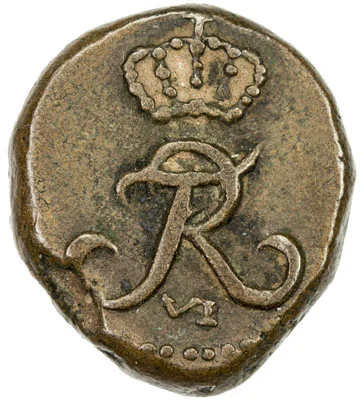
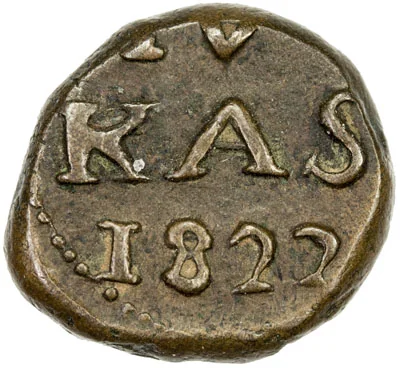
4 cash – Danish India
Add to wishlist
India
Context
Years: 1815–1824
Country: India
Issuer: Danish India
Ruler: Frederick VI
Currency:
(1730—1818)
Demonetized: Yes
Material
References
KM: #
Numista: #113798
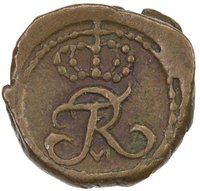
Obverse
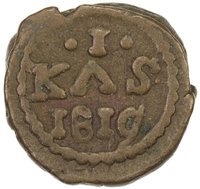
Reverse
Edge
Mintings
| Year | Mint Mark | Mintage | Quality | Collection |
|---|---|---|---|---|
| 1815 | — | — | ||
| 1816 | — | — | ||
| 1817 | — | — | ||
| 1820 | — | — | ||
| 1821 | — | — | ||
| 1822 | — | — | ||
| 1823 | — | — | ||
| 1824 | — | — |
Historical background
In 1815, Danish India consisted of small, scattered colonial outposts, most notably the town of Tranquebar (Tharangambadi) on the Coromandel Coast and the fort of Serampore (Frederiksnagore) in Bengal. The currency situation was inherently complex and pluralistic, reflecting the enclaves' integration into the vibrant and multifaceted economic landscape of pre-colonial India. There was no single, dominant "Danish Indian" currency; instead, daily commerce operated through a mosaic of coins. These included various Indian silver rupees from neighboring Mughal and successor states, a plethora of smaller local copper coins (cash) for everyday transactions, and a range of European currencies from other trading powers, particularly Spanish silver dollars (pieces of eight), which were a de facto global trade currency.
The Danish administration did mint its own coins, primarily copper kash (or casch) and silver fanams at the Tranquebar mint, but these were not intended to replace the existing monetary systems. Their purpose was to facilitate local trade and payments, ensuring the Company had a reliable medium for its own expenses and tariffs. However, their circulation was largely confined to the Danish settlements and their immediate hinterlands. The authority and reach of these coins were limited, as the economic gravity of the region was overwhelmingly dictated by the vast Indian economies and the pan-Indian rupee system.
Consequently, the monetary environment in Danish India in 1815 was one of negotiated pragmatism. Danish colonial accounts were kept in a notional "Danish Indian Rupee," but this was a unit of account, not a physical coin. It served to standardize value against a fluctuating bazaar of actual physical currencies whose values and purity constantly shifted. This system required money-changers (shroffs) to be essential economic intermediaries, assessing and exchanging the mixed specie that passed through the ports. Thus, Danish monetary policy was less about imposition and more about adaptation, managing a hybrid system where local and global currencies coexisted out of practical necessity.
The Danish administration did mint its own coins, primarily copper kash (or casch) and silver fanams at the Tranquebar mint, but these were not intended to replace the existing monetary systems. Their purpose was to facilitate local trade and payments, ensuring the Company had a reliable medium for its own expenses and tariffs. However, their circulation was largely confined to the Danish settlements and their immediate hinterlands. The authority and reach of these coins were limited, as the economic gravity of the region was overwhelmingly dictated by the vast Indian economies and the pan-Indian rupee system.
Consequently, the monetary environment in Danish India in 1815 was one of negotiated pragmatism. Danish colonial accounts were kept in a notional "Danish Indian Rupee," but this was a unit of account, not a physical coin. It served to standardize value against a fluctuating bazaar of actual physical currencies whose values and purity constantly shifted. This system required money-changers (shroffs) to be essential economic intermediaries, assessing and exchanging the mixed specie that passed through the ports. Thus, Danish monetary policy was less about imposition and more about adaptation, managing a hybrid system where local and global currencies coexisted out of practical necessity.
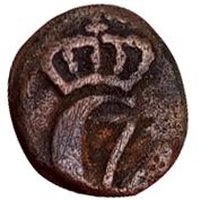
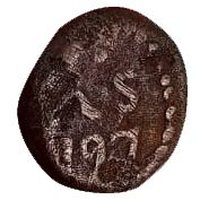
💎 Extremely Rare