

8 reales – Costa Rica
Add to wishlist
Costa Rica
Context
Years: 1841–1842
Issuer: Costa Rica
Period:
(1838—1847)
Currency:
(1841—1864)
Demonetization: 24 October 1896
Material
References
KM: #
Numista: #78603
Obverse
Description:
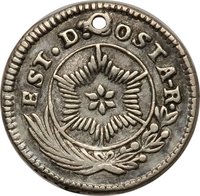
Radiant star in 7mm circle.
Reverse
Description:
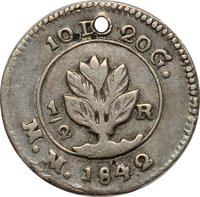
Host coin design retained.
Edge
Mints
| Name | Mark |
|---|---|
| Casa Nacional de Moneda de Costa Rica | — |
Mintings
| Year | Mint Mark | Mintage | Quality | Collection |
|---|---|---|---|---|
| — | — | — |
Historical background
In 1841, Costa Rica's currency situation was a complex tapestry of scarcity, improvisation, and transition, reflecting its status as a young and isolated republic within the dissolved Federal Republic of Central America. The state lacked a formal, unified monetary system, leading to a severe shortage of circulating coin. This scarcity stifled commerce and tax collection, forcing the government and populace to rely on a cumbersome patchwork of foreign coins, primarily Spanish colonial reales, Peruvian pesos, and other Latin American silver that entered through trade. The most common unit of account was the peso, divided into 8 reales, but the physical shortage meant barter remained a vital, if inefficient, economic practice.
Recognizing this crisis, the government of Braulio Carrillo took a pivotal step by authorizing the issuance of the nation's first paper money. In 1839, the Junta de Crédito Pública was established, and by 1841, it was issuing interest-bearing paper notes, known as billetes de crédito público or "calderas." These were not true fiat currency but rather government debt certificates intended to circulate as money. Their value was unstable and largely dependent on public confidence in the state's ability to eventually redeem them, which was often tenuous.
Thus, 1841 represents a critical juncture where Costa Rica grappled with its monetary identity. The economy operated with an unreliable mix of scarce foreign silver, primitive credit instruments, and barter. The experimental paper issue, while a necessary response to acute shortage, underscored the challenges of establishing sovereign currency and financial stability. This period set the stage for future reforms, including the later establishment of private banks and, ultimately, a national mint, as the country slowly moved toward a more standardized and controlled monetary system.
Recognizing this crisis, the government of Braulio Carrillo took a pivotal step by authorizing the issuance of the nation's first paper money. In 1839, the Junta de Crédito Pública was established, and by 1841, it was issuing interest-bearing paper notes, known as billetes de crédito público or "calderas." These were not true fiat currency but rather government debt certificates intended to circulate as money. Their value was unstable and largely dependent on public confidence in the state's ability to eventually redeem them, which was often tenuous.
Thus, 1841 represents a critical juncture where Costa Rica grappled with its monetary identity. The economy operated with an unreliable mix of scarce foreign silver, primitive credit instruments, and barter. The experimental paper issue, while a necessary response to acute shortage, underscored the challenges of establishing sovereign currency and financial stability. This period set the stage for future reforms, including the later establishment of private banks and, ultimately, a national mint, as the country slowly moved toward a more standardized and controlled monetary system.
✨ Legendary