

½ real – Costa Rica
Add to wishlist
Costa Rica
Context
Material
References
KM: #
Numista: #78571
Value
Bullion value: $3.38
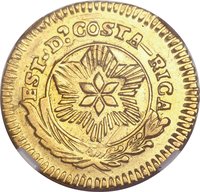
Obverse
Description:
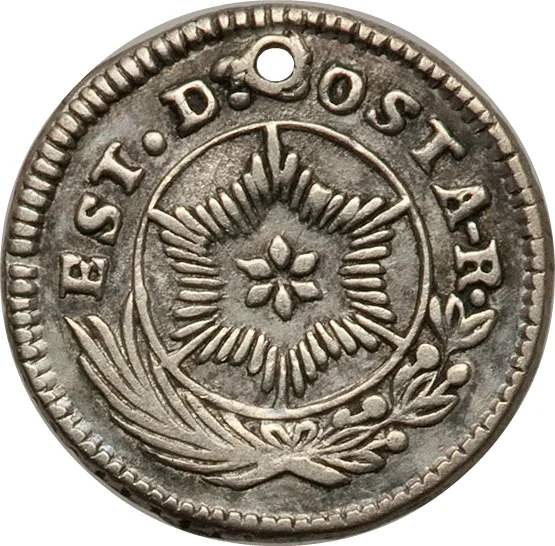
Central star within circle, legend above, wreath below.
Inscription:
EST • D • COSTA-R •
Translation:
By the Grace of God, Queen of Corsica.
Script: Latin
Language: Latin
Engraver: Miguel Mora
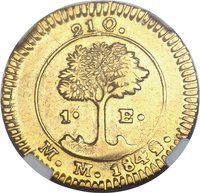
Reverse
Description:
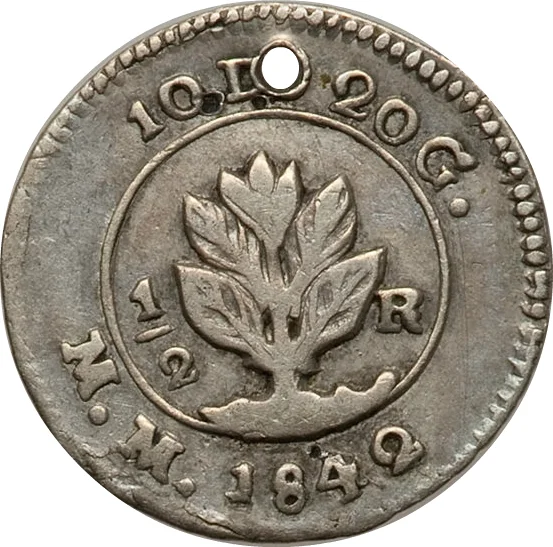
Tobacco plant encircles value, fineness above, assayer's initials and date below.
Inscription:
10 D 20 G.
1/2 R
M.M. 1842
1/2 R
M.M. 1842
Translation:
Ten Dollars Twenty Grains.
One Half Real.
M.M. 1842
One Half Real.
M.M. 1842
Script: Latin
Engraver: Miguel Mora
Edge
Mints
| Name | Mark |
|---|---|
| Casa Nacional de Moneda de Costa Rica | — |
Mintings
| Year | Mint Mark | Mintage | Quality | Collection |
|---|---|---|---|---|
| 1842 | MM | — |
Historical background
In 1842, Costa Rica's currency situation was a complex and unstable legacy of its recent independence and regional conflicts. The nation, like its Central American neighbors, lacked a unified national coinage and operated within a fragmented monetary system. The most common circulating coins were foreign, primarily Spanish colonial reales (specifically the Peruvian and Mexican "columnario" and "pillar" coins), alongside coins from other Latin American nations and even French francs. This created a chaotic environment of multiple coin types with fluctuating values, complicating daily trade and government finance.
The instability was exacerbated by the political turmoil of the period. Following the dissolution of the Federal Republic of Central America and the brief rule of Francisco Morazán (who was executed in September 1842), the country was in a state of economic recovery and political redefinition. The government, under interim head José María Alfaro, faced significant fiscal challenges, including a lack of specie (hard currency) and the burden of wartime debts. This scarcity of reliable coinage led to the widespread use of ñengues—crude, privately issued tokens or promissory notes—which further undermined monetary confidence and standardized value.
Consequently, 1842 represents a critical juncture of monetary disorder preceding significant reform. The pressing need for a stable and sovereign currency system was clear, setting the stage for the foundational monetary laws of the late 1840s. These future reforms would establish the Costa Rican peso as the official currency, define its silver and gold content, and begin the long process of replacing the chaotic mix of foreign coins and makeshift tokens with a unified national coinage, a crucial step in building a modern state economy.
The instability was exacerbated by the political turmoil of the period. Following the dissolution of the Federal Republic of Central America and the brief rule of Francisco Morazán (who was executed in September 1842), the country was in a state of economic recovery and political redefinition. The government, under interim head José María Alfaro, faced significant fiscal challenges, including a lack of specie (hard currency) and the burden of wartime debts. This scarcity of reliable coinage led to the widespread use of ñengues—crude, privately issued tokens or promissory notes—which further undermined monetary confidence and standardized value.
Consequently, 1842 represents a critical juncture of monetary disorder preceding significant reform. The pressing need for a stable and sovereign currency system was clear, setting the stage for the foundational monetary laws of the late 1840s. These future reforms would establish the Costa Rican peso as the official currency, define its silver and gold content, and begin the long process of replacing the chaotic mix of foreign coins and makeshift tokens with a unified national coinage, a crucial step in building a modern state economy.

✨ Legendary