

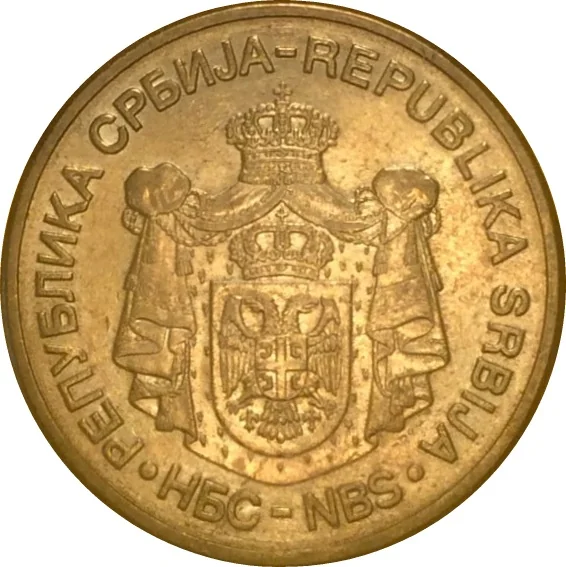
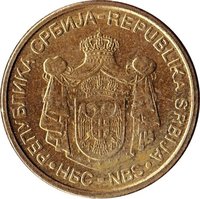
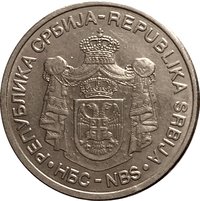
Obverse
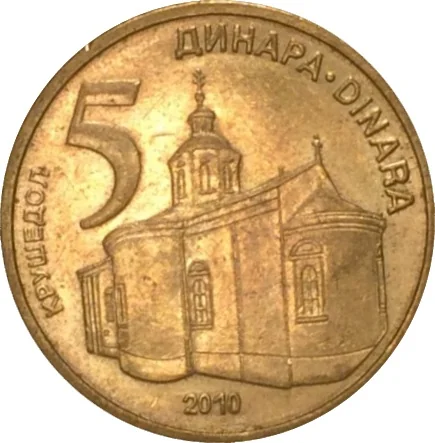
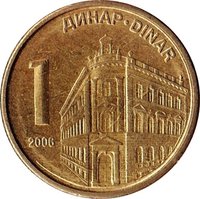
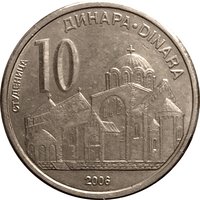
Reverse
Edge
Alternating plain and reeded segments (5 sections each)
Categories
| Symbols> Coat of Arms |
| Symbol> Double-headed eagle |
| Animal> Bird |
| Building> Religious building |
| Symbol> Crown |
Mints
| Name | Mark |
|---|---|
| Belgrade | — |
Mintings
| Year | Mint Mark | Mintage | Quality | Collection |
|---|---|---|---|---|
| 2005 | — | 5,099,500 | ||
| 2005 | — | — | In sets | |
| 2006 | — | 10,372,500 | ||
| 2006 | — | — | In sets | |
| 2007 | — | 14,998,500 | ||
| 2008 | — | 15,093,500 | ||
| 2009 | — | 9,998,500 | ||
| 2010 | — | 15,005,000 |
Historical background
In 2005, Serbia's currency situation was characterized by a period of relative stability under a managed float regime, a significant achievement following the hyperinflation and economic turmoil of the 1990s and early 2000s. The official currency was the Serbian dinar (RSD), which had been successfully re-stabilized after the 2001 monetary reform that replaced the Yugoslav dinar. The National Bank of Serbia (NBS) was the key institution managing the exchange rate, primarily targeting inflation control rather than a fixed peg, while intervening in the foreign exchange market to smooth out excessive volatility. This stability was underpinned by a program with the International Monetary Fund (IMF), which bolstered international reserves and provided a framework for disciplined fiscal and monetary policy.
The broader economic context was one of cautious transition and recovery. Serbia was navigating a complex process of market reforms and post-Milosevic reconstruction, with a growing focus on integration with European structures. While the dinar's stability against the euro was a priority for the NBS, the economy still faced challenges including a large current account deficit, reliance on foreign capital inflows, and a substantial informal "euroized" sector where many major transactions, such as real estate and car purchases, were commonly conducted in euros. This unofficial dual-currency environment reflected lingering public distrust in the dinar from past traumas and served as a practical hedge against potential future instability.
Overall, 2005 represented a year of consolidation for Serbian monetary policy. The NBS successfully maintained price stability, with inflation reduced to single digits—a stark contrast to the past. This stability was crucial for fostering economic growth and attracting foreign direct investment. However, the persistent use of euros in parts of the economy highlighted that while institutional confidence had been restored, full confidence in the national currency among the populace was a longer-term project, contingent on sustained macroeconomic discipline and continued integration into the global economy.
The broader economic context was one of cautious transition and recovery. Serbia was navigating a complex process of market reforms and post-Milosevic reconstruction, with a growing focus on integration with European structures. While the dinar's stability against the euro was a priority for the NBS, the economy still faced challenges including a large current account deficit, reliance on foreign capital inflows, and a substantial informal "euroized" sector where many major transactions, such as real estate and car purchases, were commonly conducted in euros. This unofficial dual-currency environment reflected lingering public distrust in the dinar from past traumas and served as a practical hedge against potential future instability.
Overall, 2005 represented a year of consolidation for Serbian monetary policy. The NBS successfully maintained price stability, with inflation reduced to single digits—a stark contrast to the past. This stability was crucial for fostering economic growth and attracting foreign direct investment. However, the persistent use of euros in parts of the economy highlighted that while institutional confidence had been restored, full confidence in the national currency among the populace was a longer-term project, contingent on sustained macroeconomic discipline and continued integration into the global economy.
🌱 Very Common