

10 laari – Maldives
Add to wishlist
Maldives
Context
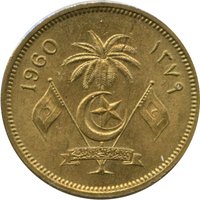
Year: 1960
Islamic (Hijri) Year:: 1379
Issuer: Maldives
Ruler: Muhammad Fareed Didi
Currency:
(since 1947)
Total mintage: 601,270
Material
Diameter: 23.1 mm
Weight: 5.3 g
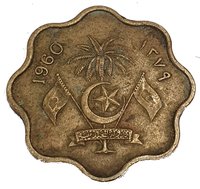
Shape: Scalloped
Composition: Nickel brass
Magnetic: No
Technique: Milled
Alignment: Medal alignment
flip
References
KM: #
Numista: #7820
Value
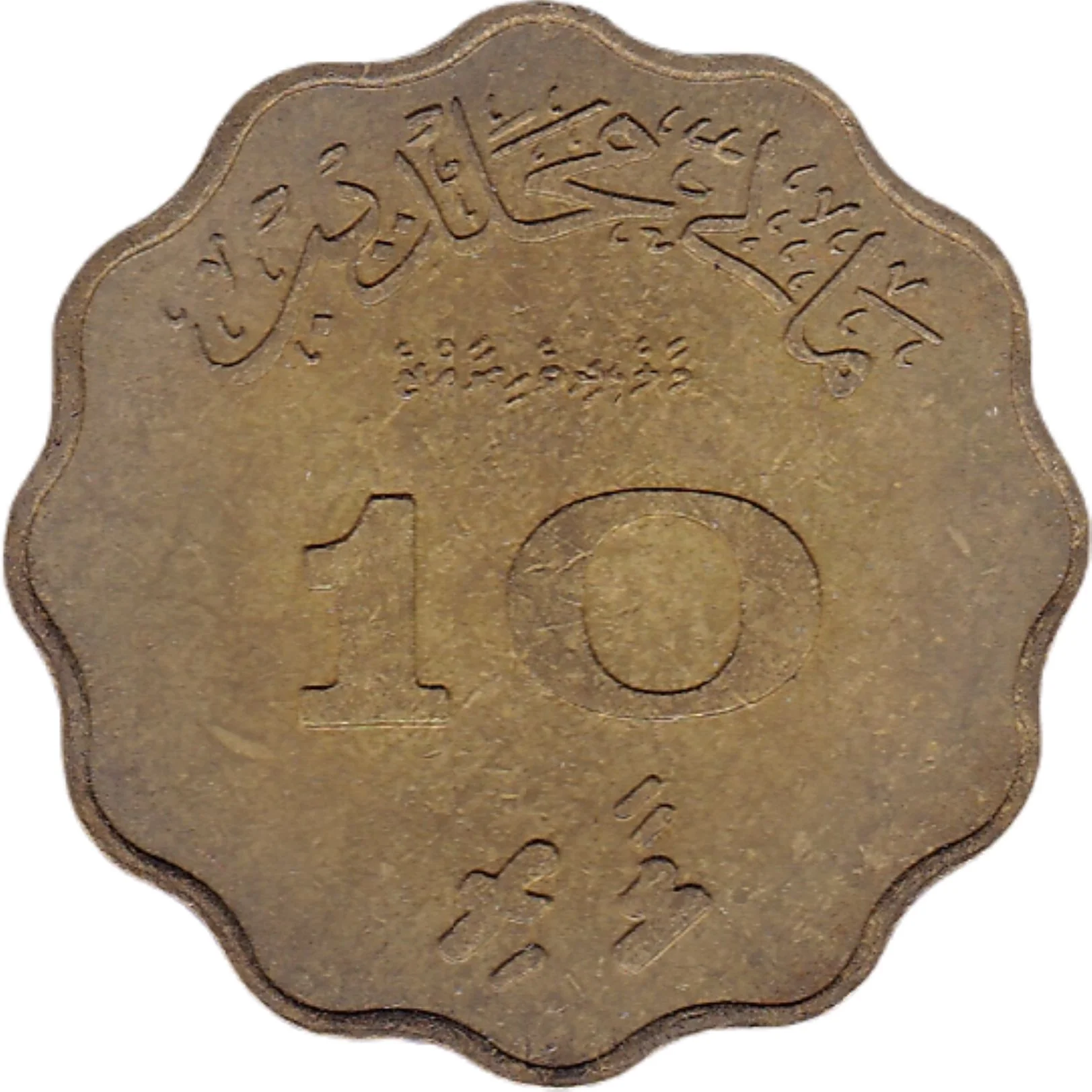
Exchange value: 0.10 MVR
Obverse
Description:
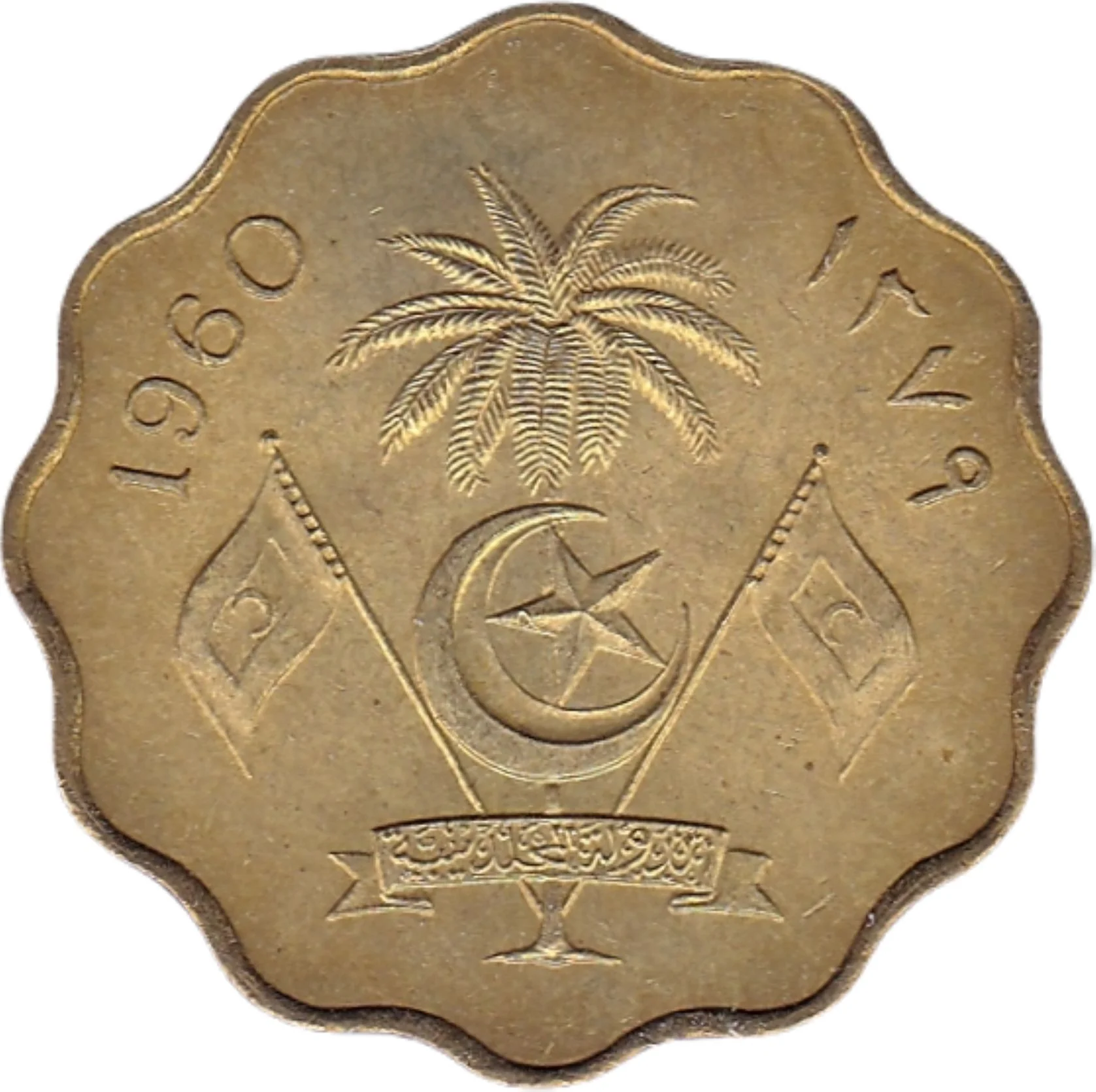
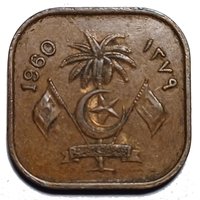
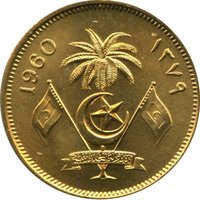
National emblem between dates.
Inscription:
1960 ١٣٧٩
الدولة المحلديبية
الدولة المحلديبية
Translation:
1960 1379
The Mahaldean State
The Mahaldean State
Languages: Arabic, Eastern Arabic numerals
Reverse
Edge
Plain
Categories
| Symbols> Coat of Arms |
Mints
| Name | Mark |
|---|---|
| Royal Mint (Tower Hill) | — |
Mintings
| Year | Mint Mark | Mintage | Quality | Collection |
|---|---|---|---|---|
| 1960 | — | 600,000 | ||
| 1960 | — | 1,270 | Proof |
Historical background
In the 1960s, the Maldives operated under a dual currency system that reflected its historical economic ties and its status as a British protectorate. The official currency was the Maldivian Rupee (also known as the Rufiyaa), which was pegged to the Indian Rupee at par. This linkage was a legacy of centuries of trade and cultural exchange with the Indian subcontinent, and Indian Rupee notes and coins circulated widely alongside the locally issued Maldivian currency. The economy was overwhelmingly based on subsistence fishing and small-scale agriculture, with limited foreign exchange earnings primarily from the export of dried fish (Maldive fish) to Sri Lanka.
Simultaneously, the British Pound Sterling played a significant, albeit unofficial, role due to the presence of a Royal Air Force base on Gan Island in the southern Addu Atoll, established during World War II. The base, which operated until 1976, injected Sterling directly into the local economy of the south, creating a parallel monetary zone. This led to practical complexities, as transactions in the capital, Malé, and the northern atolls were conducted in Rupees, while the economy around Gan functioned largely on Sterling, highlighting a fragmented monetary landscape within the small archipelago.
This dual system was increasingly seen as inefficient and restrictive for a nation seeking greater economic autonomy. The peg to the Indian Rupee, while stable, did not serve the Maldives' specific developmental needs. Consequently, the decade set the stage for a major monetary reform. In 1960, the Maldivian government began the process of establishing a more independent and unified currency system, which would culminate in the creation of a new decimalized Rufiyaa in 1961, divided into 100 laari, and the establishment of the Maldives Monetary Authority in 1981.
Simultaneously, the British Pound Sterling played a significant, albeit unofficial, role due to the presence of a Royal Air Force base on Gan Island in the southern Addu Atoll, established during World War II. The base, which operated until 1976, injected Sterling directly into the local economy of the south, creating a parallel monetary zone. This led to practical complexities, as transactions in the capital, Malé, and the northern atolls were conducted in Rupees, while the economy around Gan functioned largely on Sterling, highlighting a fragmented monetary landscape within the small archipelago.
This dual system was increasingly seen as inefficient and restrictive for a nation seeking greater economic autonomy. The peg to the Indian Rupee, while stable, did not serve the Maldives' specific developmental needs. Consequently, the decade set the stage for a major monetary reform. In 1960, the Maldivian government began the process of establishing a more independent and unified currency system, which would culminate in the creation of a new decimalized Rufiyaa in 1961, divided into 100 laari, and the establishment of the Maldives Monetary Authority in 1981.
Series: 1960 Maldives circulation coins

🌱 Fairly Common