

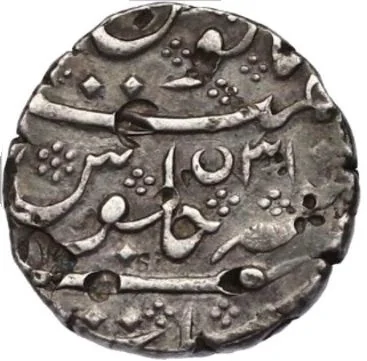
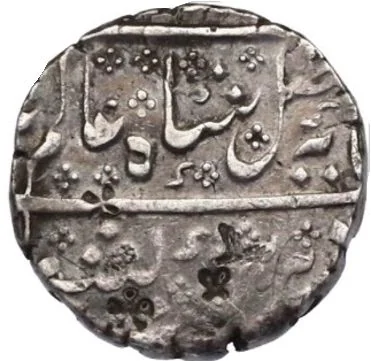
1 rupee – Surat
Add to wishlist
India
Obverse
Description:
Persian couplet by Shah Alam II.
Reverse
Description:
Persian - Julus mint.
Edge
Mintings
| Year | Mint Mark | Mintage | Quality | Collection |
|---|---|---|---|---|
| 1809 | — | — | ||
| 1810 | — | — | ||
| 1811 | — | — | ||
| 1812 | — | — |
Historical background
In 1809, Surat was a city caught between two declining monetary systems and the rising power of the British East India Company. The city, once the premier Mughal port, had seen its political authority fracture. While the Mughal Emperor in Delhi and the Peshwa in Pune nominally held sway, real control was increasingly exercised by the British, who had taken over the castle and key revenues in 1800. This political duality was reflected in the currency: the Mughal silver rupee and the Maratha sikka rupee both circulated, but their value and acceptance were unstable due to the weakening of their issuing authorities.
The monetary landscape was further complicated by a severe shortage of specie (coin). Decades of political instability and warfare had disrupted trade routes and bullion flows. Furthermore, the Company itself was exacerbating the problem by systematically remitting vast sums of silver to Bengal and to China (for tea purchases), draining the region of hard currency. This scarcity led to the widespread use of older, worn, and clipped coins, as well as a reliance on the dhabu (a local copper coin) for small transactions, creating a chaotic multi-tiered system where exchange rates were volatile and uncertain.
Consequently, trade and daily commerce in Surat were hampered by constant friction. Merchants and the public faced difficulties in assessing the true value of coins, leading to disputes and a loss of confidence. This economic distress provided the context for the British administration, under the Surat Political Agent, to actively pursue currency reform. The situation in 1809 was thus a transitional crisis, paving the way for the Company's eventual imposition of a standardized rupee, the "Surat Rupee," in 1813, which would firmly align the city's economy with the burgeoning British Indian monetary system.
The monetary landscape was further complicated by a severe shortage of specie (coin). Decades of political instability and warfare had disrupted trade routes and bullion flows. Furthermore, the Company itself was exacerbating the problem by systematically remitting vast sums of silver to Bengal and to China (for tea purchases), draining the region of hard currency. This scarcity led to the widespread use of older, worn, and clipped coins, as well as a reliance on the dhabu (a local copper coin) for small transactions, creating a chaotic multi-tiered system where exchange rates were volatile and uncertain.
Consequently, trade and daily commerce in Surat were hampered by constant friction. Merchants and the public faced difficulties in assessing the true value of coins, leading to disputes and a loss of confidence. This economic distress provided the context for the British administration, under the Surat Political Agent, to actively pursue currency reform. The situation in 1809 was thus a transitional crisis, paving the way for the Company's eventual imposition of a standardized rupee, the "Surat Rupee," in 1813, which would firmly align the city's economy with the burgeoning British Indian monetary system.

✨ Legendary