

50 centavos – Argentina
Add to wishlist
Argentina
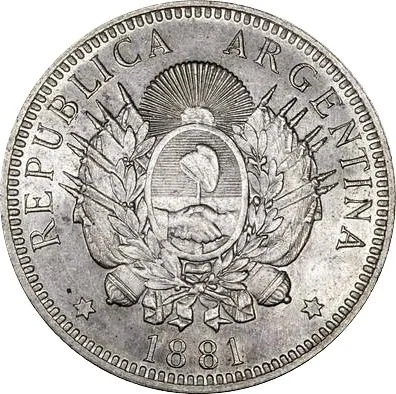
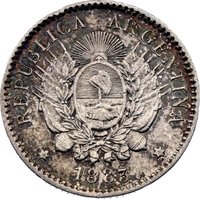
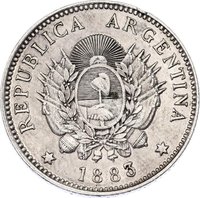
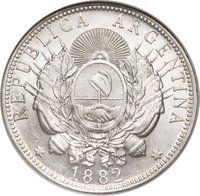
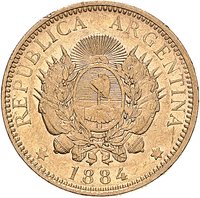
Obverse
Description:
Argentine Arms, year and lettering.
Inscription:
REPÚBLICA ARGENTINA
* 1881 *
* 1881 *
Translation:
Argentine Republic
* 1881 *
* 1881 *
Script: Lao
Language: Spanish
Engraver: Eugène-André Oudiné
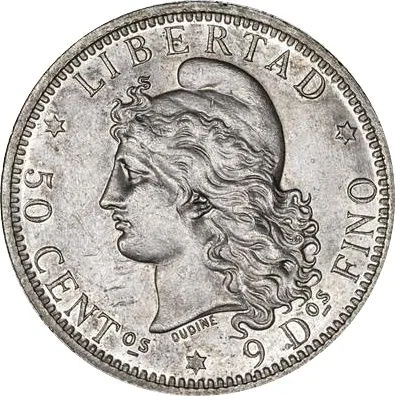
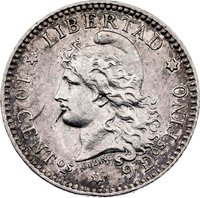
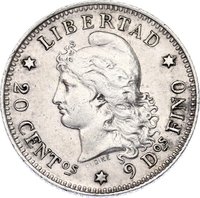
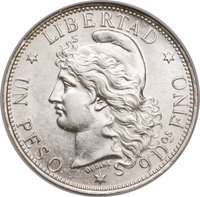
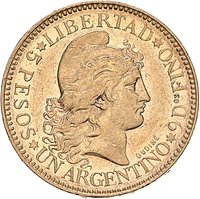
Reverse
Description:
Oudine’s Liberty head in Phrygian cap, left. Value and lettering.
Inscription:
* LIBERTAD *
50 CENTos* 9 Dos FINO
50 CENTos* 9 Dos FINO
Script: Latin
Engraver: Eugène-André Oudiné
Edge
Reeded
Categories
| Symbol> Sun |
| Symbol> Allegory |
| Symbols> Coat of Arms |
| Symbol> Phrygian cap |
Mintings
| Year | Mint Mark | Mintage | Quality | Collection |
|---|---|---|---|---|
| 1881 | — | 1,020 | ||
| 1882 | — | 476,000 | ||
| 1883 | — | 2,273,000 |
Historical background
In 1881, Argentina stood at a pivotal moment of national consolidation, seeking to unify a chaotic monetary landscape. Following decades of political fragmentation, a plethora of currencies circulated: provincial paper money, gold and silver coins from various nations, and private banknotes of wildly varying credibility. This disorder stifled internal trade, complicated foreign commerce, and symbolized the lack of a strong, unified national state. The economic instability was exacerbated by the speculative boom and subsequent crash of the 1870s, underscoring the urgent need for a single, trustworthy currency to underpin the nation's ambitious growth.
Responding to this crisis, President Julio A. Roca's government passed the Monetary Law of 1881, a landmark act of economic nation-building. The law established the peso moneda nacional as the sole legal tender, creating a bimetallic system based on gold and silver. Crucially, it granted exclusive note-issuing power to the Banco Nacional, a forerunner to a central bank, effectively ending the free-for-all of private and provincial emissions. The new currency was proudly adorned with national symbols—the Sun of May and the Argentine coat of arms—physically embedding the idea of the state in everyday economic life.
The reform initially succeeded in creating a uniform currency and fostering confidence, but its long-term stability was undermined by fiscal pressures. The government, facing debt and spending needs, soon allowed the Banco Nacional to exceed the legal limits on paper money not backed by metal reserves. This began a drift away from the promised convertibility, planting the seeds for future inflation and devaluation. Thus, while the 1881 law successfully created a national currency, it also initiated a persistent tension between the discipline of the gold standard and the political temptation to print money, a dilemma that would define Argentine monetary history for generations to come.
Responding to this crisis, President Julio A. Roca's government passed the Monetary Law of 1881, a landmark act of economic nation-building. The law established the peso moneda nacional as the sole legal tender, creating a bimetallic system based on gold and silver. Crucially, it granted exclusive note-issuing power to the Banco Nacional, a forerunner to a central bank, effectively ending the free-for-all of private and provincial emissions. The new currency was proudly adorned with national symbols—the Sun of May and the Argentine coat of arms—physically embedding the idea of the state in everyday economic life.
The reform initially succeeded in creating a uniform currency and fostering confidence, but its long-term stability was undermined by fiscal pressures. The government, facing debt and spending needs, soon allowed the Banco Nacional to exceed the legal limits on paper money not backed by metal reserves. This began a drift away from the promised convertibility, planting the seeds for future inflation and devaluation. Thus, while the 1881 law successfully created a national currency, it also initiated a persistent tension between the discipline of the gold standard and the political temptation to print money, a dilemma that would define Argentine monetary history for generations to come.
Series: 1881 Argentina circulation coins
🌱 Fairly Common