

2 euro – Latvia
Add to wishlist
Circulating commemorative coins
Commemoration: The Black Stork
Latvia
Obverse
Description:
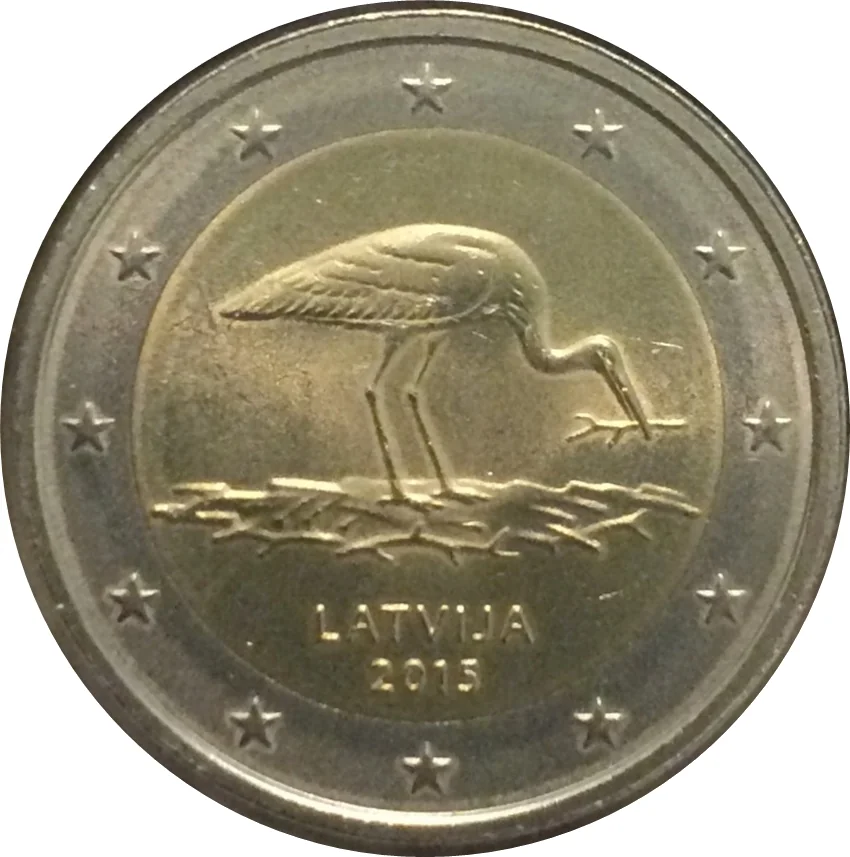
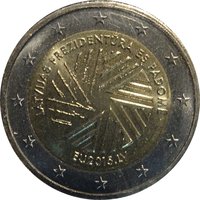
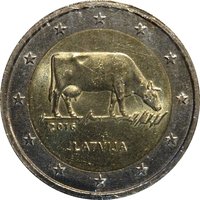
This design features the black stork, a European conservation flagship species. It commemorates Latvia's 2005 Black Stork Protection Plan. "LATVIJA" and "2015" appear at the bottom, with the EU stars on the coin's outer ring.
Inscription:
LATVIJA
2015
2015
Translation:
Latvia
2015
2015
Script: Latin
Language: Latvian
Designer: Olga Šilova
Reverse
Edge
The inscription DIEVS SVĒTĪ LATVIJU with words separated by stars; fine-milled edge.
Legend:
DIEVS ☆ SVĒTĪ ☆ LATVIJU ☆
Translation:
GOD ☆ BLESS ☆ LATVIA ☆
Language: Latvian
Mints
| Name | Mark |
|---|---|
| Lithuanian Mint | — |
Mintings
| Year | Mint Mark | Mintage | Quality | Collection |
|---|---|---|---|---|
| 2015 | — | 1,000,000 | ||
| 2015 | — | 20,000 | BU |
Historical background
In 2015, Latvia was in its second year as a member of the Eurozone, having adopted the euro on January 1, 2014. This move marked a significant milestone, solidifying its integration with core European economic and political structures after a deliberate, decade-long journey following EU accession in 2004. The primary motivation for the switch from the lat was to eliminate currency exchange risks, lower borrowing costs, attract further foreign investment, and deepen financial stability. By 2015, the initial technical transition was complete, with euros fully circulated and the lat a relic of the past.
The broader economic context in 2015, however, presented challenges. Latvia's economy was experiencing a notable slowdown, partly due to economic stagnation in Russia following the 2014 annexation of Crimea and the resulting Western sanctions. This impacted Latvian exports and transit sectors. Furthermore, the country was under the scrutiny of the European Central Bank (ECB), which in 2015 was implementing a quantitative easing program to combat deflationary pressures across the Eurozone. For Latvia, this meant its monetary policy was now fully set in Frankfurt, a shift that required domestic fiscal policy to bear more responsibility for managing economic fluctuations.
Domestically, the currency situation was stable but accompanied by persistent public debate. While businesses and the financial sector largely welcomed the euro for the predictability it offered, a segment of the population, particularly older citizens, remained nostalgic for the lat and blamed the euro for perceived price increases during the changeover. Politically, the adoption was considered a success for the governing coalition, reinforcing Latvia's Western alignment at a time of heightened geopolitical tension with Russia. Thus, in 2015, the euro was firmly established as Latvia's operational currency, serving as a symbol of European integration while the nation navigated external economic headwinds under a new, centralized monetary framework.
The broader economic context in 2015, however, presented challenges. Latvia's economy was experiencing a notable slowdown, partly due to economic stagnation in Russia following the 2014 annexation of Crimea and the resulting Western sanctions. This impacted Latvian exports and transit sectors. Furthermore, the country was under the scrutiny of the European Central Bank (ECB), which in 2015 was implementing a quantitative easing program to combat deflationary pressures across the Eurozone. For Latvia, this meant its monetary policy was now fully set in Frankfurt, a shift that required domestic fiscal policy to bear more responsibility for managing economic fluctuations.
Domestically, the currency situation was stable but accompanied by persistent public debate. While businesses and the financial sector largely welcomed the euro for the predictability it offered, a segment of the population, particularly older citizens, remained nostalgic for the lat and blamed the euro for perceived price increases during the changeover. Politically, the adoption was considered a success for the governing coalition, reinforcing Latvia's Western alignment at a time of heightened geopolitical tension with Russia. Thus, in 2015, the euro was firmly established as Latvia's operational currency, serving as a symbol of European integration while the nation navigated external economic headwinds under a new, centralized monetary framework.
Series: Latvia 2 euro commemoratives
🌱 Very Common