

Obverse
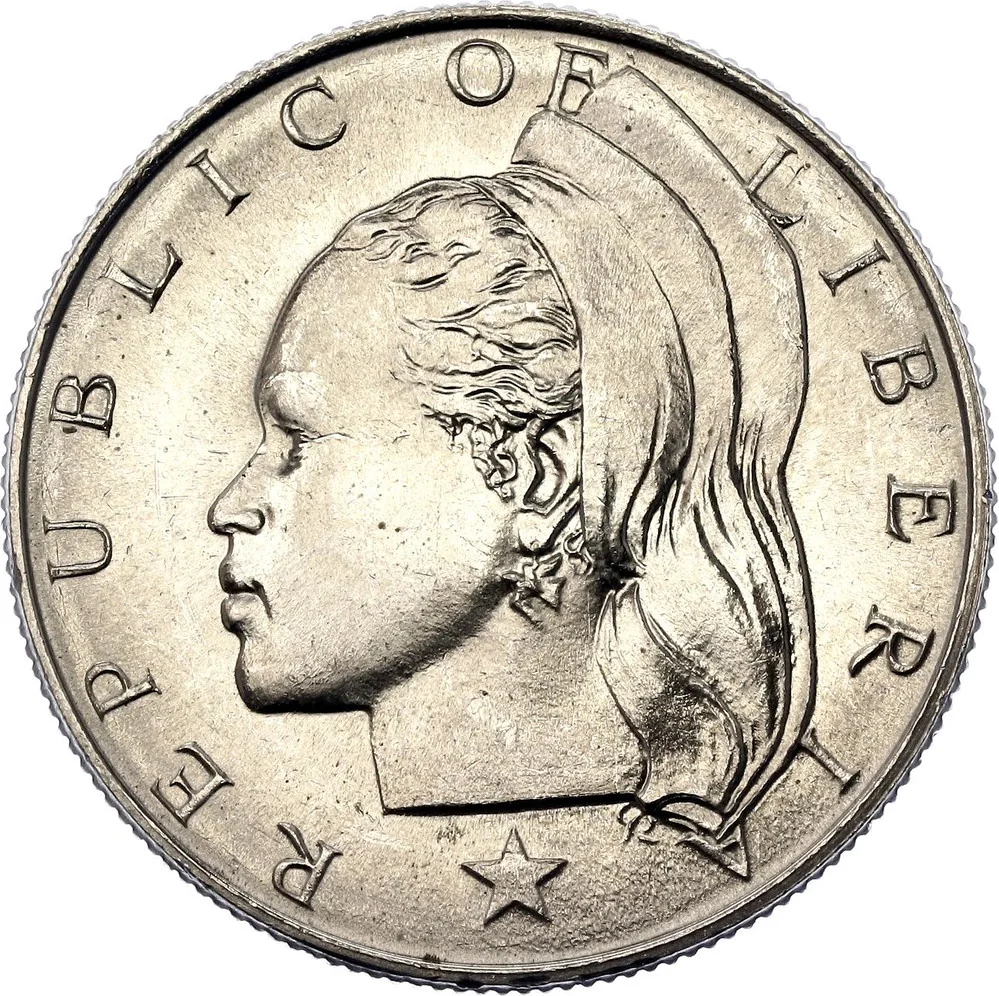
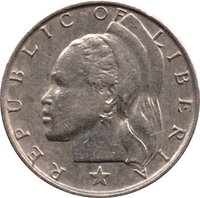
Description:
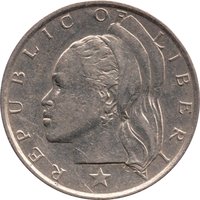
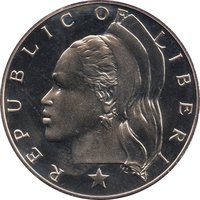
Native woman's profile with a five-point star below.
Inscription:
REPUBLIC OF LIBERIA
Script: Latin
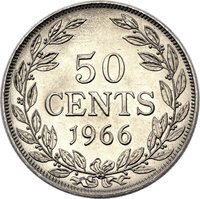
Reverse
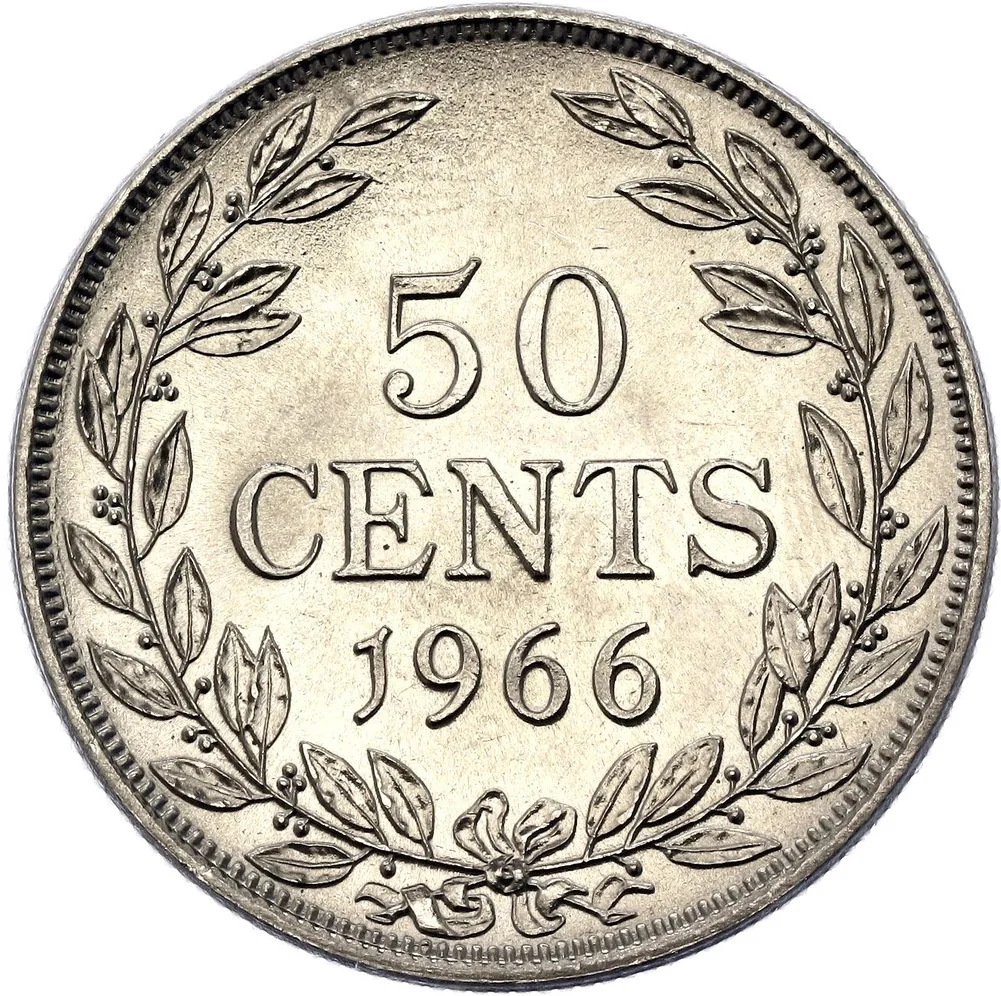
Description:
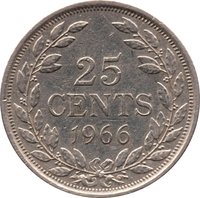
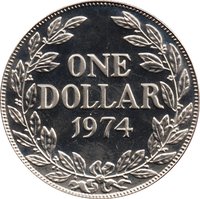
Olive branches flank denomination and year, tied with ribbon below.
Inscription:
50
CENTS
1973
CENTS
1973
Script: Latin
Edge
Reeded
Mints
| Name | Mark |
|---|---|
| Royal Mint (Tower Hill) | — |
| Royal Mint | — |
| United States Mint of San Francisco | — |
Mintings
| Year | Mint Mark | Mintage | Quality | Collection |
|---|---|---|---|---|
| 1966 | — | 200,000 | ||
| 1968 | 1968-1990 | 1,000,000 | ||
| 1968 | — | 14,000 | Proof | |
| 1969 | — | 5,056 | Proof | |
| 1970 | — | 3,464 | Proof | |
| 1971 | — | 3,032 | Proof | |
| 1972 | — | 4,866 | Proof | |
| 1973 | — | 10,542 | Proof | |
| 1973 | — | 1,000,000 | ||
| 1974 | — | 9,362 | Proof | |
| 1975 | — | 800,000 | ||
| 1975 | — | 4,056 | Proof |
Historical background
In 1966, Liberia's currency situation was defined by the unique co-circulation of two distinct currencies: the U.S. dollar and the Liberian dollar, which were fixed at parity (1:1). This system was a legacy of Liberia's founding and its deep economic and political ties with the United States. The U.S. dollar was legal tender and served as the de facto primary currency for government accounts, large-scale commerce, and foreign trade, providing a strong anchor for monetary stability. The Liberian dollar, issued by the Bank of Liberia (the central bank), existed largely in coinage and smaller banknotes for everyday transactions.
Economically, this dual system provided stability but also highlighted Liberia's dependent economic structure. The fixed parity and free convertibility facilitated foreign investment, particularly in the dominant rubber and iron ore sectors controlled by American firms like Firestone and the Liberian Mining Company. However, it also meant Liberia had limited independent monetary policy; the money supply was effectively determined by the balance of payments and the inflow of U.S. dollars rather than by domestic policy tools. This arrangement worked adequately while export revenues were strong, but it left the economy vulnerable to external shocks.
Politically, the currency regime reflected the long-standing administration of President William Tubman, who had been in power since 1944. His "Open Door" economic policy encouraged foreign capital, making the use of the U.S. dollar a practical necessity. In 1966, the system was functioning without immediate crisis, but underlying tensions existed. The reliance on the U.S. dollar underscored a lack of monetary sovereignty, and there were occasional public concerns about the adequacy of Liberian currency in circulation. This period represented a calm before future storms, as global economic shifts in the 1970s would later strain and ultimately break the fixed parity, leading to significant currency instability.
Economically, this dual system provided stability but also highlighted Liberia's dependent economic structure. The fixed parity and free convertibility facilitated foreign investment, particularly in the dominant rubber and iron ore sectors controlled by American firms like Firestone and the Liberian Mining Company. However, it also meant Liberia had limited independent monetary policy; the money supply was effectively determined by the balance of payments and the inflow of U.S. dollars rather than by domestic policy tools. This arrangement worked adequately while export revenues were strong, but it left the economy vulnerable to external shocks.
Politically, the currency regime reflected the long-standing administration of President William Tubman, who had been in power since 1944. His "Open Door" economic policy encouraged foreign capital, making the use of the U.S. dollar a practical necessity. In 1966, the system was functioning without immediate crisis, but underlying tensions existed. The reliance on the U.S. dollar underscored a lack of monetary sovereignty, and there were occasional public concerns about the adequacy of Liberian currency in circulation. This period represented a calm before future storms, as global economic shifts in the 1970s would later strain and ultimately break the fixed parity, leading to significant currency instability.
Series: 1966 Liberia circulation coins
🌱 Common