

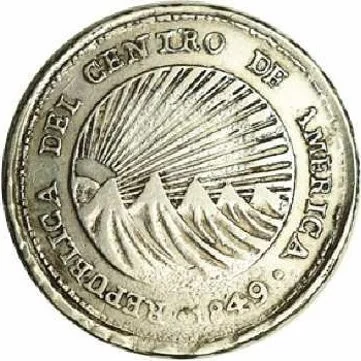
Obverse
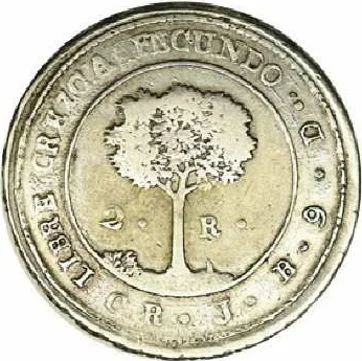
Reverse
Edge
Mints
| Name | Mark |
|---|---|
| Casa Nacional de Moneda de Costa Rica | CR |
Mintings
| Year | Mint Mark | Mintage | Quality | Collection |
|---|---|---|---|---|
| 1849 | CR | — |
Historical background
The currency situation in the Federal Republic of Central America in 1849 was one of profound disorder and fragmentation, reflecting the political collapse of the federation itself. The union of Guatemala, El Salvador, Honduras, Nicaragua, and Costa Rica had effectively dissolved by 1841, leaving no central authority to issue or regulate a common currency. Consequently, the monetary landscape was a chaotic patchwork where the old Spanish colonial coinage—especially silver reales and gold escudos—remained in widespread circulation alongside a limited and uneven supply of coins minted by the individual successor states during the brief federal period.
This vacuum of official currency led to the heavy reliance on foreign coinage to facilitate trade, both internally and internationally. British sovereigns, French francs, and, most significantly, various Spanish-American and Mexican silver dollars (most notably the "Peso Fuerte" or "Piece of Eight") became the de facto standards for larger transactions. Their widespread acceptance, however, did not bring stability, as their values fluctuated based on weight, fineness, and the local market. This environment encouraged clipping, counterfeiting, and the circulation of heavily worn coins, creating constant disputes over exchange rates and values in everyday commerce.
By 1849, each of the five former member states was independently grappling with this monetary anarchy, taking the first tentative steps toward establishing their own national currency systems. They faced the immense challenge of recalling the heterogeneous mix of coins in circulation, assaying their metal content, and issuing new, trusted national coinage—a process that would take decades. Thus, the currency situation of 1849 was a transitional period of deep instability, defined by the legacy of a failed federation and the struggling birth of separate national economies.
This vacuum of official currency led to the heavy reliance on foreign coinage to facilitate trade, both internally and internationally. British sovereigns, French francs, and, most significantly, various Spanish-American and Mexican silver dollars (most notably the "Peso Fuerte" or "Piece of Eight") became the de facto standards for larger transactions. Their widespread acceptance, however, did not bring stability, as their values fluctuated based on weight, fineness, and the local market. This environment encouraged clipping, counterfeiting, and the circulation of heavily worn coins, creating constant disputes over exchange rates and values in everyday commerce.
By 1849, each of the five former member states was independently grappling with this monetary anarchy, taking the first tentative steps toward establishing their own national currency systems. They faced the immense challenge of recalling the heterogeneous mix of coins in circulation, assaying their metal content, and issuing new, trusted national coinage—a process that would take decades. Thus, the currency situation of 1849 was a transitional period of deep instability, defined by the legacy of a failed federation and the struggling birth of separate national economies.
✨ Legendary