

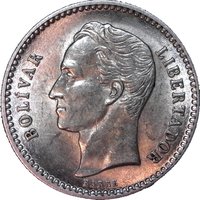
Obverse
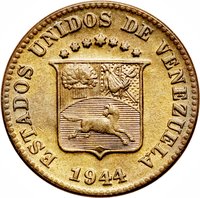
Description:
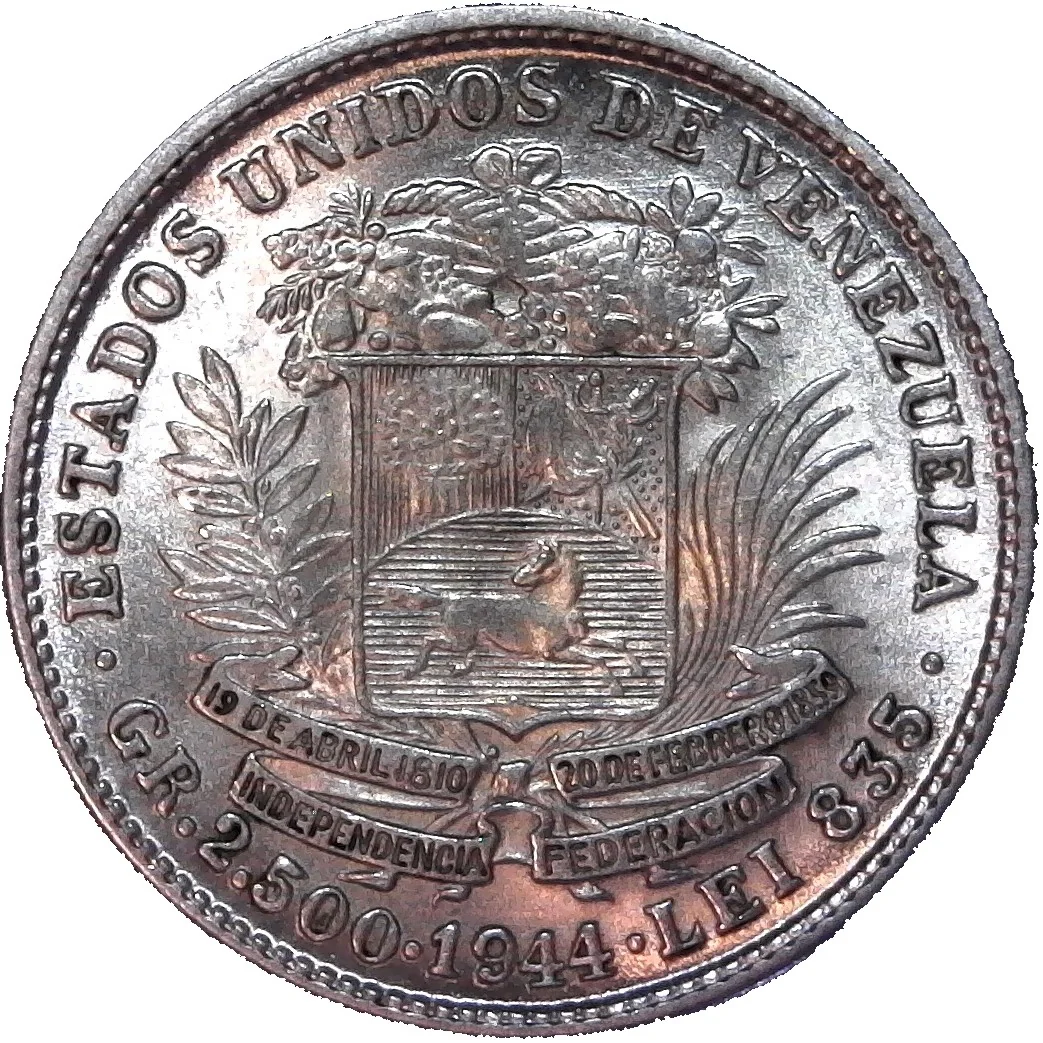
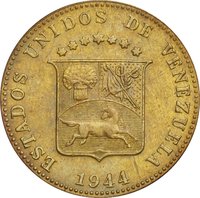
Venezuela's coat of arms encircled by text, with weight, date, and fineness below.
Inscription:
•ESTADOS UNIDOS DE VENEZUELA•
GR.2.500•1944•LEI 835
GR.2.500•1944•LEI 835
Translation:
UNITED STATES OF VENEZUELA
GR. 2.500 1944 LAW 835
GR. 2.500 1944 LAW 835
Script: Latin
Language: Spanish
Engraver: Désiré-Albert Barre
Reverse
Description:
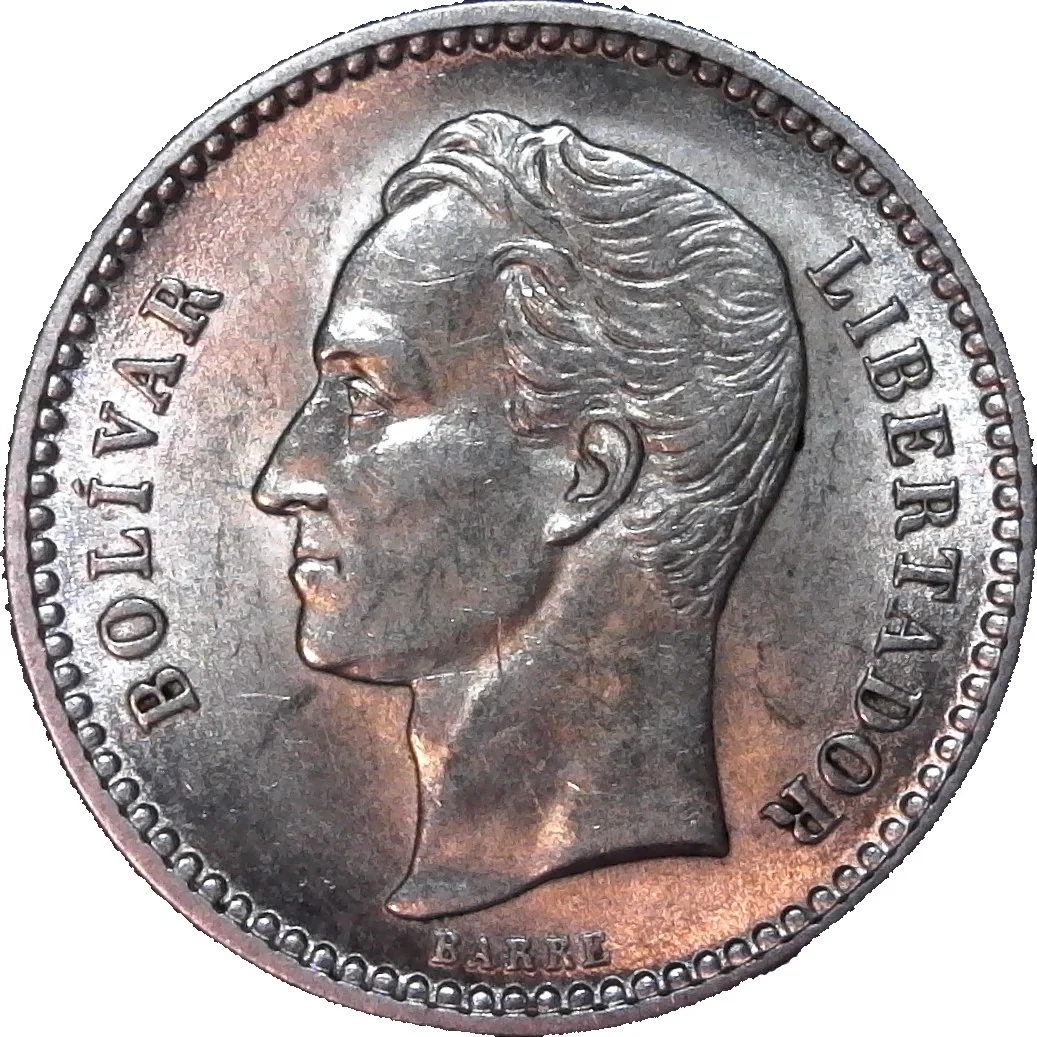
Left-facing bust with legend and engraver's name below.
Inscription:
BOLÍVAR LIBERTADOR
BARRE
BARRE
Translation:
Bolivar Liberator
Barre
Barre
Script: Latin
Language: Spanish
Engraver: Désiré-Albert Barre
Edge
Reeded
Categories
| Animal> Horse |
| Person> Military leader |
| Symbols> Coat of Arms |
| Symbol> Cornucopia |
| Person> Politician |
Mints
| Name | Mark |
|---|---|
| United States Mint of Denver | — |
| United States Mint of Philadelphia | — |
Mintings
| Year | Mint Mark | Mintage | Quality | Collection |
|---|---|---|---|---|
| 1944 | — | — | ||
| 1945 | — | 4,000,000 | ||
| 1946 | — | 2,500,000 |
Historical background
In 1944, Venezuela's currency situation was characterized by remarkable stability and strength, underpinned by the nation's burgeoning oil industry. The official currency, the Venezuelan bolívar, was pegged to the U.S. dollar at a fixed and favorable rate of 3.09 bolívares to the dollar, a parity established in 1934. This peg was effectively maintained by the government of General Isaías Medina Angarita, which exercised strict fiscal discipline and accumulated substantial gold and foreign exchange reserves from petroleum exports, primarily to the Allied powers during World War II.
This period stood in stark contrast to the volatility of earlier decades. The fixed exchange rate, managed by the Banco Central de Venezuela (founded in 1940), provided a foundation for economic planning and growth. The bolívar was considered one of the hardest and most stable currencies in Latin America, fostering significant foreign investment and financing major public works and infrastructure projects. The nation's economic health was directly tied to oil revenues, which allowed the government to maintain the peg without resorting to inflationary financing.
Consequently, the monetary landscape of 1944 was one of confidence and control. Inflation was low, and the bolívar's purchasing power was strong both domestically and internationally. This era represented the peak of the "strong bolívar" before the later economic complexities of the post-war period. The stability was a deliberate achievement of state policy, leveraging hydrocarbon wealth to create a framework of monetary credibility that supported a decade of significant national development and modernization.
This period stood in stark contrast to the volatility of earlier decades. The fixed exchange rate, managed by the Banco Central de Venezuela (founded in 1940), provided a foundation for economic planning and growth. The bolívar was considered one of the hardest and most stable currencies in Latin America, fostering significant foreign investment and financing major public works and infrastructure projects. The nation's economic health was directly tied to oil revenues, which allowed the government to maintain the peg without resorting to inflationary financing.
Consequently, the monetary landscape of 1944 was one of confidence and control. Inflation was low, and the bolívar's purchasing power was strong both domestically and internationally. This era represented the peak of the "strong bolívar" before the later economic complexities of the post-war period. The stability was a deliberate achievement of state policy, leveraging hydrocarbon wealth to create a framework of monetary credibility that supported a decade of significant national development and modernization.
🌱 Common