

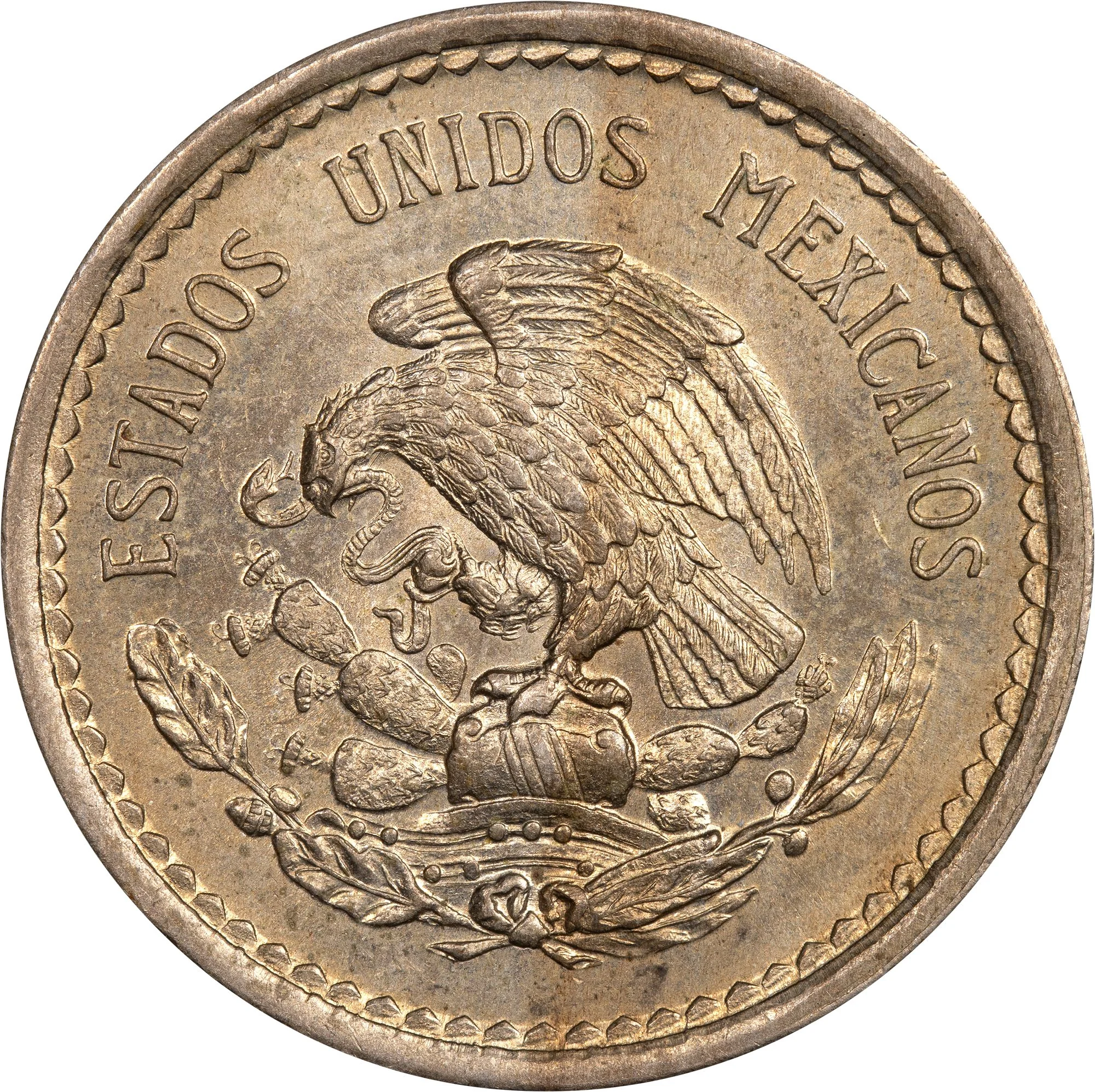
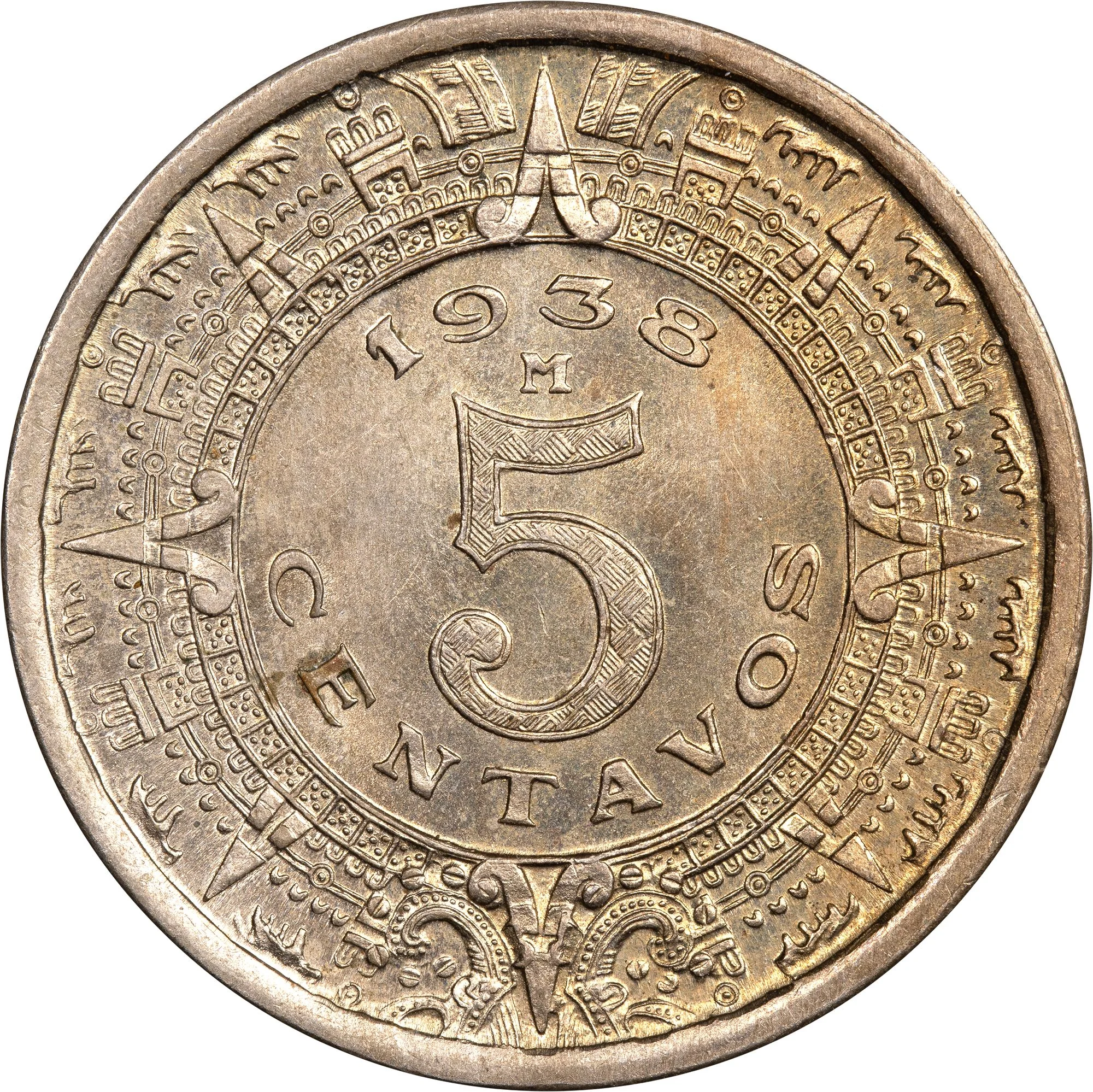
5 Centavos – Mexico
Mexico
Context
Years: 1936–1942
Issuer: Mexico 
Period:
(since 1823)
Currency:
(1863—1992)
Demonetized: Yes
Total mintage: 129,000,000
Material
Diameter: 20.5 mm
Weight: 4 g
Thickness: 1.6 mm
Shape: Round
Composition: Copper-nickel
Technique: Milled
Alignment: Coin alignment
flip
References
KM: #Click to copy to clipboard423
Numista: #7721
Value
Exchange value: 0.05 MXP
Obverse
Reverse
Description:
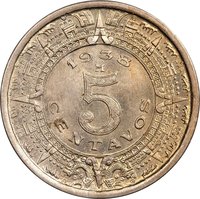
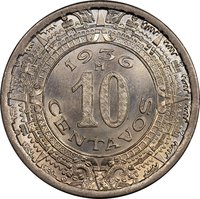
The outer rings of the Aztec Sun Stone surround the central year, mint mark (M), and 5 Centavos denomination.
Inscription:
1938
M
5
CENTAVOS
M
5
CENTAVOS
Script: Latin
Edge
Plain
Mints
| Name | Mark |
|---|---|
| Mexican Mint | M |
Mintings
Historical background
In 1936, Mexico's currency situation was characterized by relative stability under the gold standard, but this stability was fragile and sat atop significant economic and political tensions. The peso was officially pegged to the U.S. dollar and backed by gold reserves, a system maintained by President Lázaro Cárdenas's administration. However, this peg was largely artificial, supported by exchange controls rather than robust economic fundamentals. The country was still grappling with the aftermath of the Great Depression and the internal disruptions of the ongoing Mexican Revolution, which had strained public finances and limited foreign investment.
The underlying pressure stemmed from Cárdenas's ambitious socialist reforms, most notably the aggressive land redistribution program and the escalating expropriation of foreign-owned oil interests, which would culminate in the 1938 nationalization. These policies, while popular domestically, created severe friction with international capital and foreign governments, particularly the United States and Great Britain. Consequently, capital flight was a persistent concern, as wealthy Mexicans and foreign investors moved money out of the country, draining the gold and silver reserves needed to maintain the currency's fixed value.
Therefore, while the peso did not experience a major crisis in 1936 itself, the year represented a precarious calm before the storm. The monetary stability was administrative and political, not market-driven, and was fundamentally at odds with the government's expansive fiscal policies and confrontational stance toward foreign capital. The tensions building throughout 1936 and 1937 would directly lead to the severe balance of payments crisis and the eventual abandonment of the gold standard following the oil expropriation in March 1938, triggering a sharp devaluation of the peso.
The underlying pressure stemmed from Cárdenas's ambitious socialist reforms, most notably the aggressive land redistribution program and the escalating expropriation of foreign-owned oil interests, which would culminate in the 1938 nationalization. These policies, while popular domestically, created severe friction with international capital and foreign governments, particularly the United States and Great Britain. Consequently, capital flight was a persistent concern, as wealthy Mexicans and foreign investors moved money out of the country, draining the gold and silver reserves needed to maintain the currency's fixed value.
Therefore, while the peso did not experience a major crisis in 1936 itself, the year represented a precarious calm before the storm. The monetary stability was administrative and political, not market-driven, and was fundamentally at odds with the government's expansive fiscal policies and confrontational stance toward foreign capital. The tensions building throughout 1936 and 1937 would directly lead to the severe balance of payments crisis and the eventual abandonment of the gold standard following the oil expropriation in March 1938, triggering a sharp devaluation of the peso.
🌱 Very Common