

1 penny – New Guinea
Add to wishlist
Papua New Guinea
Context
Year: 1936
Country: Papua New Guinea
Issuer: New Guinea
Ruler: Edward VIII
Currency:
(1915—1966)
Demonetized: Yes
Total mintage: 360,000
Material
Diameter: 26.7 mm
Weight: 6.6 g
Thickness: 1.6 mm
Shape: Round with a round hole
Composition: Bronze
Magnetic: No
Technique: Milled
Alignment: Medal alignment
flip
References
KM: #
Numista: #11347
Obverse
Description:
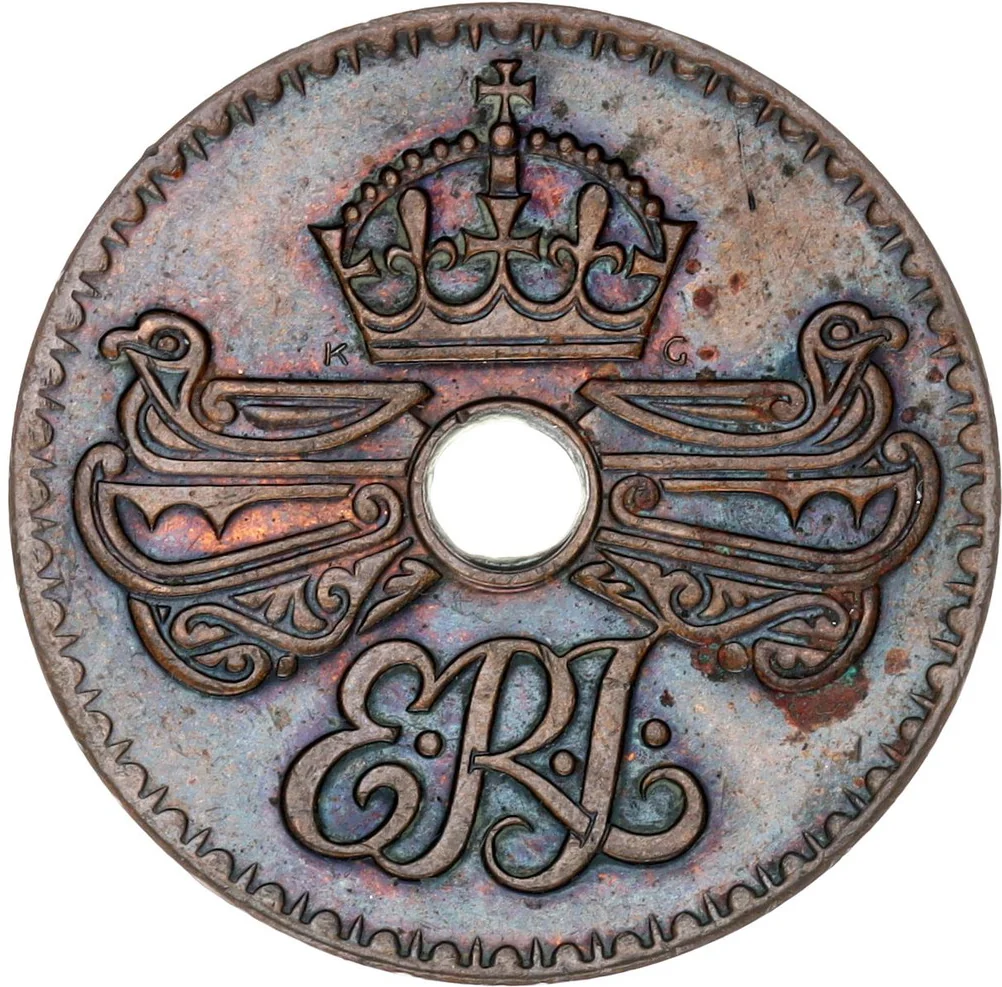
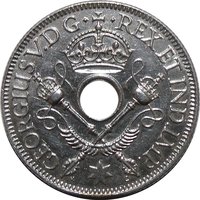
A central hole with swimming birds, a crown above, and a monogram below.
Inscription:
K G
E·R·I·
E·R·I·
Translation:
K G
E·R·I·
E·R·I·
Script: Latin
Language: Latin
Engraver: George Kruger Gray
Reverse
Description:
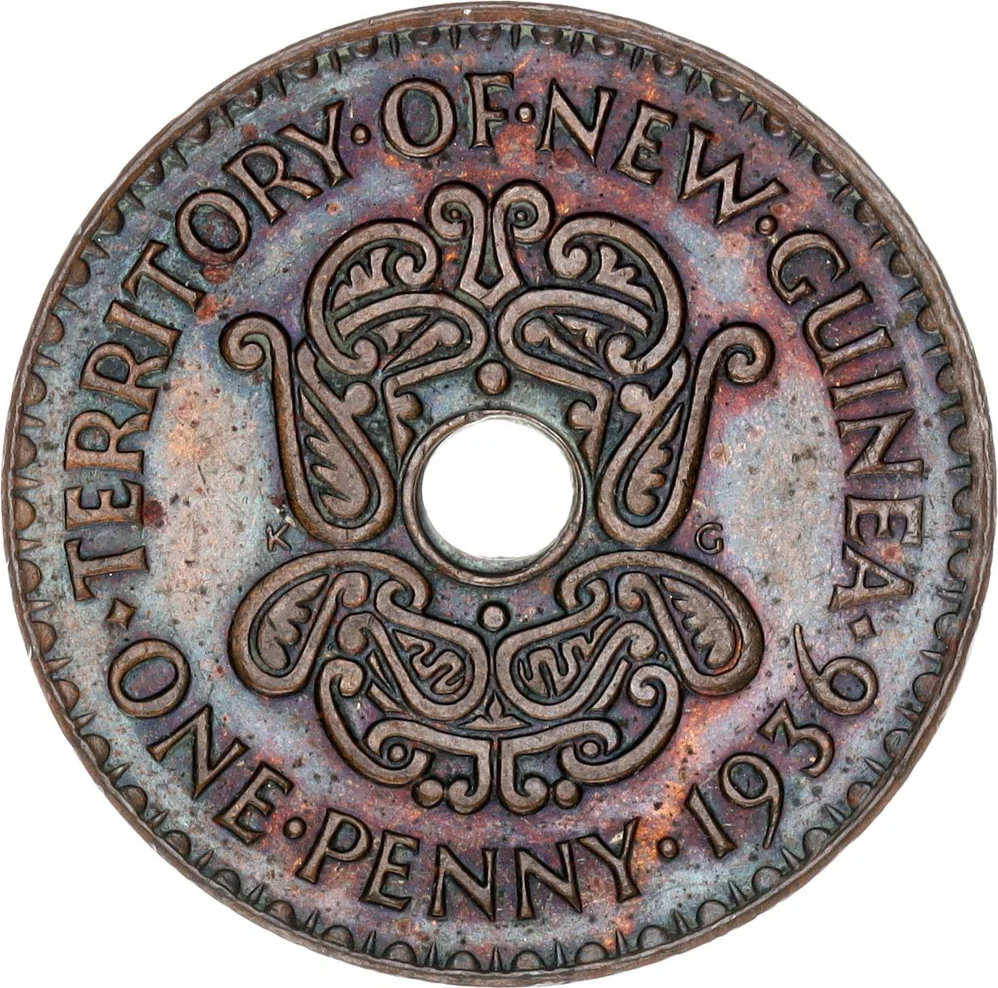
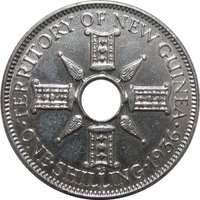
Artistic ring design.
Inscription:
TERRITORY·OF·NEW·GUINEA
K G
ONE·PENNY·1936
K G
ONE·PENNY·1936
Script: Latin
Engraver: George Kruger Gray
Edge
Plain
Mints
| Name | Mark |
|---|---|
| Royal Mint | — |
Mintings
| Year | Mint Mark | Mintage | Quality | Collection |
|---|---|---|---|---|
| 1936 | — | 360,000 | ||
| 1936 | — | — | Proof |
Historical background
In 1936, the island of New Guinea was divided into three separate political territories, each with its own distinct currency system tied to a colonial power. The eastern half, the Territory of New Guinea, was an Australian-administered League of Nations mandate, using the Australian pound. The southeastern quarter, the Territory of Papua, was an Australian possession and also used the Australian pound, facilitating trade within the Australian sphere. The western half, known as Dutch New Guinea, remained under the Netherlands and used the Dutch guilder, integrating its economy with the wider Dutch East Indies.
This monetary fragmentation reflected the island's colonial partition and created a practical economic divide. The Australian pound and the Dutch guilder were not directly interchangeable at par, requiring conversion for any cross-border trade, which was limited primarily to coastal areas. In the vast and rugged interior, where colonial administrative control was often minimal, traditional shell money and barter systems remained prevalent, operating in parallel with the introduced coinage in many highland societies only recently contacted by outsiders.
The currency situation was thus one of imposed duality and disconnection. While government stations, missionaries, and coastal plantations operated on sterling or guilder systems, the subsistence economies of the interior largely functioned outside this monetary framework. This would begin to change significantly in the subsequent decade, as the Second World War and the post-war push for development brought unprecedented outside influence and a more unified push towards a cash economy across the entire island.
This monetary fragmentation reflected the island's colonial partition and created a practical economic divide. The Australian pound and the Dutch guilder were not directly interchangeable at par, requiring conversion for any cross-border trade, which was limited primarily to coastal areas. In the vast and rugged interior, where colonial administrative control was often minimal, traditional shell money and barter systems remained prevalent, operating in parallel with the introduced coinage in many highland societies only recently contacted by outsiders.
The currency situation was thus one of imposed duality and disconnection. While government stations, missionaries, and coastal plantations operated on sterling or guilder systems, the subsistence economies of the interior largely functioned outside this monetary framework. This would begin to change significantly in the subsequent decade, as the Second World War and the post-war push for development brought unprecedented outside influence and a more unified push towards a cash economy across the entire island.
🌱 Common