

3 Pence – New Guinea
Papua New Guinea
Context
Years: 1937–1944
Country: Papua New Guinea 
Issuer: New Guinea
Ruler: George VI
Currency:
(1915—1966)
Demonetized: Yes
Total mintage: 500,000
Material
Diameter: 16.34 mm
Weight: 1.3 g
Thickness: 1 mm
Shape: Round with a round hole
Composition: Copper-nickel
Technique: Milled
Alignment: Medal alignment
flip
References
KM: #Click to copy to clipboard10
Numista: #9922
Obverse
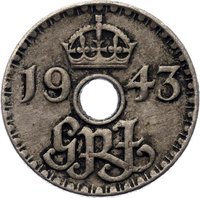
Description:
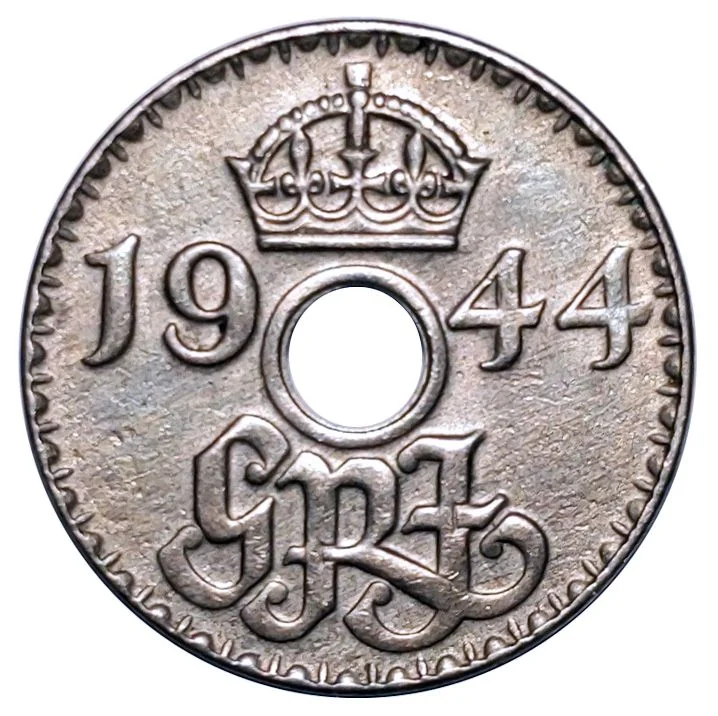
Crowned monogram, date split by hole.
Inscription:
19 44
GRI
GRI
Script: Latin
Engraver: George Kruger Gray
Reverse
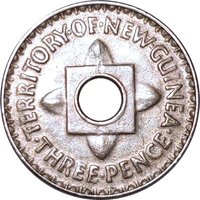
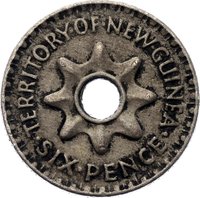
Description:
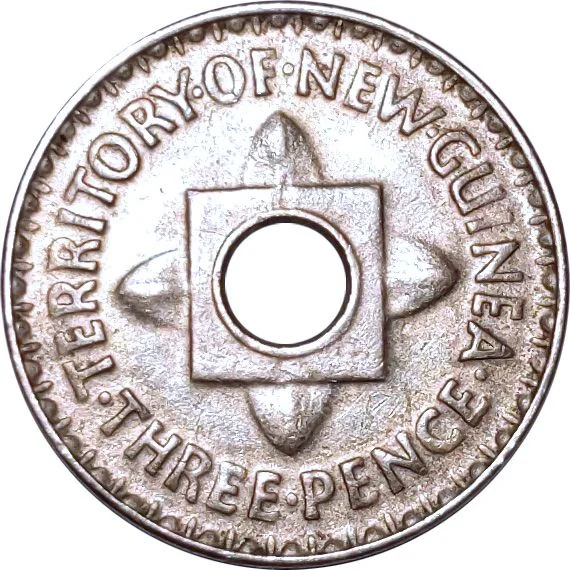
War club design from above, encircled by lettering.
Inscription:
TERRITORY·OF·NEW·GUINEA
·THREE·PENCE·
·THREE·PENCE·
Script: Latin
Engraver: George Kruger Gray
Edge
Plain
Mintings
| Year | Mint Mark | Mintage | Quality | Collection |
|---|---|---|---|---|
| 1937 | — | — | ||
| 1944 | — | 500,000 |
Historical background
In 1937, the island of New Guinea was politically and administratively divided, leading to a complex currency situation. The eastern half, comprising the Territory of Papua and the Mandated Territory of New Guinea (both under Australian administration), used the Australian pound (£A) as its official currency. This system was managed by the Australian government and a few trading banks, with Australian coinage and banknotes circulating as the primary legal tender. However, the remoteness of many areas and the limited penetration of the cash economy meant that traditional shell money and barter remained significant in highland and isolated coastal communities.
The western half of the island, known as Dutch New Guinea, was a possession of the Netherlands. Here, the official currency was the Dutch gulden (florin), issued and managed by the Java Bank (the central bank of the Dutch East Indies). As part of the wider Netherlands Indies monetary system, the currency was pegged to the gold standard. Similar to the east, the use of formal currency was largely confined to coastal administrative posts, missions, and plantations, with subsistence economies and traditional exchange mediums prevailing inland.
This dual-currency divide reflected the colonial partition of the island. The primary users of official currencies were government officers, missionaries, plantation owners (in copra and rubber), and a small number of indigenous wage laborers. For the vast majority of the island's indigenous population, the introduced currencies were peripheral; their economies operated on a different axis, valuing traditional wealth items like shell rings, feathers, and pigs for social and ceremonial transactions. Thus, 1937 New Guinea presented a layered monetary landscape where modern colonial currencies overlay, but did not fully displace, ancient systems of value.
The western half of the island, known as Dutch New Guinea, was a possession of the Netherlands. Here, the official currency was the Dutch gulden (florin), issued and managed by the Java Bank (the central bank of the Dutch East Indies). As part of the wider Netherlands Indies monetary system, the currency was pegged to the gold standard. Similar to the east, the use of formal currency was largely confined to coastal administrative posts, missions, and plantations, with subsistence economies and traditional exchange mediums prevailing inland.
This dual-currency divide reflected the colonial partition of the island. The primary users of official currencies were government officers, missionaries, plantation owners (in copra and rubber), and a small number of indigenous wage laborers. For the vast majority of the island's indigenous population, the introduced currencies were peripheral; their economies operated on a different axis, valuing traditional wealth items like shell rings, feathers, and pigs for social and ceremonial transactions. Thus, 1937 New Guinea presented a layered monetary landscape where modern colonial currencies overlay, but did not fully displace, ancient systems of value.
🌱 Common